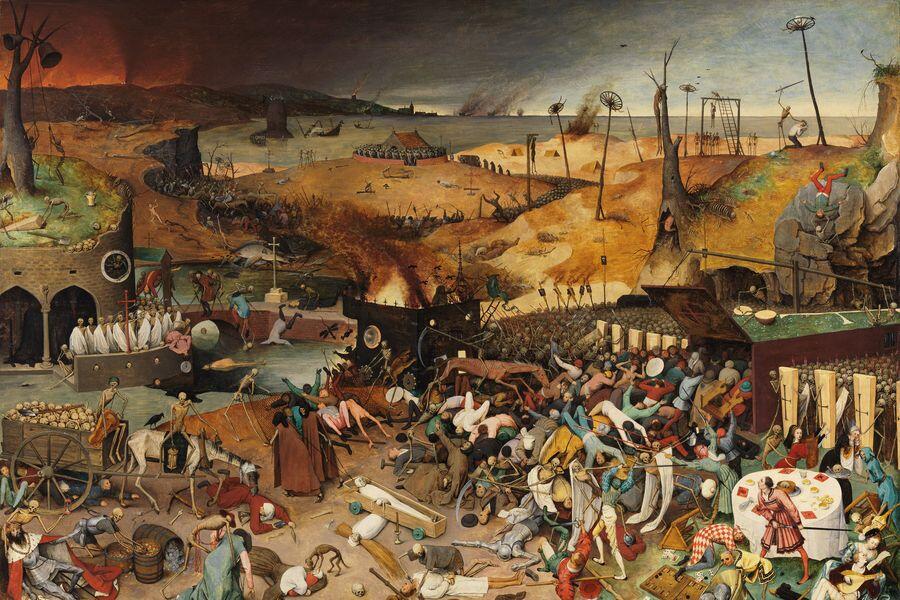
War is a business with an excellent return on investment for those who wage it and a catastrophic loss for those who fund it. The puzzle is not why humans fight but why they keep paying for fights that ruin them.
Between 2020 and 2024, the Pentagon spent 4.4 trillion dollars. More than half of that sum flowed to five corporations: Lockheed Martin, Boeing, General Dynamics, Raytheon, and Northrop Grumman. These firms employ over seven hundred lobbyists in Washington, more than one for every member of Congress. Their executives cycle between corporate boardrooms and Pentagon offices so frequently that observers have stopped pretending the distinction exists. The costs of the wars these contracts funded fell on different populations entirely: taxpayers who financed the spending and soldiers who bore the physical risks, along with foreign civilians who absorbed the explosions. None of these groups employed seven hundred lobbyists. None of them sat on the boards of defense contractors. None of them made procurement decisions. The structure ensured that those who profited from war never paid its price, and those who paid its price never shared in its profits.
This pattern is not corruption in the colloquial sense. Corruption implies deviation from an intended system. What we observe is the system functioning exactly as designed. Mancur Olson formalized the dynamic in his analysis of collective action: small groups with concentrated interests will always outorganize large groups with diffuse interests because the per-capita benefit of organizing is higher for the few than for the many. A billion-dollar weapons contract delivers enormous concentrated value to a contractor and distributes its costs across millions of taxpayers at pennies per person. The contractor will spend lavishly on lobbyists and campaign contributions, knowing the investment pays through future contracts and revolving-door employment. The taxpayers will not organize against it because no individual taxpayer saves enough by killing a single contract to justify the effort.
War persists because it is profitable for those who decide to wage it. The costs fall on people who have no voice in the decision. This is not a failure of democracy. Democracy aggregates preferences through voting, but voting cannot overcome the logic of concentrated benefits and dispersed costs. The defense industry won this arithmetic decades ago.
Sermons against war accomplish nothing because the congregation is wrong. The people who weep at images of dead children have no power to stop the killing. The people who could stop it are counting quarterly earnings in boardrooms where such images never appear. Moral suasion addresses the powerless and ignores the powerful, which explains why Lockheed's shareholders do not attend peace rallies and Raytheon's executives do not read antiwar poetry. The beneficiaries of conflict have no reason to listen to arguments about its horrors, and no argument about horror has ever changed an incentive structure.
What would change incentive structures is a system in which peace is more profitable than war for those who currently profit from war. This is a design problem, not a moral problem. The question is whether we can construct institutions where the accountants who currently calculate profits from weapons sales would instead calculate profits from conflict avoidance. The question is whether we can make the defense contractor's shareholders better off when their company prevents violence than when it supplies it.
The state monopoly on defense makes this impossible by design. When defense is funded through taxation, revenue flows regardless of performance. A government that fights losing wars collects the same taxes as one that keeps the peace. A contractor whose missiles malfunction receives the same payment as one whose missiles work. The severed link between customer satisfaction and revenue is what economists call a principal-agent problem: the agent (the defense establishment) pursues its own interests because the principal (the taxpaying public) cannot monitor performance or withdraw funding. In market competition, firms that fail to satisfy customers go bankrupt. In government contracting, firms that fail to deliver value hire more lobbyists and secure larger appropriations.
Private provision of defense would reconnect revenue to performance. Hans-Hermann Hoppe has outlined what such a system might look like: competing insurance companies that cover their clients against violence. These firms would profit when violence does not occur and lose money when it does. Their incentive structure would invert the current model. Where government defense establishments inflate threats to justify larger budgets, private insurers would minimize threats to reduce claims. Where military contractors profit from weapons deployed, private insurers would profit from weapons never needed. Where Pentagon procurement officers gain career advancement by approving expensive programs, insurance executives would advance by identifying the cheapest effective deterrent.
The critic will object that competing defense firms might form cartels and wage aggressive war. The objection deserves serious response. Cartels require barriers to entry and stable coordination among participants. A cartel of private defense firms would face neither. Any firm that defected from the cartel by offering protection to refugees from the cartel's aggression would capture market share from every firm that remained. Capital and labor flee violence toward safety, and flight is precisely what aggressive cartels cannot prevent when they lack the state's power to close borders and conscript labor. States suppress competition through legal monopoly. Private cartels must suppress it through economic force, and economic force fails when customers can exit. The cartel objection also carries an implicit comparison: that states manage defense better. The twentieth century produced more corpses under state management than any private cartel could hope to match.
The deeper objection comes from international relations realists who argue that security concerns override economic incentives. States arm themselves against potential threats regardless of trade volumes because they cannot verify other states' intentions and cannot commit to peaceful behavior when power balances shift. This objection has force against interstate war but dissolves when states themselves dissolve. The security dilemma exists because sovereign states cannot credibly commit to future restraint. Private defense providers operating within a legal framework of enforceable contracts face no such barrier. They can commit because contracts bind them, and contract breach carries financial consequences that political promises do not.
The inflation mechanism that enables modern war would also disappear under a sound monetary standard. Mises observed that the abandonment of the gold standard allowed governments to finance wars from the entire wealth of their populations through currency debasement. Under hard money, a state that wishes to wage war must explicitly tax its citizens or borrow at market rates. Both mechanisms encounter resistance that inflation does not: citizens notice taxes and bondholders demand risk premiums, but inflation extracts wealth while its victims remain unaware of the extraction. Every major war of the past century coincided with monetary expansion. A return to sound money would not prevent all conflict, but it would force war's advocates to honestly price their adventures.
War diverts capital from production. Every missile is a factory never built. Every weapons engineer is a problem-solver redirected from creating value people would voluntarily purchase. Every soldier patrolling foreign territory is a worker unavailable for productive labor at home. Bastiat's broken window applies at civilizational scale: the jets and tanks and aircraft carriers are visible, but the hospitals and homes and productive capacity they displaced remain forever invisible because they were never built. The cost of war is not measured in the destruction it causes but in the creation it prevents.
A market for peace would be a market where violence is bad for business. Defense providers would profit from preventing claims, not from filing them. The accountant's spreadsheet would show higher returns for deterrence than for deployment. This requires no improvement in human nature. The same executives who currently profit from conflict would profit from peace under a different incentive structure. What must change is not the moral character of the participants but the economic logic of the game.
War is a business. The structure that makes it profitable can be redesigned to make peace more profitable. The obstacle is not intellectual but political: those who benefit from the current arrangement will resist its replacement. Resistance does not refute the design. It only measures the value of the alternative.