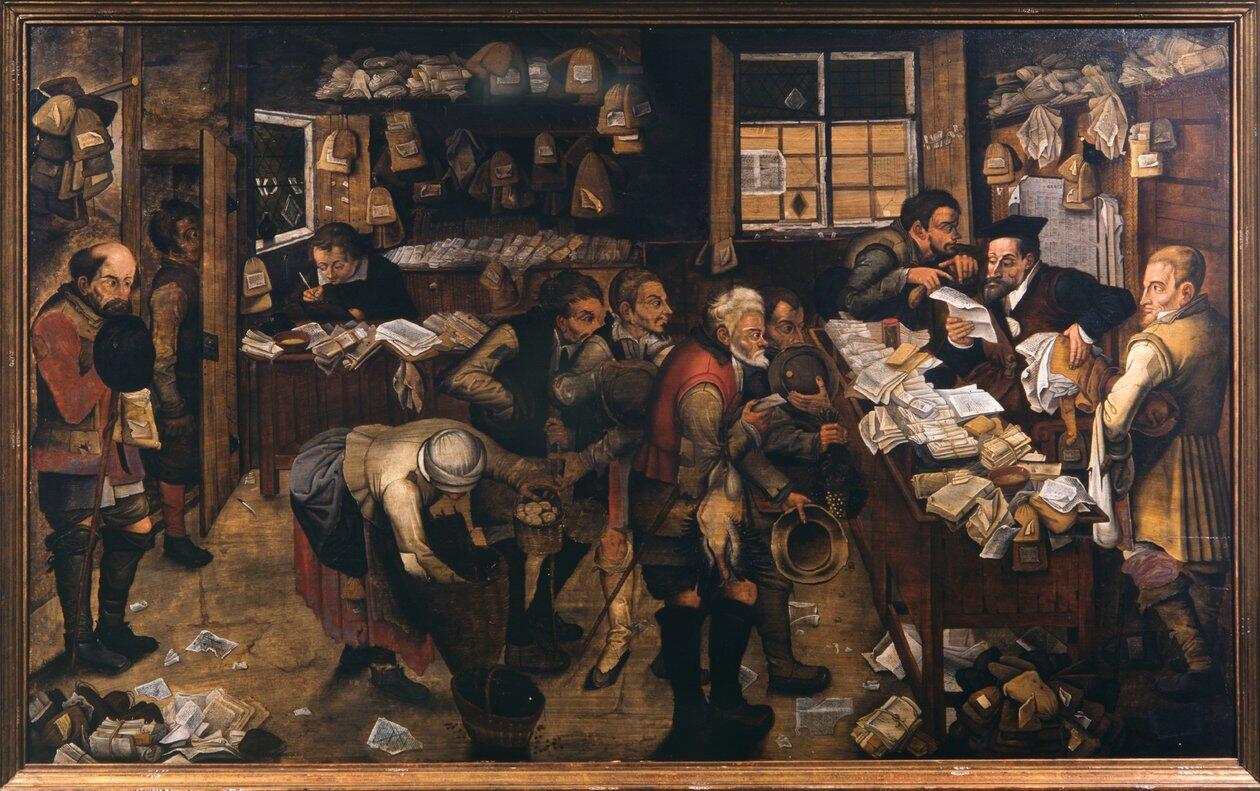
In 1275, at the fair of St. Ives in Huntingdonshire, a merchant brought a complaint that a trading partner had delivered defective wool. A piepowder court convened that same morning. Its name tells you how fast this world moved: pieds poudres, dusty feet, because disputes were resolved before the dust settled on the merchants' boots. Witnesses testified before noon and the court ruled by afternoon, so that the losing party paid restitution before the fair closed for the day. Both merchants resumed trading the next morning with their capital freed and their reputations intact. From complaint to enforcement, the process took fewer hours than a modern attorney takes to return a phone call.
Seven centuries later, a commercial dispute in London's High Court takes an average of eighteen months to reach trial. Litigating a contract dispute through American federal court costs a median of $91,000 in legal fees, and both parties pay whether they win or lose. When a judgment finally arrives, it comes from a generalist judge who spent the previous week hearing an unrelated criminal matter and who must be educated from scratch in the trade customs and technical details that a medieval piepowder judge already knew from personal experience. One cause explains the difference, and it is the same cause everywhere: when a single provider controls a market, it delivers what the provider wants to produce, which is rarely what the customer needs.
Conventional legal theory treats dispute resolution as a good that only the sovereign can provide. The historical record in every instance shows the opposite: private provision preceded the monopoly and outperformed it. Dispute resolution is excludable and rivalrous, its quality subjectively valued by the parties, which means it has all the properties of a private good. Where producers compete, price signals drive quality up and cost down because suppliers who fail to satisfy customers lose their business. A monopoly court operates free of that discipline. Mises made this argument about commodity markets, where rational allocation requires price signals and central planning produces perpetual misallocation. Courts insulated from competition face this same problem when they try to design procedures and set standards, deprived of the feedback that rivalry provides, and they accumulate procedures that waste time and pricing that places justice beyond the reach of ordinary people.
Unchallenged providers overproduce what serves themselves and underproduce what serves the customer. Public courts follow this pattern with mechanical regularity. Procedural complexity multiplies because it justifies the legal profession's existence, jurisdictional expansion continues because it grows departmental budgets, and precedent accumulates without pruning because reversal would mean admitting error. Any litigant hoping for a quick and affordable resolution discovers a system where faster proceedings would cut billable hours and simpler procedures would shrink the caseloads that justify expanding budgets.
International commercial arbitration provides the clearest market verdict. Under the New York Convention, recognized by 172 countries, businesses can submit cross-border disputes to private arbitration and have the result enforced by domestic courts worldwide. Companies adopted this option decades ago because state courts were too slow and too expensive for commerce that moves at modern speed, and because generalist judges lacked the industry knowledge to evaluate specialized disputes competently. Private tribunals won wherever they were available, and the monopolist kept exactly the customer profile monopolists always keep: those too poor or too uninformed to choose otherwise.
Enforcement is the standard objection. Critics assume that without armed agents ready to seize property and imprison the noncompliant, private court rulings carry no weight. Centuries of evidence show the assumption to be false.
A merchant expelled from Champagne fairs in the twelfth century lost access to the most profitable trading network in medieval Europe, and a trader boycotted by the Hanseatic League lost the entire Baltic market. Beth Din enforced its rulings through community standing: members who defied judgments found their business relationships severed and their family's standing damaged across generations. Iceland's commonwealth sustained private adjudication for three centuries without any state apparatus, using transferable claims that allowed victims to sell their right to collect damages to champions powerful enough to enforce them, which transformed every judgment into a tradeable economic instrument. Compliance followed from calculated self-interest. Any merchant who defied a piepowder court ruling and discovered that no trader at the fair would deal with him received a penalty more immediate and more precisely targeted than anything a government prison could deliver.
Modern technology extends this enforcement principle to global scale. Multisig escrow on Bitcoin eliminates the need for a trusted intermediary: two of three keys must sign to release funds, so neither buyer nor seller can abscond with payment while the arbiter who holds the deciding key participates honestly. Mostro implements this pattern for everyday Bitcoin commerce on Nostr with programmatic escrow built into every transaction. Resolvr, built by the Open Source Justice Foundation on Nostr, uses crowdsourced zap polls to adjudicate bounty disputes and Discreet Log Contracts to lock escrowed funds on Bitcoin, releasing payment only when the community verdict arrives. Nostr's web of trust completes the enforcement architecture: a trader's follow graph and transaction history accumulate into a public record that any counterparty can audit before entering a deal. Damage to that record destroys future trading opportunities as effectively as expulsion from a medieval fair destroyed a merchant's livelihood.
Central economic planning fails because no planner can possess the dispersed knowledge of millions of participants, and centralized legal systems face this same deficit with analogous consequences. A legislature drafting rules for an entire jurisdiction confronts the same information problem as a central planner setting prices for an entire economy: specialized local understanding cannot be collected at the center. Medieval merchant law succeeded because it matched legal authority with practical expertise. Maritime tribunals staffed by experienced sailors decided maritime disputes according to customs that landlocked judges would never encounter, fair courts applied trade practices that only active traders understood, and guild courts enforced craft standards that only practitioners could evaluate. Procedure adapted to the specific norms of the industry served, and this specialization is what made rulings respected and obeyed voluntarily.
Protocol designers have rediscovered this principle through independent experimentation. DeFi protocols encode their own dispute resolution into smart contracts, with liquidation rules and penalty structures specific to the instruments they govern. Nostr relay operators set their own terms of service, each relay functioning as a voluntary jurisdiction whose rules reflect its community's preferences. Parties to a multisig arrangement choose their arbiter and define release conditions before the transaction begins. Angor builds milestone-based fund release into its crowdfunding architecture so that investors and project creators share a common enforcement mechanism without involving any court. Specialization in law, like specialization in production, improves quality because local knowledge informs the rules and the participants who live within those rules are the ones best positioned to evaluate whether they work.
Every time transaction costs drop, private dispute resolution reappears: at Champagne fairs when medieval trade routes connected isolated markets, in online arbitration when internet commerce outpaced government courts, and in cryptographic escrow when pseudonymous commerce required enforcement without identity disclosure. Identical mechanisms drove each case. Voluntary exchange generates disputes faster than monopoly courts can resolve them, and entrepreneurs who build private alternatives accumulate reputational capital with every successful resolution in a self-reinforcing cycle that state courts cannot replicate because they never had to earn a customer.
What emerges is an economic law. Wherever voluntary trade outpaces monopoly adjudication, private courts appear because the profit opportunity is too large and the need too pressing for the market to leave it unfilled. Time carries a price, and monopoly courts waste it in quantities that competitive providers would never dare impose on paying customers.
Already the direction is visible. International commercial arbitration handles the majority of cross-border business disputes in most trading nations. On-chain escrow operates continuously on a network that no single government controls. Resolvr adjudicates bounty disputes through crowdsourced zap polls on Nostr with Bitcoin escrow. Mostro enables peer-to-peer trades with built-in arbitration on a protocol that no one can shut down. All of these are expressions of a pattern that began when the first merchant settled a dispute at a fair court and returned to trading before sundown.
Justice is a service. Like all services, it degrades under monopoly and improves under competition. Court systems that governments built will endure for as long as governments can compel their use. Merchants, as they have done for a thousand years, will keep building something faster.