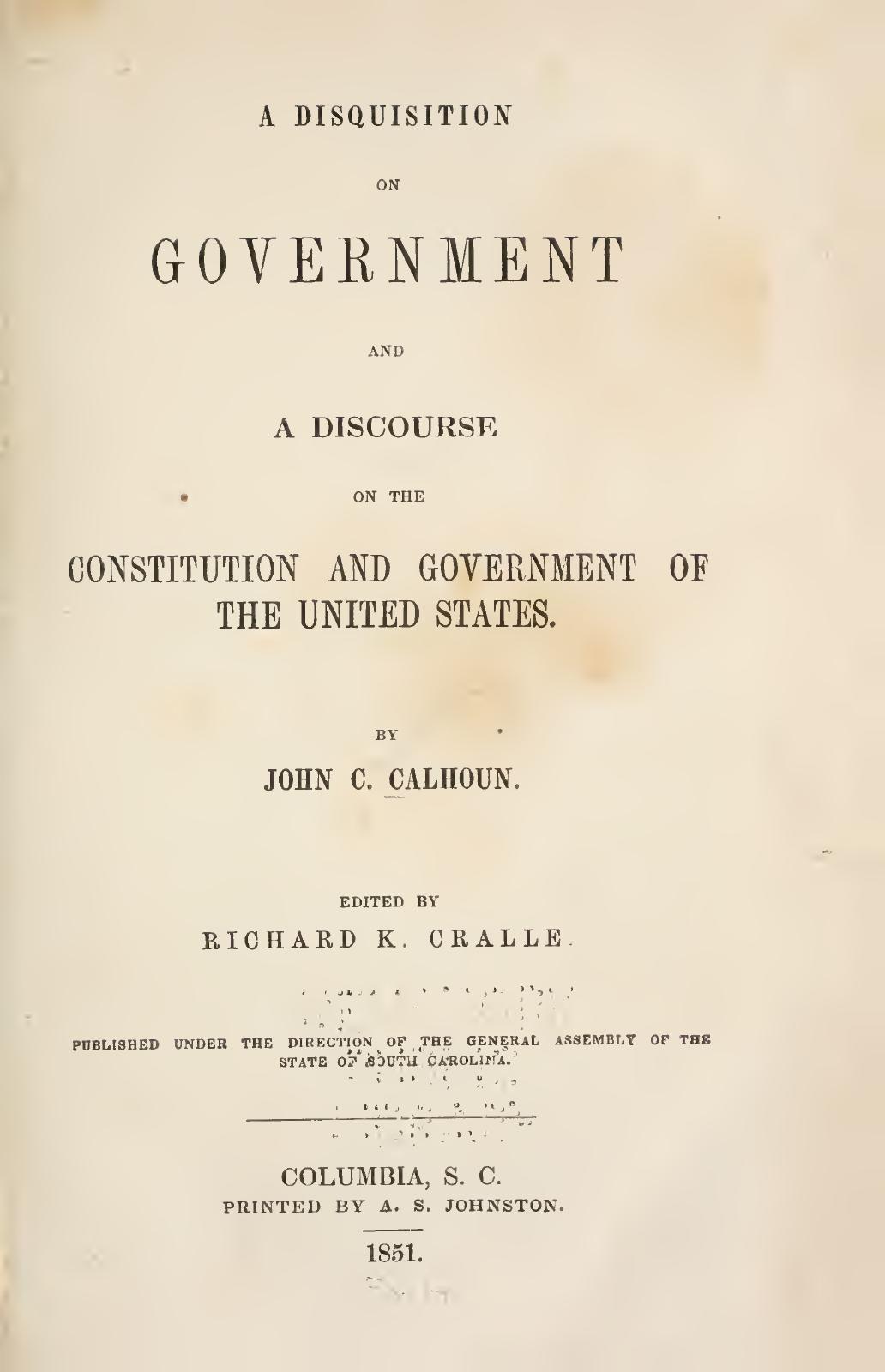
Published posthumously at Columbia, South Carolina, in 1851, Calhoun's A Disquisition on Government asks what keeps an elected coalition from turning public power against everyone else. Its answer is sharp about institutional incentives and openly hostile to equal liberty. This review reads Union and Liberty, Liberty Fund's 1992 anthology edited by Ross Lence, with selected passages checked against the original 1851 edition, downloadable as a complete PDF facsimile. That volume also contains the companion Discourse, a separate work this review leaves aside. Its editor, Richard Crallé, explains in an advertisement that the author never revised his manuscripts and that editing was confined to a few transpositions, omitted repetitions and corrected verbal inaccuracies.
Calhoun starts from premises he calls incontestable: people are social beings, and society requires government. Each person also feels what affects him directly more intensely than what reaches him through others. He treats government as necessary and of Divine ordination, assumptions a reader can question while still using what follows. On his account, officials share the stronger direct feelings of the people they govern, so powers given them to prevent injustice can become instruments of aggrandizement. Suffrage makes representatives answer to electors, yet that responsiveness can serve a majority coalition that extracts from the rest. That leaves the reader asking what restrains a winning coalition after the election.
His fiscal analysis holds that equal taxes still leave some people paying more than they receive once disbursements, including salaries and public employment, are counted. He confines the point to spending within the community and sets aside tribute and foreign expenditure. His divide between tax-payers and tax-consumers describes net cashflow incidence. Because his direct accounting leaves the full value of protection and services unmeasured, it is silent on whether public salaries or services are worth what they cost. It explains why a coalition that controls where money lands has a standing motive to expand both sides of the budget.
Written restrictions and separate departments, Calhoun contends, offer weak protection when one coalition controls every branch. The dominant party favors broad construction, leaving the weaker party with strict construction, an argument the majority is free to ignore. Affected groups need the power to block. His remedy is the concurrent majority: the sense of each significant interest is taken through its own majority or appropriate organ, and government acts only with each one's concurrence or subject to its veto. This differs from unanimous individual consent and from automatic rule by a numerical minority, and its specific devices remain a proposal of his era.
Everything turns on choices he handles quickly: which interests receive an organ, and how dissenters inside a group fare under its majority. He assumes a perfect organism and enlightened voters, then admits that perfection may be impossible and claims that representing a few great and prominent interests would still largely serve. That fallback is the theory's most vulnerable point, since a veto confined to prominent interests protects those interests, and some vetoes preserve oppression.
He anticipates the objection that such a system would stall. Because every interest needs government to continue, he argues, the necessity of acting will force compromise, and he offers jury unanimity as his analogy. The argument depends on a shared stake in survival and a comparable ability to bargain. Two objections can be pressed on his own terms: a group that loses little from delay can hold the rest hostage, and an interest denied an organ is absent from the bargaining altogether.
The deepest limit is normative. The Disquisition states that it is a dangerous error to think all people equally entitled to liberty. It treats liberty as a reward for the intelligent and virtuous and calls subjection to despotic rule a just punishment for the undeserving. It also rejects the opinion that all men are born free and equal. Calhoun concedes equality of citizens before the law, which leaves open who qualifies, and he ranks protection above liberty whenever the two conflict. These are core premises of the argument. Applied to Calhoun's society, a scheme that shields recognized interests through their own organs leaves enslaved people without independent standing, since any veto touching their condition would rest with those who held them in bondage. In separate Senate remarks of February 6, 1837, reprinted in the anthology Union and Liberty, he defends Southern racial slavery as a good where two races live together and asserts that both benefit. Slavery was a grave wrong, and that apology and its benefit claims must be rejected. The speech documents the author's commitments; other arguments for minority protection should be judged on their own premises.
The closing comparison of Rome and Britain shows the rest of the project. In his judgment Britain's structure could hold extensive dominions while preserving its constitution, with the burden of taxes as the likeliest limit, so national power and imperial stability belong to his aims. Read the Disquisition for how electoral accountability fails to restrain organized transfers and how vetoes change bargaining. Test each mechanism by asking who holds an organ, and treat its doctrine of earned liberty as a position to refute.