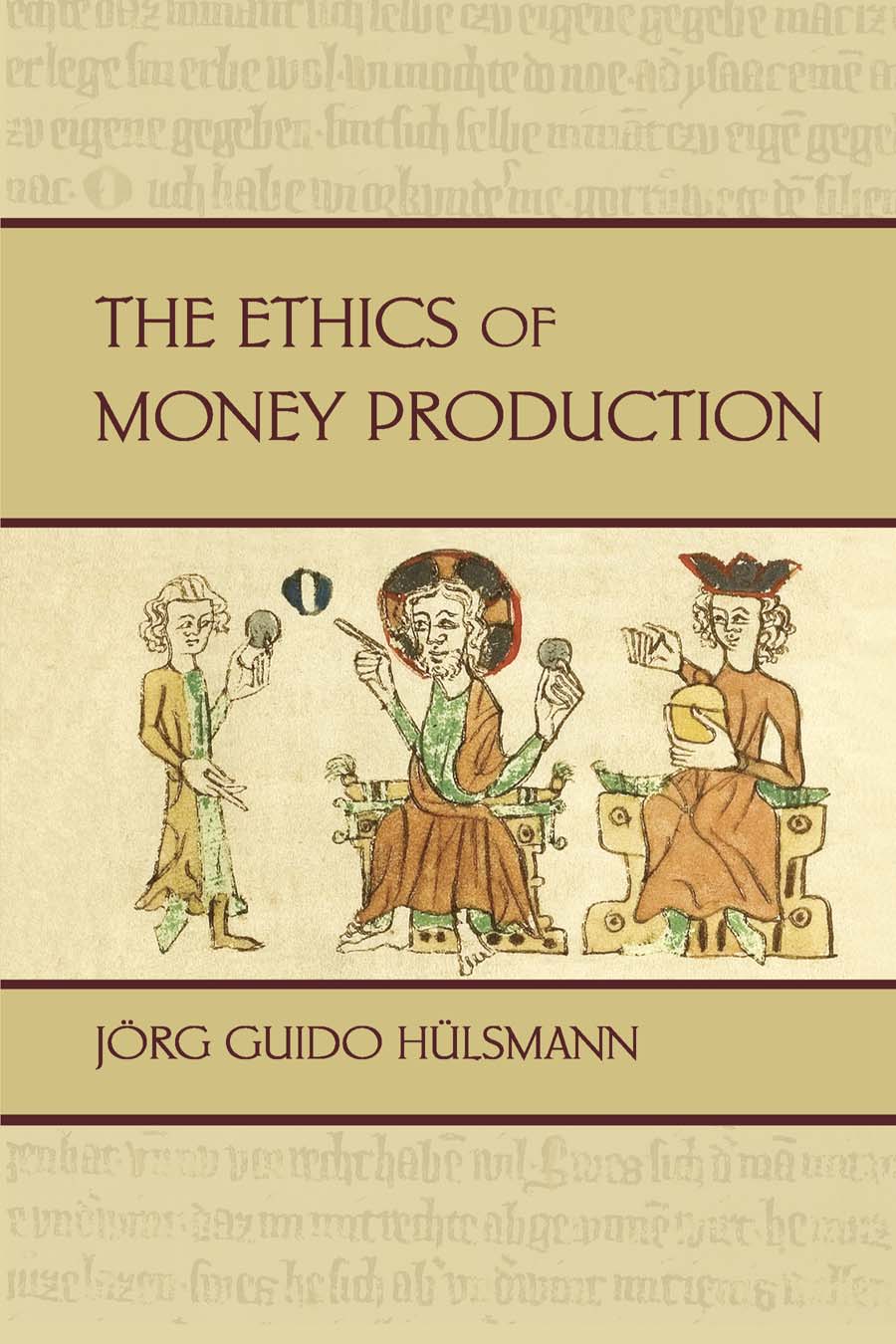
The Ethics of Money Production asks which ways of creating money a person can defend under ordinary rules of property and contract. Jörg Guido Hülsmann answers by joining Austrian monetary theory to scholastic ethics and grounding both in philosophical realism. The preface offers this synthesis as his own proposal, which other Austrians may contest. He declares his normative premise early: legitimate money production respects the property of money users and delivers whatever its certificates promise. Three parts carry that premise from free-market production through fraud and legal privilege into monetary history. The reader gains a portable question for any monetary arrangement: who owns the asset, and which law shields whom when a promise breaks?
Natural money, his first definition, is whatever free people choose as their medium of exchange; forced money circulates because anyone using a better alternative would face violence. Silver and gold earned their monetary roles through that choice. The label attaches to the choosing, so a society's money has to be discovered in practice, by letting people choose, and several monies can circulate together. Oresme and the scholastics recur, yet an early footnote rejects a distinctively Christian economic science and rests the ethical case on natural reason open to any reader.
In his account a coin's value combines its metal with the minter's record for honest weight and replacing worn pieces, so coins and bullion trade as different goods. Here Hülsmann departs from Rothbard's proposal to name coins by weight and asks each minter to identify himself, letting users leave a mint they distrust. He calls competition no panacea: abuses remain possible, and competition narrows their scope by enlisting every money user in vigilance. Paper separated from metal can then circulate as a money substitute when it is a redeemable title to deposited money. A loan claim is a different instrument, carrying the issuer's default risk.
The market-process chapter explains how new money moves. It enters at particular points and spreads outward, so prices rise unevenly and some may fall. Whether debtors gain at creditors' expense depends on expectations: a lender who foresees depreciation adds a price premium to the interest rate, and if prices then rise less than he expected, part of that premium becomes profit. The advantage of holding new money first resists this hedging, since foresight only repositions people within the sequence. Yet distribution effects that spring from production are compatible with justice in his view, since a free market rewards the miners and minters who serve users.
The utilitarian chapter tests defenses of managed money. Given enough divisibility, almost any quantity of money can serve, because money units and real resources are separate stocks; bank credit channels existing goods into new uses. Purchasing power lacks an impartial definition: a consumer price index weights goods that households buy in different proportions, and whoever chooses the weights holds discretion. That disqualifies indexes as objective welfare meters, a narrower claim than declaring every price comparison useless. His shoe factory and bakery example shows an entrepreneur calculating across alternatives in one money unit while purchasing power moves. Experiments with cheaper media stay open; compulsion is his target.
One argument there deserves resistance. Hülsmann grants that deflation raises debt burdens and can set off widespread bankruptcy, then reasons that factories survive a change of owners, so the net effect on output is likely zero. The reasoning assumes assets pass quickly to capable new owners. Readers should ask how long capacity sits idle while creditors and courts settle who controls it.
Part Two defines inflation as an increase in nominal money beyond what a property-respecting market would produce. Hülsmann accepts the ordinary price-level usage as legitimate vocabulary when applied consistently and prefers his counterfactual because it isolates the phenomenon he holds causally and morally relevant. Under it, mined money falls outside inflation, and a rising index alone proves no fraud. Turning to private fraud, he treats a warehouse certificate as a title to money held for the bearer, so issuing titles beyond deposits counterfeits them. A redeemable IOU belongs to another category: when the banker tells customers the notes are his debts and that he owns the money for the life of the credit, he finds the practice unobjectionable. Fraud enters when IOUs pose as certificates, which leaves candidly disclosed redeemable credit standing.
The heaviest charge falls on legal privilege, which enforces contracts asymmetrically. In his Smith hypothetical, a legalized suspension of payments means the state stops enforcing Smith's promises to his creditors while still enforcing what his debtors owe him. Bankruptcy would have handed Smith's assets to competitors who held cash in anticipation. The privilege penalizes their restraint, and the expectation of future suspensions invites them to imitate Smith. His further claim, that an economy-wide run dissolves the line between illiquidity and insolvency, is more contestable; it depends on fire-sale prices, and outside those conditions the distinction keeps its meaning. On paper money he parts with Rothbard again. An authority printing its own notes misrepresents nothing, so he classes it outside counterfeiting and allows that continued production might be justified. The compulsory privilege remains his target, even as he predicts such money would fail in open competition.
The speculative layer needs separate weighing. Hülsmann presents his historical references as illustrations of theory and concedes a pure free monetary order may never have existed, so causal tests lie elsewhere. The cultural chapter on dependence and family life is polemic awaiting evidence. It calls welfare services essential and disclaims any attack on their provision through government; its objection is that fiat finance lets those services outgrow democratic budget control. His forecasts of hyperinflation and a global paper money, including speculation tied to the 2006 American property market, are dated conjectures, and his country data date from around 2007. A brief remark on electronic money belongs to a text prefaced in August 2007 and catalogued days before the Bitcoin paper announcement of 31 October 2008, so the book's catalogue date precedes Bitcoin's public proposal; the later design leaves his property framework to be tested on its own terms.
Read the book for an ethical vocabulary that separates honest credit from disguised titles, and for an analysis of who bears risk when the state suspends promises. Its reform targets the legal privileges of central banks and monetary authorities while keeping whatever financial instruments, credit cards included, survive on a free market. Expect committed argument from scholastic premises; readers wanting a central-banking textbook or an investment manual should look elsewhere. The Mises Institute reserves all rights to the 2008 edition and offers the official full PDF.