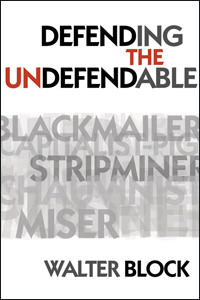
Defending the Undefendable was first published in 1976. The Ludwig von Mises Institute now offers it in a 2018 PDF edition, with a foreword by Murray Rothbard and commentary by Friedrich Hayek. It collects 32 short portraits of reviled figures drawn from commerce and from civil liberties disputes, and Walter Block argues each case with sharp caricature and illustrated satire. The reason to read it is the discipline it demands. Before public disgust can justify force, Block asks the reader to specify the act and the rights it touches. Then the reader has to describe the alternative that would be left once the act is punished.
The introduction sets the terms. Block defines aggression as initiated violence against nonaggressors and their property. He limits his political philosophy to one question: when force may be used. He grants that many of the activities he defends can be morally objectionable, and he calls the market amoral, a means that serves whatever ends its participants bring to it. His defense is a claim about permission against punishment, which is a much narrower claim than approval. Readers should push that distinction further than Block sometimes does. Placing an act outside justified coercion under his principle is one claim. That the people choosing it expect to gain is a separate claim, and even when it holds, whether the practice improves social outcomes stays open and needs its own evidence. The introduction occasionally slides from voluntary choice to mutual benefit for everyone, yet the chapter on the prostitute admits that either party may regret a bargain afterward. Choice reveals expected gain under the chooser's circumstances. Fraud, coercion and harm to others remain questions of fact.
In the blackmail chapter, Block asks why a person entitled to reveal a true fact may be forbidden to offer silence for a price instead. He separates a threat of aggression from a conditional offer about an act he treats as rightful. The prior right decides the case, and the reviled label settles nothing. His own exception shows how this works. A lawyer or investigator who accepted a secret under a confidentiality agreement would breach that contract by selling silence. Privacy here becomes a question of prior obligations and the right to disclose. The argument assumes rightful possession of the information and a right to publish it, and those conditions have to be shown case by case. Block predicts that legal blackmail would deter crime and that exposure would help stigmatized groups. The chapter leaves both predictions unsupported, while Block concedes harm to individual targets.
In the slumlord chapter the counterfactual carries the argument. Suppose the cheap, decrepit apartments are abolished while tenants' incomes stay fixed and no replacement housing appears. The poor lose an option they had chosen, and better homes stay unbuilt. Block's sharper point concerns rent control. Ordinarily a landlord who neglects tenants loses them, then bears the cost of reletting the unit and may have to charge a lower rent. Where a departing tenant can be replaced at a higher, uncontrolled rent, vacancy becomes profitable, and the landlord's incentive shifts from maintenance toward pushing tenants out. That result depends on how a particular control regime treats turnover. It also assumes tenants who can move and competitors who can enter. On Block's own terms, the permission he extends to landlords stops short of fraud, broken maintenance promises and concealed hazards, since each would deceive a tenant or breach an agreement. Block names poverty as the basic cause of slums, and he lays the deterioration of housing and the slumlord's worst excesses on government programs, rent control above all, along with building codes and urban renewal. That causal claim rests on reasoning and examples; the chapter offers little evidence about how housing fared under those programs, and Block himself calls his account of the slumlord's public image speculative.
A speculator who buys food in a plentiful year raises its price at that time. He stores it and sells in a predicted lean year, which keeps the scarcity price lower than it would be with no storage. A correct forecast rewards him for bearing storage costs and timing risk, and a mistaken one uses up his capital. Block concedes that a wrong forecast can worsen a famine. His answer is that losses drive bad forecasters out of the market. Loss does discipline traders, though slowly and only after the damage is done. It culls persistent bad forecasters over time, while each new forecast still carries the risk of error, including errors that deepen a famine.
The closing chapter, on the employer of child labor, applies the same lost option reasoning to poor young workers and shows the book's chief limitation. Block rejects fixed ages of majority as arbitrary. Following a theory he credits to Rothbard, he defines adulthood as leaving home and supporting oneself. He then treats that fact as proof of the capacity to make contracts. For young people still at home, the chapter allows work with parental consent. Hiding and starving a dependent child, or refusing to offer it for adoption, Block condemns as equivalent to murder, yet he denies any general positive duty of parents and describes parenthood as conditional caretaking, a contested premise. Supporting oneself shows that a young person has managed alone. Whether that person can understand and consent to every arrangement an employer offers is a separate question, and the chapter answers it with a philosophical test where evidence is needed. Here the word voluntary has to be earned case by case.
Read Defending the Undefendable as practice in separating disapproval from aggression, and both from predicted consequence. Each verdict rests on an assumption worth finding. The book suits readers willing to argue back, including those who reject Block's theory of rights. The blackmail, slumlord and speculator chapters reward slow reading. Readers looking for a guide to safe business practice, or for evidence about coercion and capacity, should look elsewhere. Publisher page: Defending the Undefendable at the Mises Institute. Source edition: 2018 Mises Institute PDF.