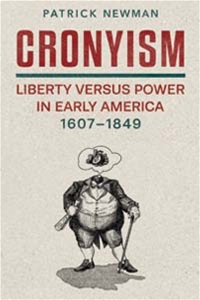
Patrick Newman's Cronyism: Liberty versus Power in Early America, 1607–1849 is a political and economic history running from Jamestown to the election of 1848 and the institutions Congress created in its wake. Newman defines cronyism as policy rewarding connected politicians, officials, firms and allied groups at public expense, and he carries that definition from colonial charters through the Hamiltonian program to the Jeffersonian and Jacksonian reform movements. The book earns its place on a liberty shelf by asking of each privilege who received it and what those recipients later did to keep the granting state large and solvent.
In the introduction (pages 13 to 19), Newman adopts Murray Rothbard's Liberty versus Power framework and calls his narrative deliberately old fashioned, centered on party contests and elite white men in government. His thesis holds that privilege grew in a staggered, nonlinear way. Interventionist coalitions from the Federalists to the Whigs pushed it upward, while reform coalitions cut it back and then, once in office and tempted by territorial ambition, began dispensing favors of their own. Readers who treat the framework as a hypothesis to test against the footnoted narrative will gain far more than readers expecting neutral consensus history.
Hamilton's fiscal program shows the mechanism plainly, beginning with a face-value debt assumption that rewarded securities holders. The Bank of the United States (pages 89 to 90) received a twenty-year federal charter, exclusive at the national level and carrying interstate reach, while existing state banks continued to operate. The government took an ownership stake, and subscribers could pay partly in federal bonds for an institution that would hold most public deposits. These terms tied wealthy creditors to the central government. Newman then reads the Report on Manufactures beside New Jersey's charter for the Society for Establishing Useful Manufactures, whose promoters bought shares expecting federal subsidies for cotton goods. Congress balked at the direct subsidies after Jefferson and Madison read the general welfare clause narrowly, yet it passed the Tariff of 1792 once Hamilton tied higher duties to revenue for frontier war (pages 99 to 100). A constituency formed around what passed, and the gap between proposal and enactment shows a program meeting real limits.
Louisiana shows how territorial scale strained a reform coalition. Jefferson doubted the Constitution allowed buying foreign territory and absorbing its residents, and he wanted an amendment, yet he pressed the treaty through when he feared Napoleon might reconsider. Newman judges that an amendment was attainable at little cost, and he reads the Federalist framers as intending broad implied powers; both are interpretive judgments. Governing the acquisition proved the deeper test. Moderate Republicans anxious about New England disaffection backed a compromise with Yazoo land claimants, many of them New Englanders, over John Randolph's objections (pages 161 to 162), and Newman ties western demands for internal improvements and combative trade policy to binding the new domain together. The argument rests on how a larger territory multiplied claimants on federal land and funds, which a reader can accept without judging every road or canal a waste.
On Texas, Newman places debt holders and slaveholding interests among annexation's backers and records the rupture when Van Buren and Thomas Hart Benton broke with Jackson and Polk. The 1845 annexation did not deliver assumption of the Texas debt, though speculators judged it more attainable once Texas sat inside the Union. In Newman's account the Mexican War nearly tripled the federal debt, and he follows the borrowing to Corcoran & Riggs, a banking house close to Treasury Secretary Robert Walker, which underwrote most of two wartime loans before lobbying for claimants. Railroad land grant proposals multiplied around the conquest, while Congress funded mail steamship contracts and in early 1849 created a Department of the Interior (pages 325 to 328).
These episodes share a structure in which a reform party's preferred end defeated its original goal. Jacksonians had destroyed the national bank and restrained spending, but conquest required money, and money came through bankers with reasons to defend the new arrangements. Newman closes with the failed Wilmot Proviso and Van Buren's Free Soil candidacy of 1848, which in his reading split the Democrats and left no significant party committed to dismantling privilege (pages 329 to 330). The chapters supply a usable test for other periods: identify the beneficiaries a measure creates, then watch whether they finance and defend the authority that pays them.
Newman's faction labels track economic policy, chiefly a party's stance on central finance and centralization, and the coalitions he credits with defending liberty included defenders of slavery and the architects of Indian removal, factions that violated universal rights. Chapter 16 calls the removal program coercive and crony and the 1838 expulsion of the Cherokee a disaster, and it acknowledges the farms, schools, written language and constitution they had built. Yet it credits Jackson with sincere if condescending concern and argues that most contemporaries weighed Indian policy lightly beside banking and tariffs. It also faults John Ross for advising his people to stay. Its economic analysis adds a further layer, treating removal as an occasion for fiscal concealment and speculative profiteering. Readers wanting removal told from the Native nations' side can pair the chapter with histories centered on that experience.
Newman holds that the Pacific ports, long sought by internationalist merchants and manufacturers, dominated Polk's reasons for war with Mexico, and he gives slavery's expansion a lesser role. In our judgment, the profits his evidence documents do not by themselves establish the relative causal weight of ports and slavery, so the ports' predominance remains Newman's argument. His record of who gained stands on firmer ground than his account of why policymakers chose war.
Dense political economic history that names interests and traces legislation through roll calls fills these chapters, so newcomers to the period may want an introductory survey at hand. Begin with the Hamilton chapter and let those pages decide whether Newman's lens sharpens your view enough to carry you through the rest.
Patrick Newman's 2021 book, published by the Mises Institute, carries a Creative Commons Attribution 4.0 license. Towards Liberty hosts an unaltered copy of the original publisher PDF as a Towards Liberty download, with identical copies at the nostr.download mirror and the 24242.io mirror. For the source edition, see the original Mises Institute PDF and the publisher's paperback edition page, which lists the 364-page print version, ISBN 978-1-61016-742-0.