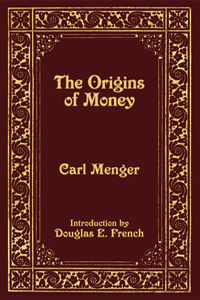
A farmer who sells grain for coin accepts a thing he cannot eat. Carl Menger's On the Origins of Money treats that habit as a puzzle and answers it with a theory of how an institution forms out of separate trading decisions. Money, he argues, grew from differences in how easily goods sell, as traders moved toward the most saleable commodity until custom fixed it as the common medium. That mechanism, worked out in about forty pages, makes the essay a strong first text for anyone who wants to reason about liquidity from its foundations.
The essay appeared in the Economic Journal in 1892 (volume 2, pages 239–255) in C. A. Foley's translation. The Mises Institute reissued it in 2009 as a booklet with a foreword by Douglas E. French. Chapter eight of Menger's 1871 Principles of Economics makes a related argument, and the 1892 essay is a separate work. French's foreword is a 2009 polemic against central banking; its verdicts on modern central bankers belong to him and to a later quarrel, while Menger's 1892 text argues about money's origin and nature.
Menger sharpens the question first. A trader accepts one commodity he may have no use for in return for everything he brought to market. The puzzle survives once coins are set aside, since cattle or cowrie shells raise it equally. The ready answer, from Plato and Aristotle through the Roman jurists, held that law or agreement appointed money for the common good. Menger objects that an enactment so momentous should have left a record, and he reports finding none, a reading of the evidence as he saw it in 1892. Theories praising gold's physical qualities have a parallel flaw: they still assume someone chose it.
Barter stalls because wants seldom coincide, and indivisible goods or mismatches of time and place block further trades. Menger's hypothetical ring, where A needs B's good, B needs C's and C needs A's, shows welcome deals left undone. The remedy is that goods differ in saleableness. Anyone reselling a coat bought minutes earlier learns that buying and selling prices are two magnitudes; a modern reader would call the gap a bid-ask spread. Menger measures saleableness by how near the price warranted by current conditions an owner can sell, adding time and quantity as dimensions. Corn on an organised exchange loses pennies; astronomical instruments sold on a deadline fare far worse. Distress prices are set aside, since at some price anything sells.
Section V explains what produces saleableness. Want counts when held by people with purchasing power. Divisibility and organised speculative markets widen the set of buyers. Transport cost relative to value and arbitrage set limits in space; durability, storage cost, the interest rate and periodic markets set them in time. Political and social restrictions appear in each list. Monetary fitness therefore depends on far more than scarcity or a metal's physical traits, since the buyers who want a good and the workings of its markets weigh as heavily.
That list grounds the genesis argument. A trader with a hard-to-sell good gains by swapping it for something more saleable that he will only pass on, because the detour brings him nearer his goal at a better price. The gain exists before anyone treats the intermediate good as money, so the process can start. Discerning traders begin, and others learn from their success until habit makes the most saleable good universally accepted. Nobody must foresee the final institution or sign a unanimous pact. Once a good becomes money its saleableness rises further, and a difference of degree hardens into the practical category of money. Menger's hypothetical owner of surgical instruments, forced to sell, faces nearly incalculable prices; a footnote infers that forced sales ruin debtors in proportion to their goods' illiquidity and calls for reform of the legal machinery of execution. The money holder commands goods on offer at current prices, with no promise of stable purchasing power or universal liquidity.
Section VIII applies the theory to the precious metals. Ornamental demand concentrated among the most effective bargainers, while divisibility carried it to poorer buyers. Low transport cost and cheap hoarding extended the metals' reach in space and time. Their colour and ring aided recognition, and a durable stamp let weight and fineness be checked. Menger's ranking of advanced and primitive peoples is 1892 vocabulary, and his claims about every civilised nation are period assertions.
Section IX rewards reading to the end. Menger opens by placing money's origin in social practice, outside legislation, then credits state recognition and regulation with perfecting the institution: coinage in a full range of denominations, guarantees of weight and fineness that win public confidence, legal standards that ease the insecurity of competing currencies, and fixed ratios between admitted standards. Section VI already conceded that legislation can also institute media of exchange, while holding the spontaneous route primary. Quoting only Section IX's opening lines turns a distinction between origin and refinement into a slogan the essay never endorses.
The essay gives a logical account of a mechanism and leaves the chronology of particular societies to historians. It settles little in the dispute with credit and tax theories of money's origin and predicts nothing about Bitcoin. It is an argued origin story in formal Victorian English, and current monetary policy and investing lie outside its scope. Read it to see why some assets clear near the going price on demand while others require patience or a discount, and how that gap becomes an institution. Carl Menger's essay, translated by C. A. Foley, is © 2009 by the Ludwig von Mises Institute and published under the Creative Commons Attribution License 3.0; the Institute hosts the 2009 Mises Institute PDF of On the Origins of Money.