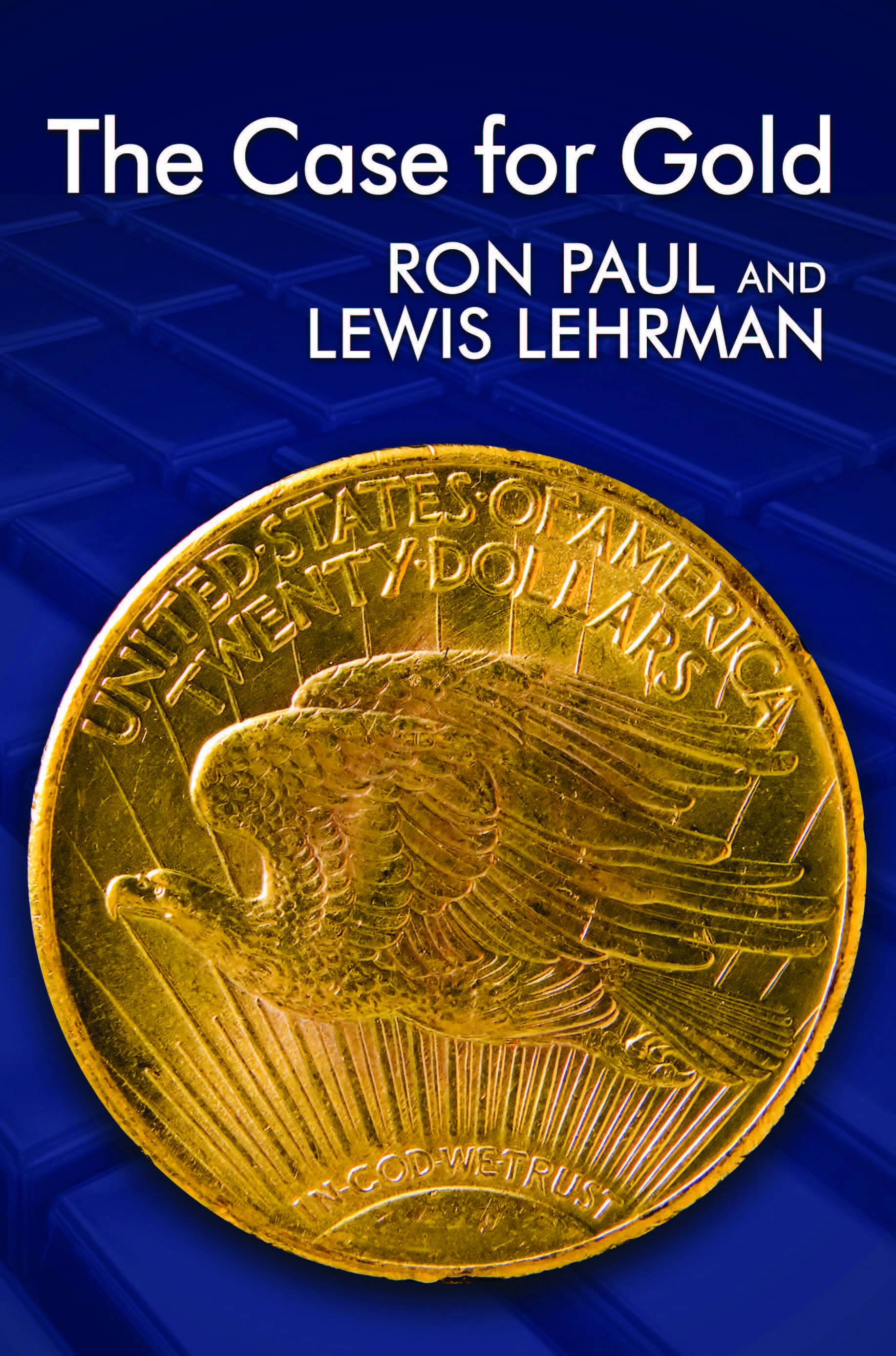
In 1982 Ron Paul and Lewis Lehrman, both members of the U.S. Gold Commission, put a minority case for monetary reform on the record, and the Cato Institute published it that year as The Case for Gold: A Minority Report of the U.S. Gold Commission. The Mises Institute serves a 2007 digital edition. Its program makes gold itself the money, with the dollar defined as a weight of the metal. Notes and deposits become separate claims redeemable in that metal, and a staged legal transition gets the country there. Read it for a worked reform plan grounded in American monetary history. Its crisis forecasts belong to 1982 and have not aged well.
A long historical section runs from colonial and Continental paper through the Jacksonian bank wars, Civil War greenbacks, national banking, the Federal Reserve and the closing of the gold window in 1971. Chapters on private coinage, the gold standard and the transition follow. The acknowledgments credit Murray Rothbard, Christopher Weber and John Robbins with help on research, drafting and editing. Across that material the authors keep two objects apart: the commodity unit, which they treat as money, and the paper substitutes whose value depends on issuers keeping their promise to redeem.
That distinction reframes what bank failures prove. Runs and worthless notes are often cited as evidence that unregulated banking fails, and Paul and Lehrman ask which privileges the failing banks held. State-granted note issue and legislatures that let banks suspend specie payment and keep operating change the experiment. A legally sanctioned suspension differs from an insolvent balance sheet, and a run on circulating notes tests a different promise from a withdrawal of deposits. Their account of the Suffolk Bank of Boston shows a private clearing bank disciplining country banks that overissued by sending their notes home for redemption. Scottish banking gets favorable treatment as a case of competitive note issue, though the authors' own pages record a 1765 statute on small notes and redemption and a suspension from 1797 to 1821. A record that mixes privilege with competition cannot settle the question in either direction.
Deficits get a similar separation. The authors grant that a deficit financed by selling bonds to the public does not by itself inflate the money supply. Inflation enters when banks and the central bank buy the debt with newly created money, and they argue that chronic deficits generate political pressure for that step. The gold-standard chapter sets a limit on its own remedy: gold cannot cancel abusive taxation or bad labor law, nor does it guarantee a free economy, though it restrains officials in an economy that is already broadly free. A reader comes away asking which failure a monetary proposal addresses before crediting gold with fiscal or regulatory results.
Gold advocacy is often pictured as a demand that Washington decree a gold dollar. The transition chapter weighs reform imposed from the top, which the authors fear would yield a pseudo-gold standard, against reform growing from private action, and prefers a mix in which government clears the legal obstacles to improvement from below. Under the plan, legal tender compulsion goes, private mints may strike coins under their own marks, foreign coins and private banknotes may compete, and courts enforce contracts written in gold. Federal Reserve notes would be retired in favor of redeemable notes that work like traveler's checks and carry no legal tender status. The plan would expose an issuer who failed to redeem to civil and criminal prosecution. The coinage chapter admits that some private minters cheated or assayed badly, so the case rests on competition and enforcement.
For banking, the authors propose that every promise to pay on demand, whether a note or a demand deposit, carry full backing in whatever it promises, with severe penalties for any shortfall or failed delivery. Because the rule targets demand promises, time deposits and term lending remain possible. The penalties are part of their proposed legal design, separate from any description of statutes then or now in force. Full reserves and the historical record of competitive note issue answer different questions. One concerns the rule for future demand promises, and the other concerns how privileged and unprivileged banks behaved. Holding them apart keeps a reader from treating the Scottish or Suffolk episodes as evidence for or against the 100 percent rule.
Sequence carries much of the program. A requirement that taxes be paid in gold or silver coins or certificates comes last, after the other reforms. That requirement governs what the government accepts for obligations owed to it. Well before that step, the authors would remove every tax on gold and silver coins and bullion, direct the Internal Revenue Service to accept all U.S. money at face value, and open legal room for competing currencies and gold contracts. Spending cuts would balance the budget alongside these changes. On cost the book pulls two ways. One passage says the transition will probably not be painless, since recessions follow any slowdown in money growth. A later passage expects the resulting recession to be brief and mild and cites 1921 as precedent. The historical chapters supply analogies for that forecast without evidence that a quick, gentle adjustment would follow in the conditions of the early 1980s.
The closing chapter turns to prediction. Without reform, it says, core inflation would accelerate through the decade, so that ten years on the media would cheer a rate falling below 50 percent. It also raises the prospect of German-style runaway inflation. The book never defines its core measure. A Bureau of Labor Statistics retrospective published in 2014 reports that by the beginning of 1992 the all-items consumer price index was rising at under 3 percent, and the index excluding food and energy at under 4 percent. That comparison marks a boundary on a dated forecast. It leaves open which policies produced the disinflation and what gold would have delivered. Read the collapse rhetoric as an argument about 1982 incentives, and decline to treat it as prophecy.
Pick up The Case for Gold for the question it answers best: how a government could leave irredeemable paper money without decreeing a new monopoly, and which promises banks would have to keep along the way. Its banking history and transition chapters reward the closest attention, and some background in American monetary history makes the middle chapters easier to follow. The Mises Institute hosts the 2007 edition: The Case for Gold, Mises Institute PDF.