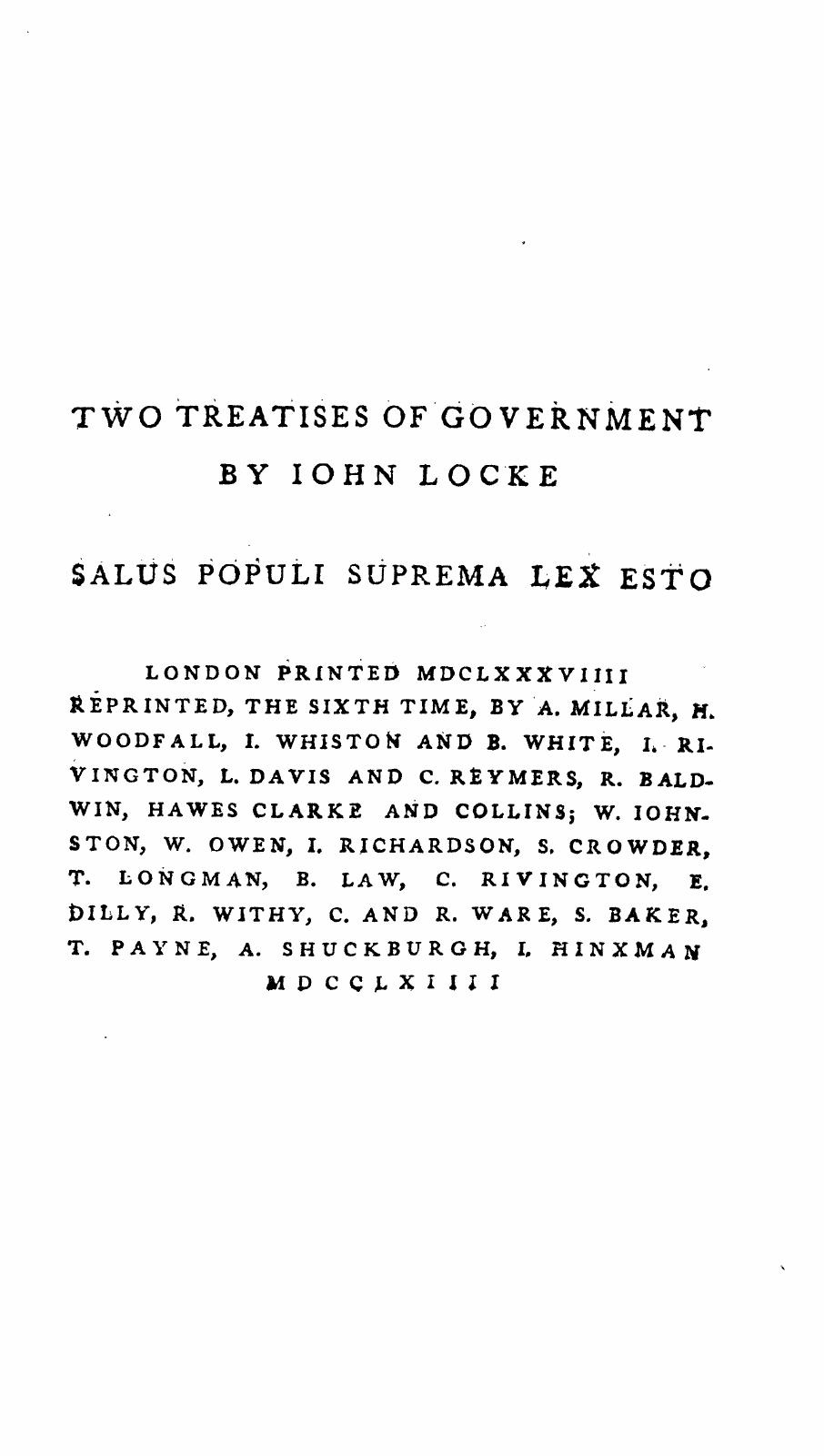
John Locke's Two Treatises of Government, a work of the late seventeenth century, joins a demolition to a construction. The First Treatise takes apart the claim, as Locke reconstructs it from Sir Robert Filmer, that kings inherit absolute dominion from Adam. The Second builds political authority from persons who already hold rights and who form a community for protective purposes. Read the two together for the distinction they teach: a title to rule differs from the possession of power. That distinction yields working tests for where authority comes from, how far it reaches and when it is lost. The text consulted for this selected reading is the Online Library of Liberty's English transcription, generated in September 2011 for its Portable Library version 6.0, of the 1764 London edition edited by Thomas Hollis, which contains both treatises in Locke's original English; see the Online Library of Liberty edition page.
The First Treatise deserves its place. It argues through scripture and textual criticism inside a shared religious frame, testing each link in a chain of claimed transfer. Grant Adam, for argument's sake, both fatherhood over his children and property in the whole earth. At his death the property can descend to one heir. Paternal power arises from begetting, and an eldest brother begat none of his siblings, so that title passes to every son who becomes a father. The two titles part company in the first generation, and their combination names no single sovereign. Locke's preface supports King William on the ground of popular consent, so his target is inherited title, with monarchy as such left standing. The lesson travels well: for any claim of authority, ask which relation grounds which power and how it reached its present holder.
The Second Treatise starts from a law of nature binding rulers and subjects alike, grounded in equality and in persons as God's workmanship, a premise any secular self ownership slogan would hide. In the property chapter the earth begins common, yet survival requires private appropriation, and Locke's gatherer of acorns shows that waiting for everyone's express permission would starve him. Labor gives title to what it removes from nature, provided enough and as good remains for others and nothing spoils. Land held in common by compact under the law of a parish belongs jointly to that parish and stays closed to individual enclosure. Money then changes the arithmetic. Spoilage caps accumulation while goods perish; a durable medium that people agree to accept lets surplus be exchanged and kept without waste. Locke treats consent to gold and silver as tacit agreement to unequal holdings, and that consent does heavy justificatory work. The application also rests on contestable premises: Locke treats parts of America as waste and measures improvement by European cultivation, so his conclusions about occupation and use depend on those descriptions.
Government cures the defects of natural enforcement, where each person judges his own case with partiality and weak execution. Political society supplies a known standing rule, an impartial judge and power to execute judgments. Property here names lives, liberties and estates together, so the protective purpose reaches well beyond land. A ruler who judges his own case with unchecked force would reproduce the original disease in worse form. The legislative is therefore supreme within the community and still bounded by preservation and by the powers individuals could lawfully hand over, and it governs through published laws and authorized judges. Locke's military example shows the mechanism: a sergeant may order a soldier toward a cannon yet may take none of his money, because each power is measured by its end. This is a normative standard, offered without claiming every state arose this way.
Consent is where the framework strains. Joining a community commits members to majority decisions, and taxes may be levied with the consent of the majority or its representatives. Locke separates that founding consent from the rule for deciding afterward and from the temporary obedience owed by anyone enjoying a territory, down to a traveler on the highway. Express membership binds more firmly: one who has given it remains perpetually a subject, unless a calamity dissolves the government he lived under, an event distinct from the end of the society, or some public act cuts him off from membership. The voluntary starting point and this generous account of tacit consent pull against each other, and the book leaves readers to weigh how much authorization the enjoyment of territory can establish.
The final chapter turns these limits into conditions of forfeiture. Legislators who replace law with arbitrary will, or subvert authorized elections, betray their trust, and the community may place authority in new hands or a new form. Locke answers the fear of perpetual rebellion by pointing to people's attachment to settled institutions and by reserving resistance for a sustained pattern of abuse, well beyond administrative error. His closing paragraph returns forfeited power to the society, which outlives its government. Resistance belongs to a political community recovering a trust, and the threshold sits far above ordinary policy grievance.
Read the book as a defense of limited political society under majority rule, with its theological foundation and its assumptions about cultivation in view. This edition's eighteenth century English, with long sentences and old spelling, asks for steady attention, and the scriptural disputes of the First Treatise ask for more. Keep both projects in mind and follow how each grant of power is limited by its purpose. The reward is a distinction worth carrying: officeholders can forfeit their title while the community that conferred it keeps political authority. For the printed original, Liberty Fund's Online Library of Liberty supplies a complete 429-page scan of the 1764 London edition printed for A. Millar and others, written by John Locke and edited by Thomas Hollis, a file separate from the 2011 transcription used for reading. The 1764 printed text is in the public domain in the United States, and verified copies of the same unmodified scan can be downloaded from the Towards Liberty relay, nostr.download or 24242.io.