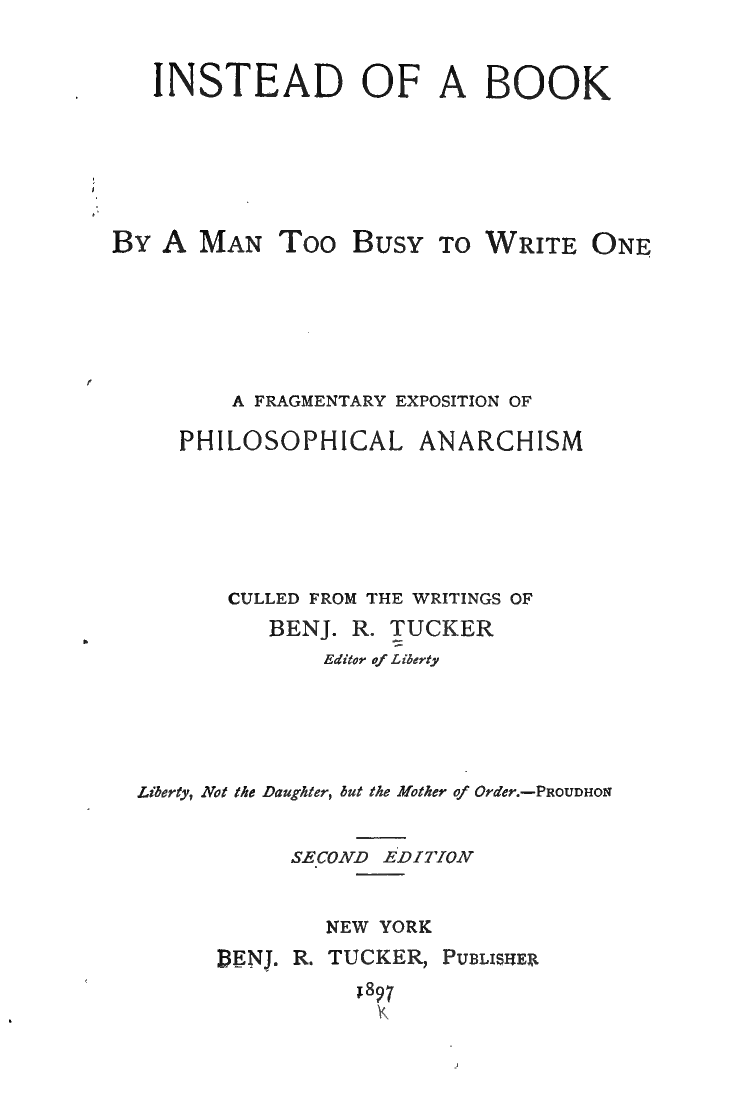
Benjamin R. Tucker gathered a dozen years of his newspaper debates into this collection, drawn from Liberty, the journal he started in Boston in 1881, and sorted by subject into eight parts. The preface warns that the articles stand almost as first written, with personal asides and digressions left in, and that terminology may shift over the years. Readers should therefore expect a working record of individualist anarchism and mutualist economics, argued under pressure from critics, in place of a systematic textbook. Tucker wants labor to receive its whole product. He opposes State Socialism because it would concentrate capital in government, and he defends voluntary exchange because he traces interest, profit, and landlord rent to state privilege.
The opening lecture, State Socialism and Anarchism (printed pages 1 to 18), sets out the frame. Tucker names four monopolies, in money, land, tariffs, and patents, and traces their effect to one-sided competition. Workers compete freely for jobs, while lenders of capital stay largely sheltered from rivals; merchants sit between, meeting competition only in part. His forecasts that interest and profit would vanish and wages rise to the full product follow from a labor-cost theory of price, and readers should test them against his argument.
In Free Trade in Banking (printed pages 227 to 235), the first voice is J. Greevz Fisher, whose long letter argues against mutual banking; Tucker's reply begins at paragraph 18. The mechanism he describes is ordinary credit. A borrower who pledges goods, or who offers a note endorsed by solvent parties, trades a little-known credit for a bank's widely accepted notes, much as a homeowner keeps living in a mortgaged house. Tucker accepts a voluntary custom of preferring gold; his objection targets laws that tax or forbid rival notes. Money and Capital (printed pages 215 to 217) makes the case depend on such notes being readily accepted as sound money. Open entry into note issue could plausibly lower borrowing costs, but a fall all the way to zero interest remains contestable, because lending against collateral still carries default risk and the cost of waiting.
In Land Occupancy and its Conditions (printed pages 324 to 326), Tucker would protect only titles grounded in occupancy and use, and a voluntary association defending occupiers falls outside government as he defines it. Economic Rent (printed pages 343 to 348), his answer to Stephen T. Byington, is franker still. Tucker concedes that bargain-hunting buyers leave the advantage of a superior site standing, and he gives only indirect reasons to expect it to shrink. Once enforcement of absentee titles ends, he argues, so does the payment to a landlord, while the remaining advantage of location stays with the producer who occupies the land. Even if that remainder proved permanent, he would resist letting Henry George's Single Tax confiscate it, accepting a limited inequality between one worker's product and another's as part of the cost of liberty.
On method, The Method of Anarchy (printed pages 415 to 417) argues that a coordinated withholding of payment works only when enough people take part and understand their reasons. Tucker offers the Irish Land League's rent strike as his example and blames its collapse on followers who resumed paying when their leaders told them to. That account is Tucker's advocacy, and it explains why he insists on economic education before action. The Power of Passive Resistance (printed pages 411 to 414) also allows violence in extreme emergencies, so the collection stops short of absolute pacifism.
A good path begins with State Socialism and Anarchism, then moves to Free Trade in Banking, Economic Rent, and The Method of Anarchy. The index by Francis D. Tandy and Henry Cohen helps trace a topic across essays. Each essay closes on its own terms, leaving the book's threads open in place of one final conclusion. It suits readers who want to see this tradition in its own disputes and can weigh its claims critically. This 1897 second edition is distinct from the 1893 first edition and is in the public domain in the United States. The scan comes from a Cornell University Library copy held by the Internet Archive. Download the complete 1897 scan or use the PDF mirror. Both links serve the same 542-page scan.