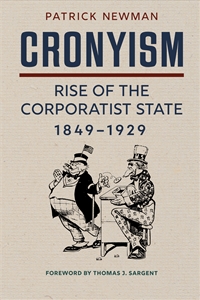
Patrick Newman's Cronyism: Rise of the Corporatist State follows American economic policy from 1849 to 1929, ending on the eve of the Great Depression. He argues that the era's dominant trend was the use of government power to shelter cartels and monopolies. Its lasting value lies in a habit of inquiry. The narrative repeatedly asks who proposed a rule and who later administered it, then traces how the answer altered a rival's ability to compete. Readers who reject some of Newman's conclusions can still adopt that instrument, and the book supplies named participants and dense footnotes for testing it against the record.
That approach marks a deliberate change. Newman's 2021 volume on early America used Murray Rothbard's contest between liberty and power. The introduction here retires that frame after 1849 because neither major coalition afterward consistently opposed privilege. Parties now differed mainly in which clients they rewarded. Its replacement is a two-step theory of rival interest groups. Legislation creates a power, often as a compromise among bankers, railroads, shippers, smaller firms and unions pressing for different terms. Appointments and enforcement then decide whose interests that power serves, and later appointees can reverse the outcome. Since victories can be undone, the account needs no permanent cabal, which keeps it tied to documented conflicts among identifiable groups. The introduction states the theory in full, so readers can start here, and the chapters apply it to railroads, banking, antitrust and the regulation of food and medicine.
Railroads supply a compact model of how state power changes a private agreement. Voluntary rate pools kept collapsing in the 1880s as members quietly granted rebates and rival routes appeared. The Interstate Commerce Act of 1887 banned pooling, which dismayed many railroad leaders. Newman argues that its rebate prohibitions still made secret discounting costlier, and that Cleveland's appointees under Thomas Cooley read its vague clauses in ways the eastern trunk lines welcomed, over protests from shippers' groups. Those lines regrouped as a rate association that fixed rates without dividing traffic, and eastbound grain rates held steady for several years. Western roads tried the same device with commissioners' approval and kept cutting. Cooley resigned in 1891, and later breakdowns sent railroad men back to Washington. Read closely, the chapter places the decisive variable in enforcement. Posted prices help a cartel when an agency will punish defectors, and the information alone guarantees nothing.
Chapter 8 shows a statute holding still while its uses swing. Under Edward Hurley, from 1915 into early 1917, the Federal Trade Commission offered businessmen advance advice on unfair competition and promoted uniform cost accounting through trade associations. After he resigned, Wilson appointed critics of big business who opened investigations into large firms. Wartime controls and higher taxes then cut into corporate gains until business groups turned on the agency they had sought. Coolidge's 1925 appointment of William Humphrey produced a business-friendly majority. Under that majority, trade practice conferences let industries draft rules against secret price cuts and departures from posted prices, and the commission enforced them. The portable lesson is that a statute's name reveals little about policy until one knows who holds the seats and how they use discretion. Newman also grants that tax reductions in the 1920s could benefit the wider economy. Cooperation or shared accounting standards do not by themselves establish consumer harm without an enforcement record of the kind he documents.
The chapter on food and medicine adds a third mechanism, the uniform rule with unequal costs. Senator Albert Beveridge's 1906 inspection bill would have charged packers for federal inspection. The large Chicago firms worked instead for a House version that put inspection costs on taxpayers. Its sanitary requirements forced smaller plants to rebuild or duplicate equipment that modern facilities already had, while inspection gave established brands a selling point abroad. Newman records the limits of that edge too. Ranchers and grocers later won concessions of their own, and the arrival of refrigerated trucking opened the trade to newer rivals.
Medical licensing applies the same logic to a profession. From 1904 the American Medical Association's Council on Medical Education pressed state boards to license only graduates of approved schools with longer programs and laboratories, and the Carnegie Foundation's Flexner Report of 1910 advanced that agenda. Smaller schools that could not afford the upgrades closed or merged, and physicians per capita declined. Training and facility requirements rose as the supply of providers shrank, and credentialed doctors gained from the scarcity. Whether the stricter requirements improved clinical quality or left patients better off is a separate empirical question that closures alone cannot settle.
That question exposes the book's main limitation. Lobbying records can show who sought an advantage and trace a cost mechanism. A verdict on consumer welfare also needs the benefits a rule delivered and an estimate of what would have happened without it. The 1906 food and drug law, according to the FDA's own history, targeted adulteration and misbranding and required disclosure of certain ingredients, with no premarket approval. Labeling of that kind addresses a problem of consumer information even where incumbents profited. Newman does engage the health record, citing an official review that found some meat condemnation rules stricter than safety required. His weighting still treats public interest justifications largely as cover. The introduction's broader propositions, that lasting cartels need state backing and that growth came from markets despite government, are the book's thesis. The case studies illustrate those propositions without proving them.
Thomas J. Sargent's foreword sets the economist's habit of compressing history into models beside the historian's interpretive work. It is a comment on method that leaves each verdict for readers to judge. The 2026 book suits readers of regulatory and Progressive Era history who want an argued political economy and will check its interpretations against the footnoted sources. Analysts studying how agencies change hands can take up the railroad or trade commission chapters on their own. Anyone wanting a neutral survey or a quantitative welfare history should expect an advocate's case pressed hard.
The publisher distributes the complete book as a free PDF under the Creative Commons Attribution-NonCommercial 4.0 International license, and the 412-page paperback carries ISBN 9781610167826. Both the complete PDF and the paperback listing sit on Mises Institute sites, with license terms at Creative Commons.