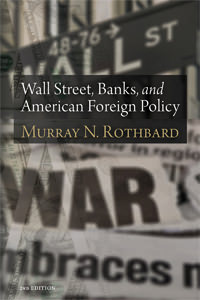
Murray N. Rothbard's Wall Street, Banks, and American Foreign Policy treats American interventions as entries in a ledger: who financed a policy, and whose balance sheet improved when it succeeded? He carries that question from Civil War bond underwriting to the 1984 primaries, arguing that public borrowing gave major banking houses a lasting stake in the state's wars and rescues. Read carefully, the book works as a search tool. Following the money shows which actors had the resources and access to press a decision, and where their aims overlapped. Benefit and family ties cannot by themselves prove that those actors caused the decision, and a reader who holds both propositions gets the full value of the work.
The main essay first appeared in World Market Perspective in 1984 and became a Center for Libertarian Studies monograph in 1995. In 2011 the Mises Institute issued a second edition under a Creative Commons Attribution 3.0 license, with introductions by two separate contributors: Anthony Gregory wrote one for that edition, and Justin Raimondo's carries a 1995 label. Rothbard alone wrote the main argument. Gregory's and Raimondo's comments on later bailouts and administrations reflect their own hindsight.
His opening states the premise behind everything that follows. A manufacturer, Rothbard argues, can compete on the market or seek privilege according to his own values, while bankers face structural pressure toward the state. A commercial bank lending on fractional reserves, in his account, lives near insolvency and prizes a lender of last resort; an investment bank underwriting government bonds profits from deficits and from the taxes that redeem them. Rothbard treats this as an inherent disposition of the trade. We read it more narrowly, as an incentive hypothesis: underwriting creates a stake, and a stake predicts lobbying that leaves records. By Rothbard's account, Jay Cooke lobbied and paid for Salmon P. Chase's rise to the Treasury, and Chase repaid him with a monopoly on underwriting the federal war debt. Cooke and Chase then, he writes, built a national banking system that tied each bank's credit expansion to bonds bought from Cooke. This is Rothbard's narrative drawn from secondary sources, a sequence to verify in the archives before treating it as a proven causal chain.
The First World War chapters apply the logic at scale. Rothbard describes the Morgan house as purchasing agent and leading lender for the Allies, so each loan enlarged its stake in Allied victory. The Federal Reserve, founded at the end of 1913, supplies his mechanism: centralized reserves let banks expand credit to fund those loans and, after April 1917, federal deficits. A creditor stake explains why a lender would favor intervention; showing that the stake produced American entry requires evidence about the decision itself. Two further claims stay attributed to him. His view that the older gold-standard system could not have financed the loans or the war is a counterfactual, and he frames the chain from American entry to the Second World War as a possibility.
Guatemala is the strongest case and the best place to learn the method. Rothbard traces the Arbenz government's seizure of uncultivated United Fruit land, then follows the company's ties through law firms and bank boards to officials including the Dulles brothers and national security adviser Robert Cutler. State Department historians corroborate the core events. Their Foreign Relations of the United States account records United Fruit's support, CIA training of an exile force, air operations, diplomatic and propaganda pressure, and Arbenz's resignation. That record also describes the planners' anticommunist and security concerns, so it confirms the intervention while leaving open how much weight financial motive carried.
Each layer of the chapter supports a different inference. Interlocking directorates join United Fruit to a sugar company and the Schroder banking house. Lobbying runs through a Council on Foreign Relations study group led by a United Fruit consultant and through a planning report warning of communist infiltration. Decision and implementation sit elsewhere: Eisenhower assigned the operation to the CIA in late 1953, and Frank Wisner directed it. Afterward the revolving door turned, when Walter Bedell Smith joined United Fruit's board. Land loss gave the company a strong reason to lobby, and officials with legal or board ties gave it a familiar audience, a correlation that leaves motive undetermined. Rothbard's count of eight CFR members among twelve top officials includes men who joined within a few years, and a later seat cannot establish an earlier controlling motive.
Vietnam supplies a counterexample, and Rothbard records it himself. In March 1968 Lyndon Johnson convened his senior advisers, the so-called Wise Men, and found only two still holding the hard line. Robert McNamara had already turned dovish, and Clark Clifford, his hard-line successor, changed his mind after investigating. A network that splits and reverses itself behaves like a coalition of factions. Raimondo's introduction concedes as much when it describes congruent interest groups with no central committee. Profit operates alongside ideological conviction and security fears, with electoral pressure adding its own weight, so a sound method compares cases where money pointed one way and policy went another.
Rothbard marks his weaker inferences, and readers should keep those markers attached. He grants that no hard facts show a Standard Oil motive behind Theodore Roosevelt's antitrust campaign. Trilateral grooming of Jimmy Carter appears as his more likely explanation, an inference by his own wording, and on Kissinger and David Rockefeller he suggests only that they might have foreseen the Iran hostage crisis. Each is a hypothesis awaiting documents. Some factual statements need checking as well. Rothbard credits Nixon with first establishing diplomatic relations with Communist China, while the State Department history of China policy separates the 1972 rapprochement and 1973 liaison offices from formal relations, which began under Carter in 1979. Raimondo's introduction adds its own polemic, holding that the conclusion follows from monetary theory before evidence arrives and treating libertarians who stop short as lacking nerve. That framing is advocacy; the historical case still rests on documents.
Read the book for the question it trains: whose assets changed value when Washington intervened abroad, and how did their owners reach the officials who decided? Expect dense runs of names and board seats; they document access, and the causal chain still needs proof. Use the book as a compact revisionist research map. Before relying on any of its claims, go to the original records and set officials' stated motives beside their financial ties, then look for cases where the same interest existed and intervention never came. Rothbard's analysis ends with the 1984 candidates, offering a historical method and leaving present-day networks to fresh research. The Mises Institute hosts the 2011 edition as an official PDF: 2011 edition PDF from the Mises Institute