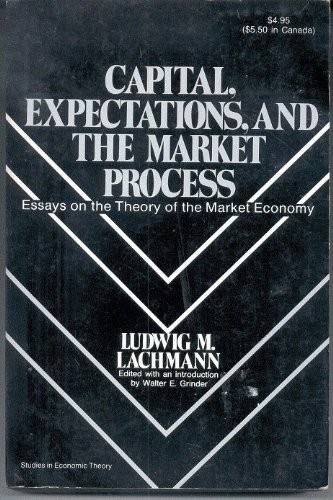
Ludwig M. Lachmann's Capital, Expectations, and the Market Process treats the market economy as a sequence of plans. People interpret changing knowledge, commit durable resources and revise when events defeat them. From that premise he derives capital as a structure of plans, markets that coordinate without forming a determinate whole, and wealth the market keeps revaluing. Read it to test whether an economic story holds together at the level of plans; it offers no forecasts of investment or employment.
Walter E. Grinder edited the 1977 volume and wrote its introduction; the eighteen essays are Lachmann's. Seventeen appeared between 1940 and 1973. The eighteenth, written for this book and first printed here, opens it by assessing Austrian economics amid the disputes of the 1970s; later parts cover expectations, the market process, capital and macroeconomics, and policy. Positions shift over the decades, and Grinder generalizes more boldly than most essays, so weigh Lachmann's arguments on their own.
The method rests on a 1943 argument about interpretation. Lachmann imagines two farmers who watch apple prices rise. One reads inflation; the other reads a shift in demand driven by vegetarianism, and their plans diverge. An observed price means something only inside a framework that includes a judgment about which forces drive change. Expectations are therefore subjective without being arbitrary, and the economist's job is to reconstruct the interpretation until the response becomes intelligible. Formal tools stay in the kit: Lachmann calls the pure logic of choice, equations included, useful for making action comprehensible, and he wants ideal types of expectation checked against economic history. His target is research that ties objective facts directly to expectations and skips the interpretation between them. The farmers are a teaching device; how real farmers read prices is an empirical question.
Capital receives the same treatment in a 1947 essay on complementarity and substitution. Lachmann treats capital as a homogeneous fund and as a structure of universal complements, presenting both as ideal types, each an analytical simplification. The two relations belong to different moments of action: goods are complements within the plan that gives each a function, and substitution becomes relevant when an unforeseen change forces revision. In his illustration, four delivery vans, each serving a quarter of a town, work as complements under the firm's schedule; when the schedule breaks, one can stand in for another. Change converts some complements into substitutes while many relations survive, so the analyst first asks which plan a disturbance defeated.
A second constructed sequence follows accumulation through the economy. Capital expands in film production and cinema earnings rise. Where idle labour and sites exist, new cinemas appear; in crowded city centres, theatres, ice rinks and dance halls are converted. Building rents rise. Costumes and freezing equipment lose value unless someone fits them into a new combination, and owners of idle complementary goods capture gains. Two conclusions follow that aggregate reasoning hides. Accumulation makes profit rates diverge, so one rate of profit has a clear meaning only in equilibrium. Spare capacity can absorb shocks when combinations break up and can invite investment in its complements. The sequence assumes rising demand for films; testing it would mean tracing asset prices and conversions in a real industry.
A 1971 essay on Mises sets the limits of coordination. Lachmann calls individual equilibrium indispensable and grants that equilibrium in a simple market still has uses, but he doubts that many interacting markets form a determinate whole, because adjustment in one market can upset another. Information spreading through prices and imitation is a real equilibrating force, though it can be slow and go stale. He therefore rejected the claim of some Keynes opponents that an unhampered market would in the end bring full employment, judging it unwarranted and no help to the market's case. The opening essay likewise defends mutual gains from exchange while declining to call real markets Pareto optimal.
In a 1956 essay the same reasoning undercuts a premise of redistribution. Lachmann separates two senses of datum. At any moment the distribution of wealth is a given fact, and it shapes the immediate future. It is not an independent condition of equilibrium, because unforeseen change keeps revaluing specific assets through capital gains and losses; staying wealthy requires correct judgments repeated over time, and heirs face the same test. He links the shareholder choosing a company and the manager choosing tools as specifying decisions at different levels of concreteness. This turnover argument is analytical: whether inherited advantage fades or inequality narrows is a question for longitudinal data the essay does not supply, and turnover by itself says nothing about desert.
The 1940 reconsideration of Austrian cycle theory states its conditions plainly. It splits the economy into consumer-goods and capital-goods industries, with labour uniform within industries and immobile between them. Add fast productivity growth, and scarce raw materials and specialized capital can cut a boom short. Its wage conclusion corrects a caricature. The model says nothing about a general wage level; Lachmann pins his main hope for recovery on rising real wages in consumer industries, while capital-goods wages enter through investment costs. His historical check is brief. It finds resource scarcity at earlier breakdowns and admits a poor fit for 1929, when consumer prices held steady and raw-material stocks rose. The 1943 essay adds that such a crisis needs elastic expectations and that no single type of expectation guards against every crisis.
Policy enters through the 1963 presidential address on cultivated growth. Lachmann asks whether voluntary Economic Budgeting, in which firms exchange plans and information without command or coercion, is compatible with a market economy, and he declines to argue for or against any particular scheme. Because action depends on interpretation and knowledge is unevenly spread, he finds the charge of incompatibility unwarranted. He then goes further. Some knowledge, input-output tables for instance, may spread best through specialists communicating directly, and a public agency guided by competent economists could spread it faster and more thoroughly. He will not say which route makes fewer mistakes. Readers expecting the firmer anti-intervention line of Grinder's introduction will find a conceptual inquiry that leaves the practical verdict open.
The collection suits advanced readers of capital theory, methodology and economic history who know the debates around Hicks, Keynes and the Austrian school and can tolerate overlap and dated references. It supplies causal analysis of plans, not investment forecasts or policy advice. The questions it sharpens are which plans a given change defeats and what evidence would turn a plausible sequence into a tested claim. The Mises Institute hosts the full text of the 1977 edition as a PDF.