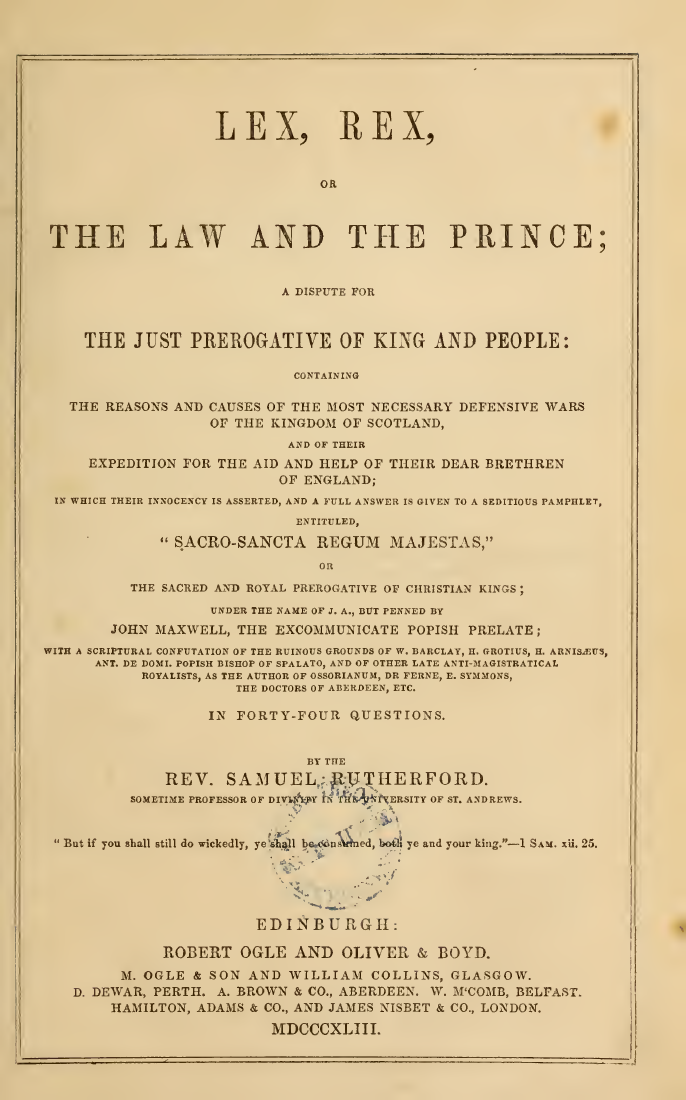
Samuel Rutherford, a Scottish Presbyterian minister, published Lex, Rex in 1644 while civil war divided the British kingdoms. The book answers royalist defenders of absolute monarchy, chiefly the prelate John Maxwell. It is a scholastic disputation in forty-four questions, each stating assertions and answering objections with Scripture and legal authorities. The going is slow. Still, Rutherford keeps pressing a question that many theories of limited government leave vague: what makes a limit on a ruler more than a pious hope?
The accessible edition is the 1843 Edinburgh printing by Robert Ogle and Oliver & Boyd, scanned from a Princeton Theological Seminary Library copy and available at the Internet Archive as a complete PDF. An anonymous editorial preface and a short life of the author precede Rutherford's own preface. At pages 235 to 283 the volume appends an English version of George Buchanan's De Jure Regni apud Scotos, a separate dialogue by a different author. Page references below are to printed pages, and the page images are safer than the scan's error-strewn machine text.
Questions I to IV (pages 1 to 9) separate an office from the person holding it. Rutherford argues that God ordains civil government much as Christ ordains the pastoral office. Whether this man or that one becomes king is a human choice, as a congregation chooses its minister. That choice is constitutive, because the states' authoritative act turns a private man into a public person. Power lies radically in the people and passes to a ruler by grant, and the grant may be measured out, fenced with limits and tied to conditions. Civil equality underlies this, since no one is born with a crown, though Rutherford expressly excepts the subjection of children to parents and of wives to husbands. The community he describes acts through its estates and parliament, a long way from universal suffrage. His reasons stay theological throughout.
Question XVI (pages 64 to 68) applies the distinction to persons and goods. A master uses slaves for his own benefit, while a king's power is fiduciary and ministerial, held to protect the governed. If every subject's goods already belonged to the king, he could only ever take his own. The prophets' rebukes of royal extortion would then be empty, and so would the charge that Ahab acted as a tyrant in seizing Naboth's vineyard. For Rutherford, private ownership comes before kingship, and the magistrate was devised to preserve it. Yet extreme necessity makes things common and can oblige a subject to give everything for the commonwealth. Justice can also require confiscation for a fault, with the forfeited goods serving the public. His target is the claim that the king owns his subjects' goods, and he offers no general objection to taxation.
The book's pressure point comes in Question XXIV (pages 113 to 119). Enactment gives a law its penal stamp, making a breach punishable, but its goodness exists before any ruler wills it. Parliament shares in lawmaking, and the king's supremacy in executing law is derived, since the estates keep what Rutherford calls the fountain power. The royalist Dr Ferne objects that limited monarchy implies only a legal restraint on the king. Rutherford replies that a restraint that lives only in a sinful ruler's conscience restrains nothing, and that a law with no force behind it amounts to a polite request. He separates habitual subversion of fundamental law from every single wrong a ruler commits. That force belongs to estates and lawful public offices; rival private courts play no part.
The closing corollaries of Question XLIV (pages 227 to 234) gather these threads. Resistance targets a ruler's abused will and leaves the office standing, and parliament has no more license to abuse power than the king. One late question asks who owns the forts, ports, roads, arms and magazines. Rutherford answers that they are the king's in custody and official use, to be directed for the kingdom's safety, while their benefit and proper legal ownership belong to the kingdom. He cannot sell them to a foreign prince, and if his line fails they remain the kingdom's property, which the estates may no more sell than he could. Here the opening distinction between office and person has become a working rule for public assets.
The serious limitation lies in what these restraints were meant to protect. Rutherford's preface, sharp with invective against prelates and Rome, defends Presbyterian church discipline over kings and notes with approval that the civil magistrate fines blasphemy. In Question XXIV he endorses John Knox's position that the Scottish estates should not have permitted the queen her mass. The same reasoning that lets a community restrain a tyrant also binds ruler and people to a confessional order enforced by law. Readers who value freedom of conscience should feel that friction. Accountable government and religious liberty turn out to be separate achievements, and a strong case for the first can sit beside open hostility to the second. That tension is part of the book's lesson, and the constitutional argument survives it.
Lex, Rex suits readers of constitutional history and of resistance theory grounded in natural law. Biblical proof and Latin citations crowd its old-spelling pages, and objection and reply loop at length. It is a poor first book on liberty and gives no guidance on present-day law or institutions. A sensible route begins with Questions I to IV and then takes up XVI and XXIV. The corollaries of XLIV come next, and the remaining questions then supply the fuller disputes. Read that way, the book shows how a seventeenth-century theologian connected the source of political authority to the means of holding it to account.