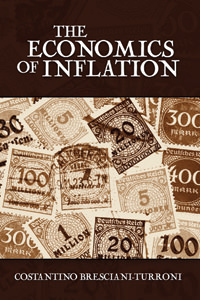
Costantino Bresciani-Turroni's The Economics of Inflation studies the German mark from the suspension of gold convertibility in 1914 through the collapse of 1923 and the stabilization that followed. He argues that the continuous issue of legal money drove the depreciation. New notes financed the government until November 1923, when the Reichsbank stopped discounting Treasury bills, and from 1922 they increasingly reached private borrowers through commercial discounts. By 1923 the exchange rate, prices, wages and note issues were pushing one another upward, yet he still traces the cause to the note issue. He worked on reparations administration in 1920s Germany. His book repays reading for its mechanical detail: it follows new money to its point of entry and tracks which groups gained or lost as prices caught up.
Bresciani-Turroni first published the study in Italian in 1931. He revised it substantially for the English edition of 1937, translated by Millicent E. Sayers with a foreword by Lionel Robbins, and that version's conclusion comments on German policy after 1933. Robbins links the inflation to later political disaster; the interpretation is his own, and he cautions that lessons from a hyperinflation do not transfer unchanged to small inflations. The Mises Institute catalogues a 2007 reprint, and its free PDF scans a 1968 third impression of the 1937 translation.
The early chapters show the sequence changing by phase. During the war, circulation outran prices while hoarding and price controls muted the effect. By late 1919 the exchange rate and import prices ran ahead of money, and through 1920 and 1921 the note issue kept climbing while domestic wholesale prices held roughly steady. He concedes that new money was hard to avoid for the 1914 mobilization and criticizes later policy. Depreciation also hurt the budget, because taxes lost real value between assessment and payment: employers kept the wage tax withheld from workers for about a fortnight, and turnover tax arrived after a quarter. Some expenses shrank in real terms too, so he places the most damaging net effect in 1922, when outlays adapted faster than receipts.
The Reichsbank defended its commercial discounts on real-bills grounds, expecting each bill to be repaid once the goods behind it were sold. Bresciani-Turroni argues that this automatic reflux guaranteed no restraint while prices kept rising: each renewed bill needed more marks to carry the same goods, so nominal demand for credit returned larger. With the discount rate far below the pace of depreciation, a loan repaid in cheaper marks worked as a subsidy, allocated by rationing. His conclusion turns this against critics who held that business would create whatever money high prices required. Emergency money and foreign-currency deposits spread in 1923, yet wage payments still required legal marks, which the Reichsbank supplied.
Reparations get a fair hearing. The author accepts that the 1921 London demands exceeded Germany's capacity and that the Ruhr occupation of 1923 cut coal and customs revenue while new notes financed passive resistance. Separating the external burden from the domestic task of raising taxes and buying foreign exchange, he argues that a payment schedule cannot by itself account for years of rising note issue. He finds unpersuasive the charge that the government deliberately ruined the currency, while recording that certain industrial interests profited from cheap credit and delayed taxes.
On production, Bresciani-Turroni rejects the common claim that inflation creates no new resources. Restricting the consumption of wage earners and fixed-income households shifted resources into plant and equipment. Firms then built plant beyond what their output required and miscalculated replacement costs in a shrinking unit, so much new capacity in iron and steel and in engineering later proved useless. Large chemical and electrical concerns that concentrated during the depreciation probably gained lasting advantages. He credits reconstruction demand and foreign purchases with part of the 1919 to 1922 recovery. By 1923 the gain had reversed, as wages adapted faster and firms could not replace their working capital.
On distribution, a real wage in 1923 depended on when it was spent. Statisticians at first compared a Friday wage with the following week's cost of living; later work objected that workers more likely spent pay on receipt. Pay periods shortened and some agreements tied wages to the dollar or to forecast prices, so certain nominal wages rose ahead of wholesale prices while real wages swung widely. Bresciani-Turroni declines to calculate total worker income for 1923 and denies that wage increases were the sole or even the main cause of that year's unemployment, pointing to economic disorganization and the Ruhr conflict. Property outcomes vary as well. Mortgaged house owners saw their debts melt away, yet controlled rents shrank so far that falling income and house values could offset the relief. He traces the gain onward to tenants and, through the low wages that cheap rents permitted, to employers, while conceding that such transfers are hard to trace.
The reform chapter corrects a tidy story. In mid-November the Reichsbank stopped discounting Treasury bills for the government, a step he treats as decisive. Legal circulation kept growing afterward: paper marks were still issued for commercial purposes, and rentenmarks circulated beside them. As confidence revived and money changed hands more slowly, this legal money displaced emergency issues and foreign cash. The rentenmark had no gold cover, and its exchange for mortgage bonds at nominal value offered no immediate redemption in gold or land. In his explanation, acceptance rested on confidence that a fixed legal issue limit would hold. When the government attempted an extra issue in December 1923, the Rentenbank's management refused, and he judges that the refusal strengthened that confidence. The budget was balanced only after the exchange rate stabilized, through spending cuts and tax revaluation helped by the erosion of old debt. A credit restriction followed in April 1924, a sign that the new money still needed defending.
His causal conclusions are inferences from official statistics, company reports, press accounts and his own observation. Walras's count of equations and unknowns serves him as a theoretical reason for a quantity limit on paper money; stability in practice remains an empirical question. Passages on moral decay and the new rich are his judgments. The book counts in the long scale, so its billions and trillions far exceed American ones, and some table figures and dates deserve checking before reuse.
Read it to see how a hyperinflation ran, from the Treasury bill and the commercial discount to the wage packet and the reform that ended it. It suits readers comfortable with economic reasoning and patient with statistical tables and German fiscal detail. Its historical case for a credible limit on the quantity of money carries no forecast about present currencies. The Mises Institute hosts The Economics of Inflation PDF.