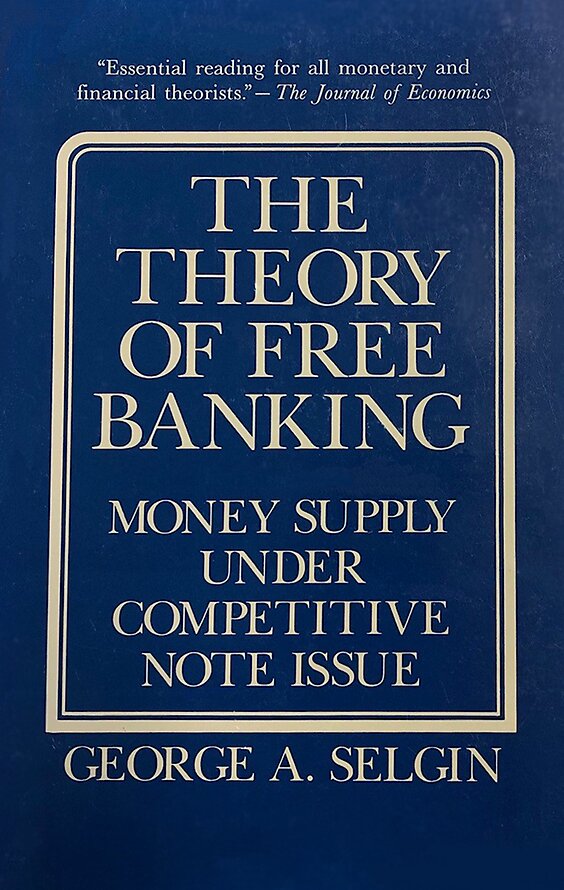
George A. Selgin's The Theory of Free Banking was published in 1988 by Rowman & Littlefield with the Cato Institute and revised from his New York University dissertation. It asks what would govern the quantity of money if competing commercial banks could issue their own redeemable notes. His answer is that rival issuers, settling claims on one another in a scarce base money, would tend to expand their liabilities when the public wants to hold more of them and contract when it wants to hold less. Lawrence H. White wrote the foreword. The book is worth reading because it builds that case as a chain of mechanisms with stated assumptions, so a reader can test each link, including the links where Selgin admits defects.
The book moves from conjectural history through theory to policy. Its second chapter imagines banking developing in a country called Ruritania, from commodity coin through note exchange and clearinghouses to a mature system in which inside money circulates and commodity money stays in bank reserves. Selgin offers this as a reconstruction. The Scottish and American episodes he cites were regulated to varying degrees, and the two kinds of evidence should be kept apart.
Selgin defines the demand for money as a demand to hold balances of bank liabilities, which is separate from a demand to borrow. When people hold notes and deposits longer, fewer liabilities return to their issuers through the clearings, so banks find they have reserves to spare against their existing liabilities. They lend, and inside money grows toward the larger demand. Because he regards holding inside money as voluntary saving routed through banks, he argues that this expansion forces saving on no one, a contested position. His monetary equilibrium requires that the public's desired holdings of inside money equal the quantity supplied at existing prices, and it lets prices fall when productivity rises.
Adverse clearings discipline a single bank. If it lends beyond what the public wants to hold of its notes, the surplus notes reach rival banks, which return them for redemption and drain its settlement reserves. The mechanism needs a definite demand to hold particular brands of note, which requires a significant share of holders to tell issuers apart, and it needs redemption that rivals can enforce. A shopkeeper who accepts a note at par has not thereby chosen to keep it, and the argument runs through that second preference.
The standard reply is that all banks could expand together, so their net clearings balance. Selgin answers with precautionary reserves. Net clearings may average zero while gross clearings still fluctuate, and each bank holds reserves against an unlucky sequence of settlements. Following Edgeworth, he argues that when payments become more frequent, the reserve needed to keep default risk constant rises by at least the square root of the factor by which gross clearings grow. With a fixed base, an expansion by all banks together raises those needs while the reserve stock stays put. Equal net positions still leave gross settlement risk to restrain the group.
The same chapter admits a defect in the mechanism. If customers make fewer and larger payments, gross clearings can stay level while the precautionary demand for reserves rises, so the money supply contracts at the moment people want to hold more money. Selgin judges the case minor because payment size and frequency usually move together. That is an estimate of magnitudes. His frequency diagrams illustrate a model whose results depend on bankers judging tolerable default risk well.
The stability chapter separates two kinds of run. In a currency run, depositors want notes in place of deposits, for instance because merchants grow wary of checks. A bank free to issue notes meets that demand by swapping one liability for another, without touching its reserves. A redemption run starts when holders distrust the bank itself, and then its notes are as suspect as its deposits, so issuing more of its own promises repairs nothing. Selgin traces many past crises to currency runs under restrictions on note issue, which turned a change in the form of money into a drain of base money. Against isolated redemption runs he points to collateralized loans from rival banks and to the option clause once used by Scottish banks to defer payment for up to six months with interest. He concedes that a panic spreading across many banks could leave too few healthy lenders.
In our assessment, maturity transformation exposes a free bank to strain when withdrawals stop offsetting one another. In Selgin's account, banks turn short, uncertain claims into longer loans by relying on offsetting withdrawals among many independent holders. The theory of panics he discusses rests on holders lacking bank-specific information about losses. Shared bad news makes redemptions move together and weakens that independence. Our reading is that the book makes a strong case for free note issue as a cure for currency shortages, and leaves correlated distrust to bank capital and contractual remedies whose adequacy needs evidence. Selgin's conclusion makes no guarantee either. It expects bad loans, failed banks, commodity-money shocks and temporary mismatches between money supplied and money demanded.
The final chapter departs from the gold programs some readers expect. Selgin keeps the fiat dollar as the unit of account and proposes that banks issue notes redeemable in Federal Reserve dollars, backed by the assets that already support checkable deposits. Once the public uses those notes as currency, the base would be frozen and used for interbank settlement. His transition calls for statutory changes, including sterilizing existing required reserves, and for making base currency deliberately inconvenient. He leaves room for another asset to replace the paper dollar as the settlement medium, and he admits the dollar could then become worthless. His view that a well-framed transition would cost little is a judgment, and his legal recommendations address the American system of 1988.
The book suits readers at ease with reserve multipliers and the loanable-funds debate, and it relies on diagrams and hypothetical numerical tables. Readers can open the 1988 text through the Online Library of Liberty PDF of The Theory of Free Banking. It helps them work out who must redeem, in what asset and on what terms, and who bears the loss when redemption fails. Readers can then set Selgin's answers for an overissuing bank and for a run of distrust against the answers a central bank gives.