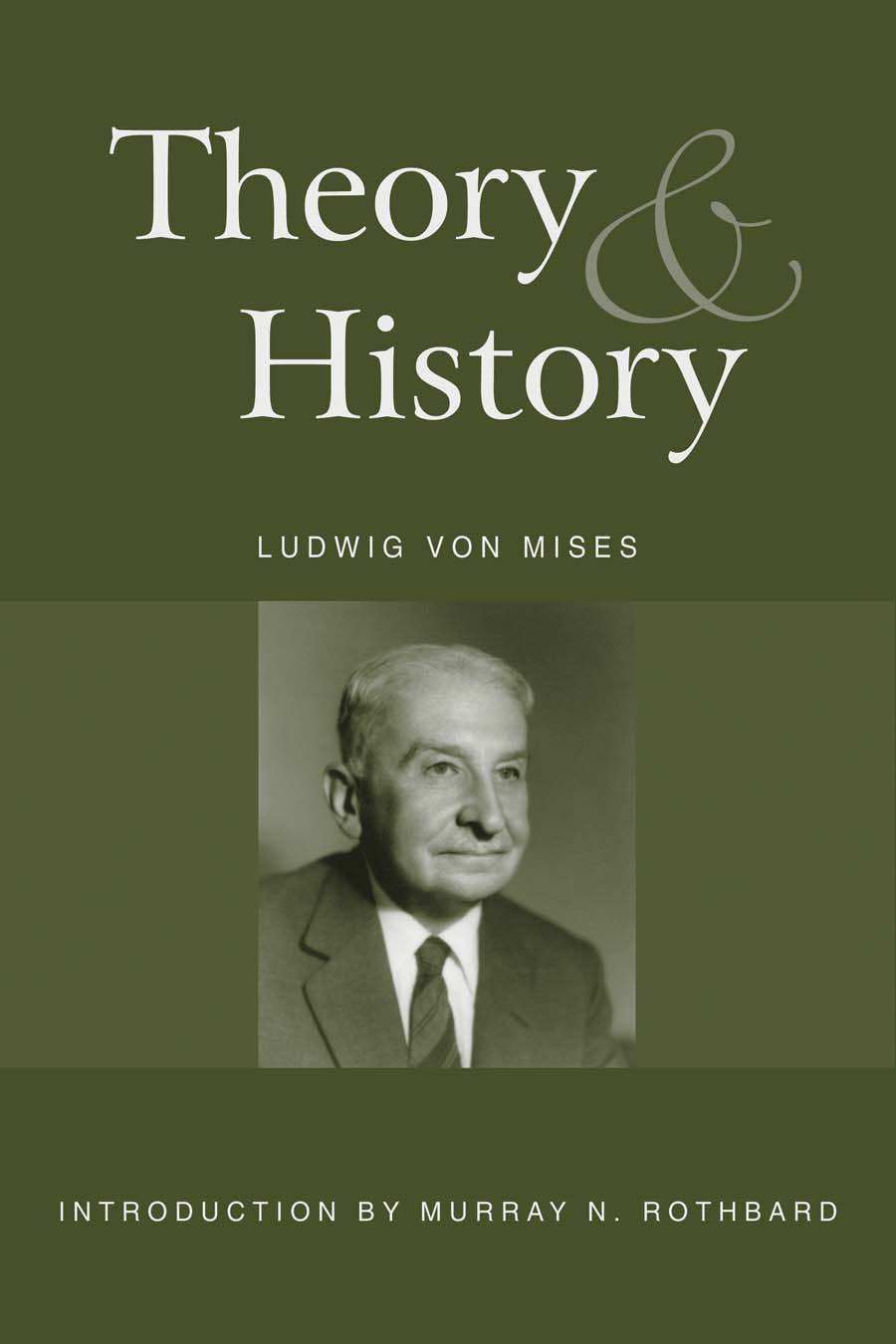
What can an economist know about a price before opening any archive, and what has to wait for the records? Ludwig von Mises built Theory and History, first published by Yale in 1957, around that division. Theory supplies the logic of choosing means for ends, and it holds wherever people act. History supplies the particulars: the ends and means of specific people, and the weight each cause carried. Mises argues that blurring the two damages both, and he follows the problem through debates over determinism, value, psychology, race, progress and planning. The Mises Institute reprint adds a 1985 preface by Murray N. Rothbard, whose verdicts on Popper and econometrics are his own.
The introduction begins with a gap in knowledge. Nobody knows how physical and physiological events produce a given thought or valuation, so Mises proposes methodological dualism: study nature and human action with separate tools for as long as that gap lasts. He presents it as a device suited to present knowledge and declines to treat it as proof of a soul apart from the body. Chapter 5 accepts determinism and causality as the ground of inquiry. Ideas count as ultimate data because their causes cannot yet be traced, and he says they grow from what already existed. He applies the same caution to forecasting. Conduct can be anticipated to some degree by methods unlike those of physics, and chapter 14 concedes that natural-science predictions also fall short of absolute certainty.
Praxeology is his name for the formal theory of purposeful action as such: whoever acts chooses among incompatible ends and applies scarce means. Its theorems are silent on what anyone wants. Why one person picks water and another wine belongs to a different inquiry. Abstract theory can state the direction of a consequence, but it leaves open a given actor's motive and the size and timing of an effect. Those questions send the reader back to evidence.
Chapter 1 offers a distinction worth borrowing. A false statement of fact can be refuted. An ultimate end cannot, and arguing against one turns it into a means to something further. A report about a preference is a different kind of statement: it is true or false, and people sometimes have reasons to lie about their valuations. Most people also absorb their values from the society that raised them. Subjective value therefore leaves descriptive claims exposed to evidence. The historian must use tested sources to establish which values moved the people studied. Mises's example is tracing India's caste system to the valuations of the generations who built and preserved it and then following its effects. Praise and condemnation belong to the historian as a private person.
Who makes history? Every idea arises in some individual mind, yet invention is cumulative. From Maxwell through Hertz to Marconi, each built on predecessors, and that debt leaves their contributions intact. Mises dismisses the schoolbook tale of great men making and ruining nations. He credits the routine of ordinary people, repeated as habit and custom, with shaping events. Institutions and social influences stay in his account, but he finds no group mind that thinks apart from its members. History is the combined result of countless intentional acts, so nobody plans its total course. Each person still plans his own conduct and often misses his aim.
Thymology is his term for informed understanding of particular motives, built from experience of other people's past conduct and from introspection. Historians use it to explain the past, and every actor uses it to anticipate others, but it remains fallible. Ideal types extend it. To speak of an Italian vote in American elections assumes that some voters act partly from shared origins. How many do so, and how strongly, stays open, and that uncertainty is what defines the type. Mises then separates two claims that political talk often merges. To say an organization directed and financed a movement is a factual assertion that records and witnesses can confirm or refute. To say the movement drew on an ideology associated with that organization is an interpretation of ideas and their influence, and support for it establishes nothing about orders or money. History shares with fiction a reliance on understanding minds, but history answers to facts, while a novel needs only psychological plausibility.
These threads meet in the final chapter. Because future ideas cannot be deduced in advance, Mises denies any law that guarantees progress. He uses the imaginary evenly rotating economy, a static state, as an analytical contrast. In his argument, competition and entrepreneurial profit can exist only where conditions shift, so the model contains no profit by assumption and makes a poor ideal for real economies. Readers should treat that as a step in Mises's own model and test it independently. The freedom argument rests on the same premise. An authority that decided which books get printed, who experiments in laboratories and which techniques change would force every innovator to seek approval from those whose doctrines he means to overturn. The claim concerns authority over all such allocation, so a single grant or partial intervention needs separate analysis. He supports democracy because it replaces rulers peacefully. He grants that majorities can err as dictators can, and he allows that totalitarian regimentation may still arrive.
The book has serious weaknesses. In the chapter on interpretations of history, Mises uses dated racial categories and credits subdivisions of the Caucasian race with eclipsing other civilizations. His last chapter adds sweeping claims about Oriental stagnation and collectivist docility. These assertions are period generalizations, and the civilizational history needs independent scholarship. Those same pages reject any racial difference in the logical structure of the mind and condemn Western racial insolence. Mises also refuses to infer future inferiority from past achievement. On race specifically, he notes that biology had so far found no anatomical traits in non-Caucasian groups that necessarily curb their mental faculties, the kind of evidence he says such a forecast would require. A fair account has to include both strands. Mid-century judgments with little standing as current science also shape his Freudian clinical claims and his dismissal of experimental psychology, and his passages on quantum physics need the same scrutiny. His apriorist method remains contested too, so each conclusion deserves checking on its own terms.
The book suits readers who want to know what kind of claim an economic argument makes and what evidence a historical claim still owes. Historians, social scientists and students of Austrian economics will get the most from the chapters on value, thymology and historical knowledge. Expect dense abstraction, polemical asides and dated assumptions that invite disagreement. The introduction, available in the publisher's official English text, is the best test of whether the rest will reward the effort.