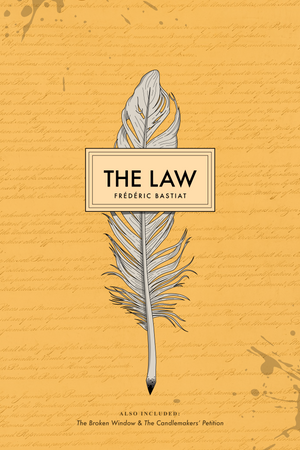
Frédéric Bastiat wrote The Law in June 1850, while serving as a deputy in a French assembly that was arguing over what the new republic owed its citizens. His pamphlet takes up a question that comes before any policy dispute: what authority can the force behind a law claim at all? Law, he argues, is the collective organization of each person's right to defend person, liberty and property. The common force therefore inherits the limits of those rights, and its reach stops where an individual's just self-defense stops. The test remains worth meeting because it separates two things that usually get run together. A measure can be properly enacted and still lack legitimate authority for the compulsion it imposes.
The argument rests on premises Bastiat states openly. He holds that life and human faculties are gifts from God and that property extends those faculties, so all of them exist before any legislature. Because a pooled force draws its warrant from the rights it combines, its powers are bounded by those its members already held. Readers who reject his theology or his account of prior ownership should weigh these as premises, since the text asserts them more than it proves them. The conclusion is also narrower than its reputation. Bastiat endorses a public force for justice and common defense, and his case is for limited government. Calling every tax theft, or wishing the state away, goes beyond what he argues.
His most useful idea is a feedback loop he calls legal plunder. In his technical sense, plunder means wealth moved from its rightful owner without consent or compensation. When law does this, it shields the taker and treats resistance as the crime. His examples begin with protective tariffs and subsidies for manufacturers and shipowners and extend to relief for the poor. Once a narrow class profits through legislation, excluded groups seek political power, some to end the practice and others to claim a share. As the franchise widens, privilege for a few can grow into claims by everyone on everyone, and Bastiat presents the poor's demand for relief as a mirror of protection already granted to the rich. He condemns the system itself and explicitly spares the motives of its beneficiaries, many of whom gain and lose without seeing why. His three-way scheme is a normative political argument, unsupported by measurement.
On charity and education he separates a goal from the means of funding it. In his reasoning, a treasury is filled by compelled payments. The question he presses is therefore who bears the compulsion, and he treats the merit of the aim separately. For Bastiat, opposing state schooling is fully compatible with valuing schooling. Advocates of any social plan remain free to promote it and to try it on themselves at their own expense and risk. What he supplies little of is evidence that voluntary provision would meet every need, and attentive readers should register that gap. He also presses an argument about symmetry. Planners describe the public as passive and prone to vice yet exempt themselves, though they come from the same humanity, and they still defend that public's right to vote. The long quotations from Rousseau, Montesquieu and others that carry this section were chosen for polemic. They serve his case well and give a one-sided picture of intellectual history and of the reformers of his day.
The final mechanism links promises to blame. Once a government undertakes to raise wages, supply credit, guarantee work and uplift the soul, it becomes answerable for every disappointment, and each failure raises the stakes of capturing power. Confined to stopping injustice, the state would be blamed for private hardship about as often as for frost. This is a plausible account of why political conflict sharpens as the state takes on more. Bastiat's forecasts of steady progress and rare revolution, however, describe outcomes that remain unverified. His claim that the United States of 1850 departed from proper law only through slavery and tariffs is idealized and incomplete, passing over the dispossession of Native Americans among other wrongs. The closing pages place their hope in providence, which rests on religious faith more than on empirical demonstration.
The text discussed here is Dean Russell's English translation, prepared for the Foundation for Economic Education with corrections suggested by Bertrand de Jouvenel. It is published at Bastiat.org. The translator added its subheads and bracketed insertions. The current FEE edition pictured above is a compilation that also contains The Broken Window and The Candlemakers' Petition. This recommendation concerns The Law alone in the Russell translation and sets aside the edition's other contents and introductory material.
The pamphlet is fierce, repetitive and crowded with quotations from political writers, yet any careful reader can follow its central test. It suits someone willing to pick a specific statute and ask whether the compulsion it authorizes could be justified by any individual right its authors claim to represent. That reader should then examine Bastiat's own premises about rights and justice with the same care.