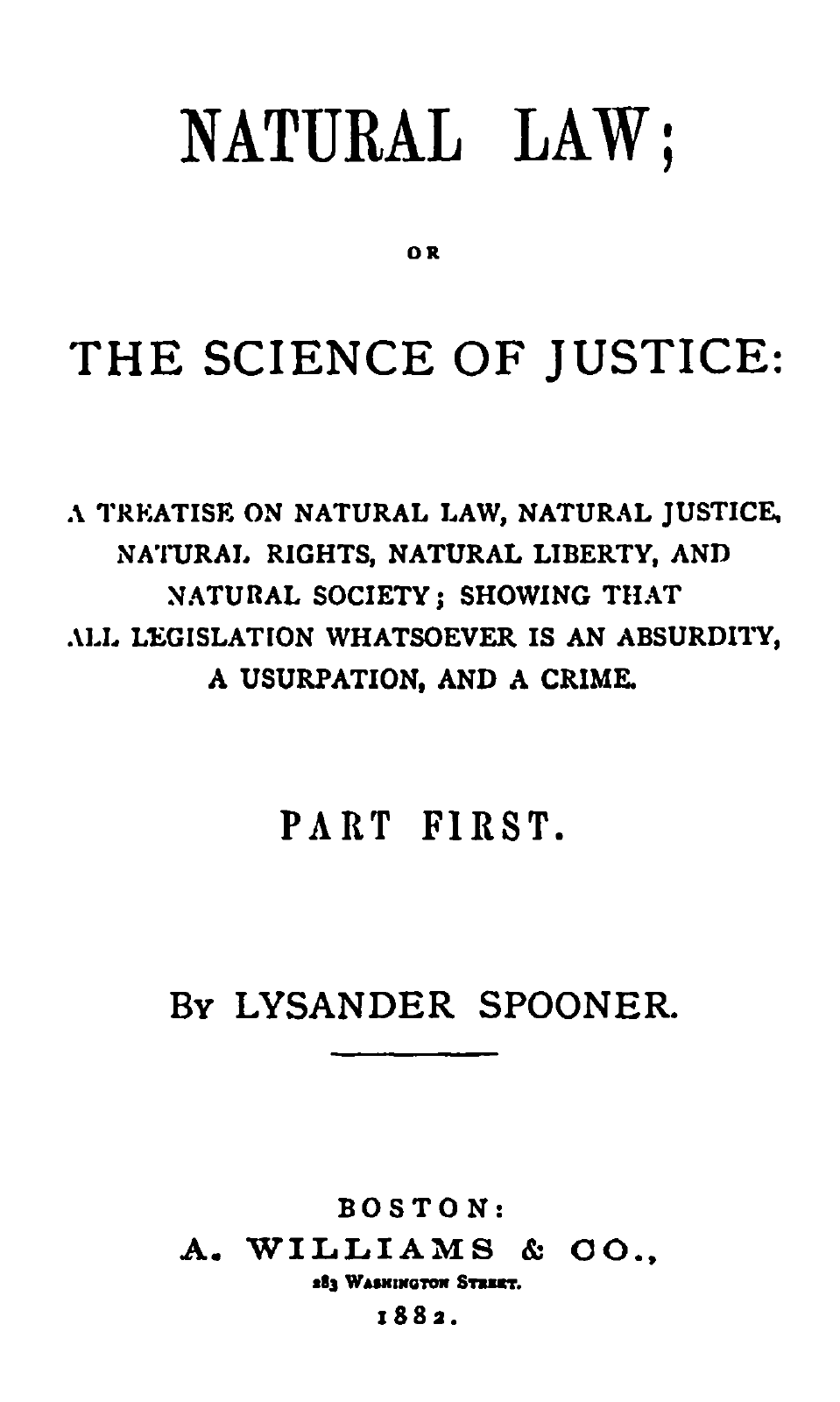
Lysander Spooner published Natural Law; or The Science of Justice in Boston in 1882 as a short pamphlet marked Part First. He calls justice the science of mine and thine and argues that ordinary people can discover and apply it independently of any legislature. The pamphlet suits readers who want to examine the moral basis of private law and who are ready to test a confident argument point by point. The download below contains the complete Part First in a modern transcription of the 1882 public-domain English text, and the same text is available as the Lysander Spooner archive PDF, listed among his collected works.
His starting point reduces legal duty to living honestly: paying debts, returning borrowed or stolen property, repairing injuries, and abstaining from theft, violence and other aggression. Feeding the hungry and caring for the sick remain real moral duties, yet each person judges whether and how far to perform them. So when someone asserts an enforceable duty, the reader can ask whether it is a determinate duty of justice owed to a particular person, such as a debt to pay, a borrowed thing to return or an injury to repair, or a duty of generosity whose extent rests with the giver. A creditor's claim rests on the debt itself, and injury is one ground of enforceable duty among several. Spooner endorses force in the service of justice. Injured people, and anyone who helps them, may compel justice singly or in concert.
Because haste and passion breed error, he recommends voluntary associations for mutual protection and judicial procedures built for deliberation and thorough investigation. Each person may join or fund one, or decline and rely on himself and on whatever help others freely offer. That separates the need for careful judgment from a provider's claim to compel support. Membership choice coexists with accountability, since a nonmember who wrongs someone remains answerable. Much depends on one assumption: Spooner holds that justice is usually plain, learned by children before arithmetic, and judged alike by most people once the facts are agreed. Readers who expect frequent hard cases will find his voluntary courts thinly specified here.
That confidence in a knowable justice drives a dilemma. If justice is natural, Spooner reasons, it is immutable, and legislation has as little power to alter it as to amend mathematics. If natural justice is absent, rights and crimes disappear, and governments claiming authority to punish crime lose their stated reason to exist. One standard therefore binds rulers and ruled, and rights precede every enactment. The practical habit is to test a law against justice before treating its passage as an obligation. Immutability and the exhaustive choice are Spooner's philosophical premises. The dilemma asserts that these two options exhaust the field and leaves alternative ethical accounts undeveloped.
The same premise raises a puzzle: if justice is so knowable, why does legislation prevail? Spooner answers with a history of dispossession. Armed bands seized land and cultivators, then organized as governments to hold their captives. Later the landholders found it more profitable to free the laborers in name while keeping the land and every means of independent subsistence, so the freed had to sell their work to former owners on the owners' terms. When the dispossessed begged or stole to survive, the landholders passed laws fixing wages and punishing theft and trespass severely, preserving their monopoly of land.
The mechanism runs from violent seizure to compelled dependence, held in place by law. It challenges any blanket defense of existing titles and directs the reader to ask how holdings were acquired and which legal restrictions block an independent livelihood.
The pamphlet closes by defining legislation as one party's claim to irresponsible dominion over others. Its genealogy is asserted for all great governments and left unproved country by country, and its argument concerns land monopoly enforced by law, which falls short of showing that all wage work is slavery. Readers seeking a sharp test for enforceable duties will find one here; the historical chapter serves best as a thesis to check against particular records.
The cover shows the original 1882 title page. The PDF of Lysander Spooner's complete Part First is offered unaltered from the Towards Liberty relay, with independent mirrors at nostr.download and 24242.io.