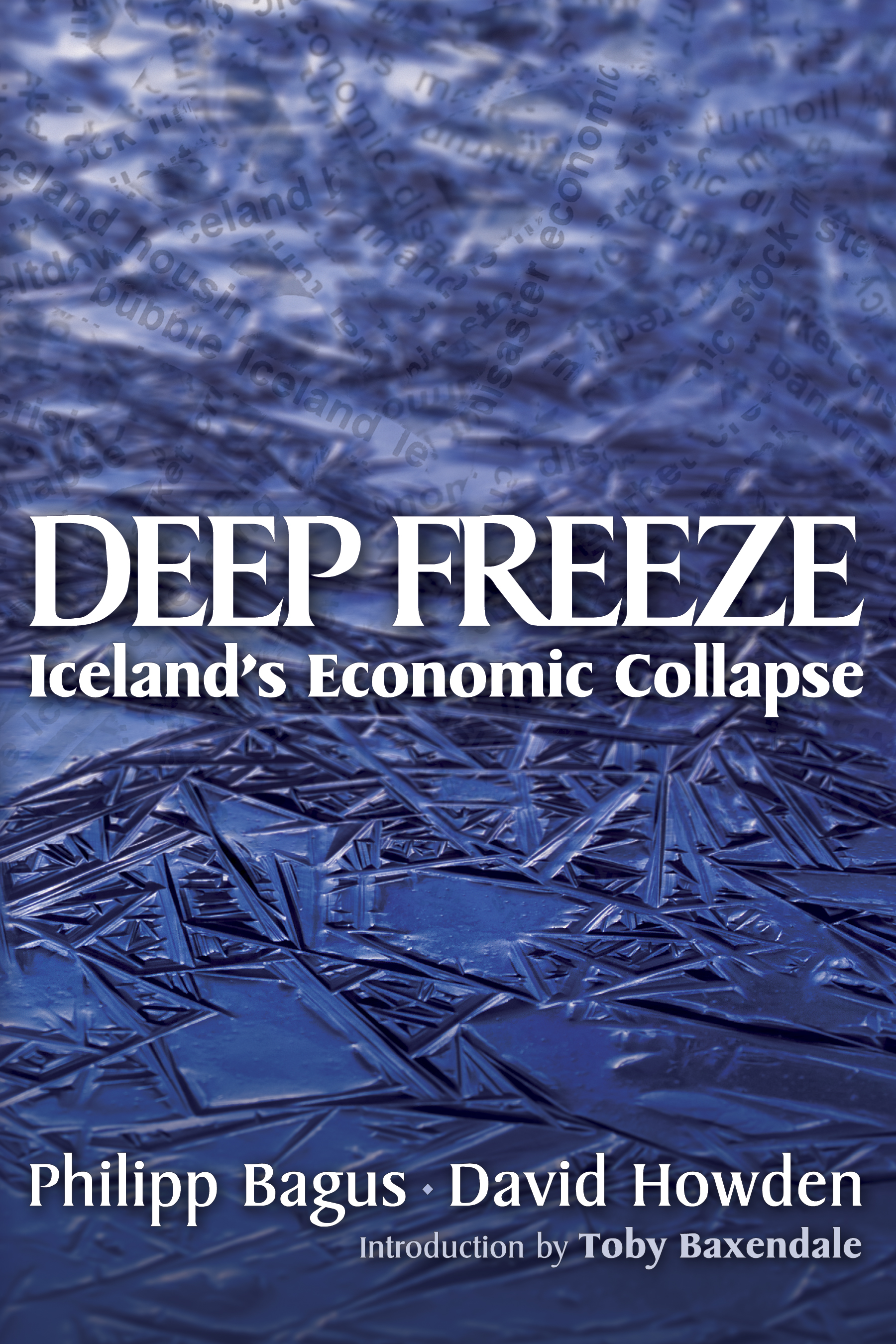
Deep Freeze, by Philipp Bagus and David Howden (Mises Institute, 2011), reads Iceland's banking boom of the 2000s and the October 2008 failure of Kaupthing, Glitnir and Landsbanki as an Austrian business cycle with two accelerants. Cheap credit at home and abroad, the authors argue, let the banks fund long krónur assets with short foreign-currency borrowing, while state housing finance and expected rescues pushed lending beyond what private caution would have allowed. When foreign lenders stopped renewing that funding, the banks needed euros and dollars that no Icelandic institution could print. Joining rollover risk and currency risk in one balance-sheet story is the book's main contribution. Its institutional verdicts reach further than its evidence, and later official records correct several of its descriptions of the aftermath.
A bank that borrows for months and lends for decades faces maturity mismatch: it must find new lenders every time its borrowing falls due. Low rates make the arrangement cheap without telling the bank whether anyone will lend again. Bagus and Howden argue that credit expansion makes renewal look reliable, so banks stack more long assets on short funding until a rise in perceived risk sends lenders away together. They call the practice risky and decline to call it fraud, keeping it apart from their normative case against fractional reserves on demand deposits. Maturity transformation and the creation of new deposit money remain separate operations, even when one bank does both.
Currency mismatch makes that fragility acute, and the book's clearest passage shows how a hedge can fail when it is needed. In the authors' illustration, a bank borrows euros for a short term and lends the proceeds as a long krónur mortgage. A swap converts each year's mortgage payment into euros at a fixed rate, covering the annual interest. Once the euro lender declines to renew, the bank owes the whole principal at once, and a swap matched to yearly payments supplies a small fraction of it. Many real swaps do exchange principal; the example isolates the gap between a hedge's payment schedule and a debt's maturity. A related constraint bound the Central Bank of Iceland, which could create krónur at will while foreign creditors wanted currencies it could supply from reserves and borrowing alone. Bagus and Howden credit the IMF with warning about short foreign borrowing as early as 2004.
Public backing, on the authors' account, explains the banks' appetite for this exposure. They read mortgage competition between the state-backed Housing Financing Fund and the commercial banks as a race that pulled bank funding into long housing loans. To that they add the CBI's 2001 lender-of-last-resort commitment and an expectation of international support, reading both as signals that losses would fall on more than shareholders. Credit, they argue, went into construction, consumption and foreign acquisitions, moving labor and capital toward projects that needed cheap funding to continue. Their argument interprets incentives without estimating how much lending the guarantees caused, and nowhere does it show that the 2001 commitment amounted to an unlimited legal promise to cover insolvent banks' debts. Private shareholders, the authors concede, faced a loss constraint the public fund lacked.
Events from 2006 to 2008 fit this reading. Bagus and Howden treat the 2006 Geyser crisis, when foreign investors questioned Icelandic banks and their funding costs rose, as a warning the system survived. Wholesale markets tightened through 2007. By autumn 2008 the króna was falling and global funding was scarce, and domestic assets that had lost value in euros could no longer cover short foreign claims that lenders refused to roll over.
Recovery, on the authors' logic, requires liquidating projects that cannot pay and retraining workers for the fisheries and energy-intensive exports that a cheaper króna favored. Their main point concerns speed: financial prices adjusted quickly, while productive capacity able to profit from the new exchange rate grows slowly, so devaluation helps a country to the extent its real economy can respond. They call for lifting the capital controls imposed in 2008 and fault the bank rescue for holding resources in finance. Discussion of benefits, quotas and European Union membership in these chapters reflects conditions in 2010 and 2011 and predates current rules.
In the conclusion, Bagus and Howden propose a gold standard with 100 percent reserves on demand deposits, under which, they argue, credit expansion could not occur. With króna and euro both defined in gold, Iceland's currency mismatch would have had no room to form. That counterfactual holds together as institutional design if two assumptions are met: gold redemption stays in force, and liability contracts follow the chosen reserve rules. Even then it proves less than the chapter claims. Gold loans still carry credit, duration, counterparty and default risk, and a bank could still borrow gold for a short term and lend it for a long one, so the claim that no housing or stock boom could have arisen remains a conviction the book leaves unproven. Its bibliography also lists a 2010 paper by Bagus whose title asks whether a 100 percent reserve system prevents the business cycle.
Deep Freeze calls Iceland a bankrupt state and says the three banks were nationalized and kept operating. In 2013 remarks published by the Bank for International Settlements, the governor of the Central Bank of Iceland reported that the sovereign paid its debts in full and on time. The old banks, in his account, were private estates in winding-up proceedings outside government control, while their domestic operations had moved into new banks, with the government holding a majority in one of them. Payments and domestic deposits kept functioning throughout. Bank failure and sovereign default are different events, and the book's wording blurs them.
On deposit insurance, the authors treat a minimum guarantee for depositors at Landsbanki's foreign branches as a state obligation. In January 2013 the EFTA Court dismissed the EFTA Surveillance Authority's Icesave case. According to the court's nonbinding press summary, the deposit-guarantee directive then in force placed no obligation on the state to ensure that payment in a systemic crisis of that scale. The guarantee fund's own liability and other parts of the safety net were separate questions.
Read Deep Freeze if you work comfortably with bank balance sheets and monetary economics and want a worked case of how cheaply funded, apparently hedged banks can fail for lack of foreign cash at maturity. Its chapters on maturity and currency mismatch hold the most durable analysis, and the later chapters apply it to housing finance and monetary reform. Pair those later chapters with the 2013 governor's account and the court summary, and check figures in the 2011 Mises Institute PDF against official series before citing them.