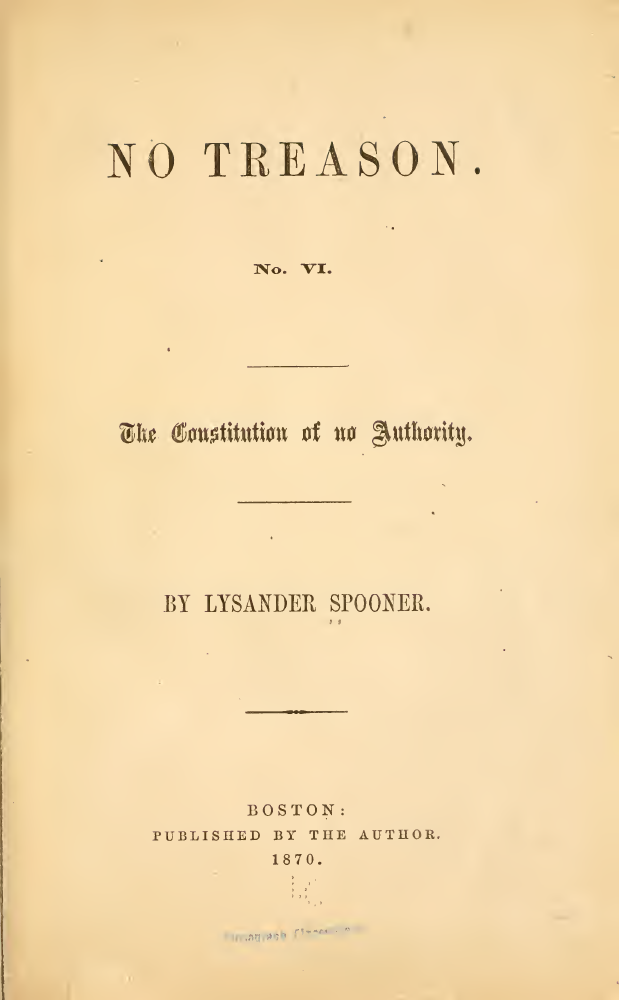
Lysander Spooner published No Treason from Boston in 1870, five years after the Civil War, as a pamphlet he designated number VI and subtitled The Constitution of No Authority. It asks why any living American has a duty to obey the Constitution, and it answers by holding the national government to the standards of individual contract and private agency. Spooner refuses to infer consent from ancestral ratification, voting or taxpaying, and he presses the reader to name the particular act that would count as personal authorization. Project Gutenberg ebook 36145 offers the English transcription used for this reading, and the cover pictured here is the title page of the Library of Congress copy of the 1870 pamphlet, scanned by the Internet Archive.
The argument begins with the founding. Spooner reads the Preamble's reference to posterity as an expression of hoped-for benefit, much as a man who plants a tree hopes his grandchildren will enjoy the fruit while lacking any power to make them eat it. Section I grants, at most, that the original parties might have contracted among themselves. Sections IV and V take back even that concession, arguing that a binding written contract requires each party's personal assent and signature and that the founding generation itself failed that test. A footnote sharpens the point: the drafters, he writes, "never signed it in any way to bind themselves by it, as a contract." These rules about written contracts are Spooner's own theory, and readers should weigh them that way.
Voting and taxation fill Sections II and III. A person living under a government that already enforces its laws and collects revenue may vote to reduce the harm it can do him, as a conscript fires back in a battle others chose for him. On Spooner's account that voter is choosing among risks others imposed, which leaves the imposition itself unauthorized. Taxpaying under threat of seizure raises the same problem, which his highwayman comparison dramatizes. Participation can coexist with dissent, so it falls short of establishing free endorsement. The result has its own limit: a failed inference to consent leaves each voter's real attitude undetermined, and ballots by themselves leave the endorsers and the defensive voters unsorted.
From the citizen, Spooner turns to the officeholder. Agency as he describes it requires an identifiable principal, limits on the agent and a principal who answers for harm done within those limits. Members of Congress chosen by secret ballot, by anonymous electors who escape personal liability for what their representatives do, fail those tests on his account, and he concludes that they hold power as usurpers. This charge, that public representation fails the conditions of private agency, sits at the center of the pamphlet. His handling of the Speech or Debate Clause is weaker. Immunity for legislative acts marks out a protected sphere, and reaching wholly unaccountable or unlimited authority requires a further inference about other checks on legislators, a step he asserts more than argues. The question he forces survives: who authorized whom to do exactly what, and who answers when harm follows?
The debt argument in Sections XVII through XIX and the Appendix belongs to the core of the work. Credit lets a government spend now against future taxes, some paid by people outside the loan agreement. Spooner argues that even debts contracted for innocent purposes, in open dealing, could bind only the parties and their own property, which carries his posterity argument forward with real force. Around it he builds a harsher polemic, attributing self-interested motives to the war's lenders, reducing Union war aims to commercial domination and claiming that voluntary protection could have ended slavery peaceably. These are his historical assertions and an unproved counterfactual. Section XIX condemns chattel slavery and calls Northern prewar complicity with slaveholders criminal. His wider use of the word slavery for political obligation serves his argument, and readers can weigh it apart from his judgment of the real institution. The Appendix presses on efficacy as well as interpretation: whatever the Constitution purports to authorize, it either authorized the government Americans had or proved unable to prevent it. The closing maxim compresses that dilemma.
Spooner's premise carries much of this weight. He assumes that political obligation must pass the tests of private contract and private agency, and he states that standard more than he derives it. An opponent may ground public authority in constitutional procedure, collective political association or the protection of rights, and must then defend that standard on its own terms. Spooner's tests apply to such accounts to the extent they rest on consent. The pamphlet forces that choice into the open and offers a sustained critique with only a sketch of voluntary protection.
Spooner writes fierce, repetitive nineteenth-century polemic that demands patience more than legal training, and some later pages turn to violent language about financiers. We recommend it to readers prepared to work closely through the first eleven sections and then the debt argument. They will come away able to separate compliance, benefit, representative selection and voluntary authorization, and to ask of any claim of consent which act supplied it and what personal obligation it can bear. A complete scan of the Library of Congress copy, with its original 1870 title page, is available as a PDF download of the 1870 scan and from a mirror copy of the same scan.