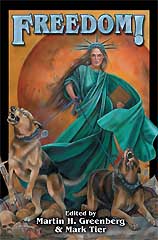
Vernor Vinge's story first appeared in 1985 in Far Frontiers volume 3. It appears today in Baen's complete publisher text, reprinted with the author's permission in Freedom!, a 2006 anthology edited by Martin H. Greenberg and Mark Tier that combined two earlier collections. The story imagines a stretch of the American interior where protection and law come from private insurers and competing legal services, then asks what happens when a neighboring republic reads that arrangement as an invitation.
An army from the New Mexican Republic arrives assuming that a region lacking government must also lack law and defense. Vinge shows that assumption failing in ways that complicate partisan hopes too. Insurers and legal providers hold real capabilities, as do local people, yet their goals conflict and coordination gets improvised under attack. Al runs Al's Protection Racket, a local insurance-oriented police service that buys wholesale violence coverage for its customers from a private protection company that kept the name Michigan State Police, and he expects MSP to send soldiers. First to arrive is Wil Brierson, an investigator with thin forces behind him. Al likens MSP's promise to a bank that cannot pay all its depositors on the same day, and that image is the story's sharpest piece of economics: a credible contract and a reserve of troops are different assets, and correlated claims expose the gap. Al's own customers rest on that wholesale contract, so any shortfall travels down the chain. Reputation drives MSP to perform, and Brierson takes serious risks to honor its word. Even so, the closing pages report major claims paid quickly while smaller damage claims drag on.
The region also strains any picture of uniform consent. Different legal providers enforce different rules. Frontier landowners fronting for the Republic have signed with one service, Midwest, and then confined workers who hold individual protection contracts of their own. Freeing those workers is a legitimate duty, and it is also the pretext the invasion was designed to provoke. Vinge shows how the seams between voluntary arrangements can be engineered into a casus belli, and how a voluntary label leaves open the claims of people living inside someone else's jurisdiction.
Alternating viewpoints give the invader a sincere voice. Strong reads MSP as a gang and his own army as liberators of poor, frightened people. That reading mistakes where the region's defenses lie and sits comfortably beside his own state's coercion. A local war enthusiast named Kiki runs a distributed sensor network that gives Brierson awareness he badly needs. She and her associates also steer the invaders onto the Schwartz farm without Schwartz's consent. Brierson calls the act legal; Al calls it immoral. Vinge keeps the two verdicts apart, since a legal service's permission does not settle whether an act is right. Schwartz, an armed autonomist who left the legal services behind, keeps a nuclear weapon that the legal services forbid and that his neighbors would reject. Once it comes into play, invading soldiers die in large numbers; Al's closing estimate is two thousand.
A gunrunner named Richardson undercuts any picture of automatic market harmony. He armed the invaders and is contractually committed on future production, so his reliability as a seller works against the security of MSP's clients. When he suggests the occupation might fade away on its own, Brierson rejects any faith in a force of history: someone has to make aggression costly.
Withdrawal, when it comes, owes more to civilian infrastructure and a direct threat to the Republic's leadership than to a conventional MSP victory. A weather company rebuffs an urgent request and then presses theft charges; its business adapts afterward. Markets keep their bureaucracies. Those deaths weigh on the ending, and Brierson finishes the story severely injured and still recovering. His last worry concerns the armed club now forming around Kiki and Schwartz.
Vinge writes briskly. Cutting between Brierson and Strong, the story carries its claims about contracts and coercion through decisions the two men make during the fighting. Compression has costs. A thin world and a fortuitous rescue, aided by advanced technology, carry the resolution, and a fictional outcome cannot prove a general economic proposition or supply a blueprint for the future. The story suits readers interested in private law and decentralized defense as partisan genre fiction, whose argument runs through violent combat and offers no neutral institutional survey.