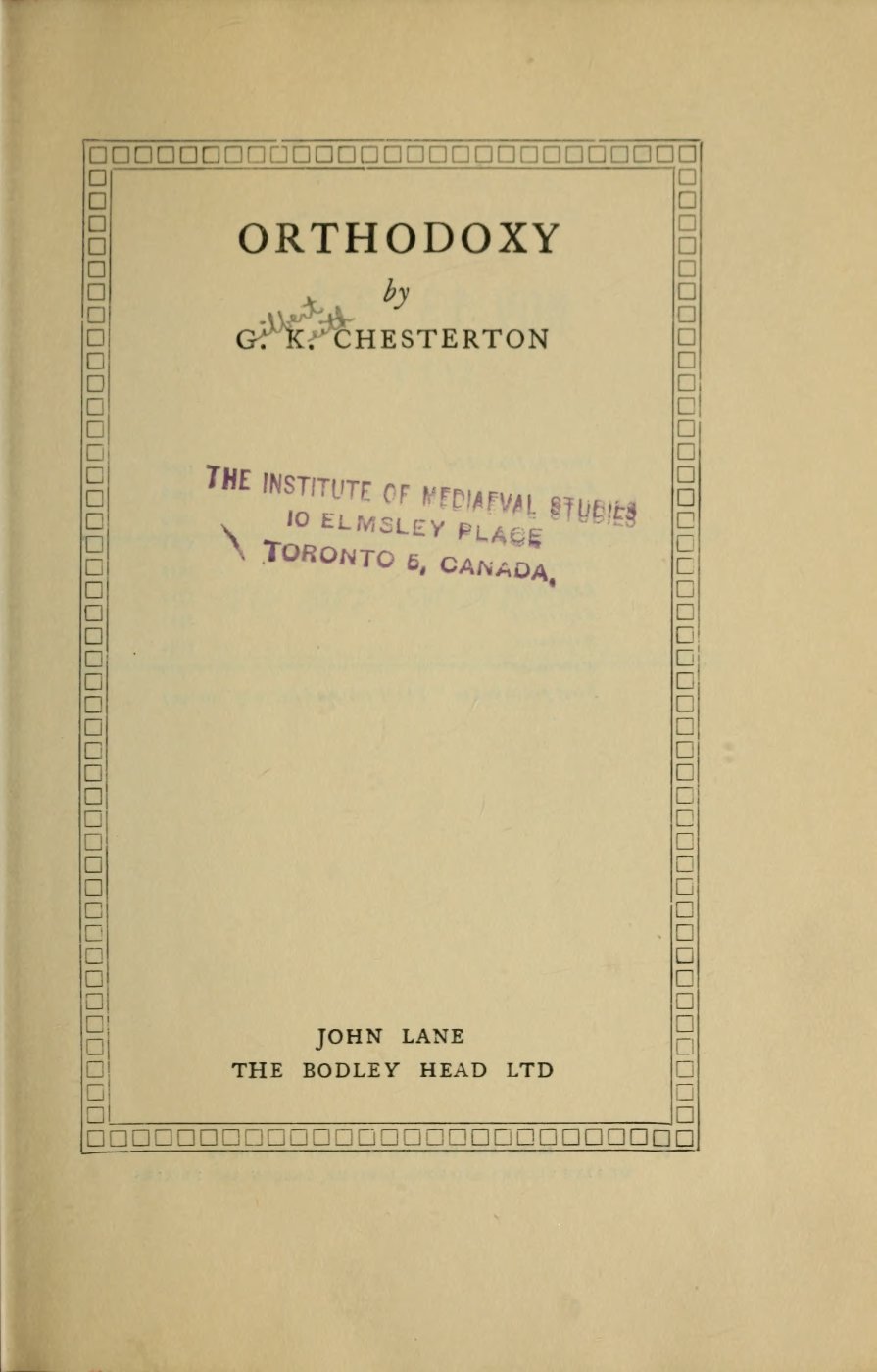
G. K. Chesterton published Orthodoxy in 1908 to answer readers of Heretics who asked what he himself believed, and his answer is an explicit Christian apologetic. He traces how a search for a philosophy that could hold adventure and belonging together ended at the Apostles' Creed. He presents the case as autobiography told through mental pictures, so its force is cumulative and depends on how well the analogies fit one another. Its arguments about explanation and reform carry further than its claim that Christianity alone could ground them.
The case opens with the maniac, used as a figure of logic. A man convinced that everyone conspires against him treats each denial as further evidence, since conspirators would deny it too. His theory therefore covers the facts as completely as any rival and cannot be refuted from inside. Chesterton treats that completeness as the symptom: an explanation that turns every objection into confirmation has shrunk to fit the mind holding it. He applies the diagnosis to materialism and solipsism, both tidy systems that leave out most of ordinary life. He then applies it to a scepticism so thorough that it discredits the reasoning it relies on.
Its positive counterpart, the fairy-tale chapter, starts from democratic trust in ordinary judgment and extends that trust to the inherited judgment of tradition. Arithmetic cannot be imagined otherwise, while a tree can be imagined bearing different fruit, so a natural law records a regularity without explaining why it holds. The witch who promises that a horn blast will topple the ogre's castle keeps her wonder after seeing it happen many times, and Chesterton accuses scientific writers of mistaking constant sequence for necessary connection. Repetition could express sustained delight, as a child demands the same game again, so a daily sunrise need not prove impersonal machinery. Goods that could have been otherwise become gifts, and that makes their conditions intelligible as the terms of a gift.
Gratitude creates a problem for a reformer, since thanks for the world can slide into excusing it. Chesterton's answer is an imagined Pimlico. A place improves when someone loves it before it deserves love, because that prior loyalty permits unlimited criticism of its present state, whereas the optimist defends the defects and the pessimist walks away. A creator distinct from creation and a Fall within it let him affirm existence while condemning its corruption. The paradox chapter extends the pattern to charity. A sensible pagan pardoned in proportion to the offence, laughing at the slave who stole wine and cursing the one who betrayed his benefactor, and this dilutes both horror at injustice and tenderness toward persons. Christianity, as Chesterton reads it, divides the crime from the criminal. It demands more anger at theft and more kindness to thieves, and each emotion runs at full strength because it has its own object.
Politics receives the same treatment. Progress should change the world to suit a fixed vision. An age that keeps changing the vision wastes its labour like a painter who resolves to make the world blue and then prefers a new colour each morning. A white post left alone turns black, so keeping a good arrangement requires repeated correction. Original sin grounds his permanent suspicion of rulers, especially comfortable and powerful ones, since better surroundings make no one incorruptible. These are a democrat's conclusions, joined to a distrust of wealth and to a social ideal that protects the freedom to bind oneself by promises.
In the final chapter Chesterton raises the decisive objection himself: a reader could keep these insights and drop the creeds. He answers first with cumulative evidence, defending testimony to miracles against dismissal on grounds of class or presumed impossibility. His central reason follows: the Church is a living teacher whose surprising claims proved right in his experience and which he expects to correct him again, as a child trusts parents whose rules about the garden proved sound. Practical adequacy and well-fitted pictures show that an outlook can sustain wonder and reform. The doctrines themselves rest on testimony and his personal record of trust, though.
The ending returns to the traveller who discovers England and closes on an imagined Christ concealing his mirth, with joy fundamental and grief real but subordinate. A scan of the 1927 Week-End Library printing from John Lane/The Bodley Head (archive.org) is on relay.towardsliberty.com, nostr.download and 24242.io; gutenberg.org follows a later printing.