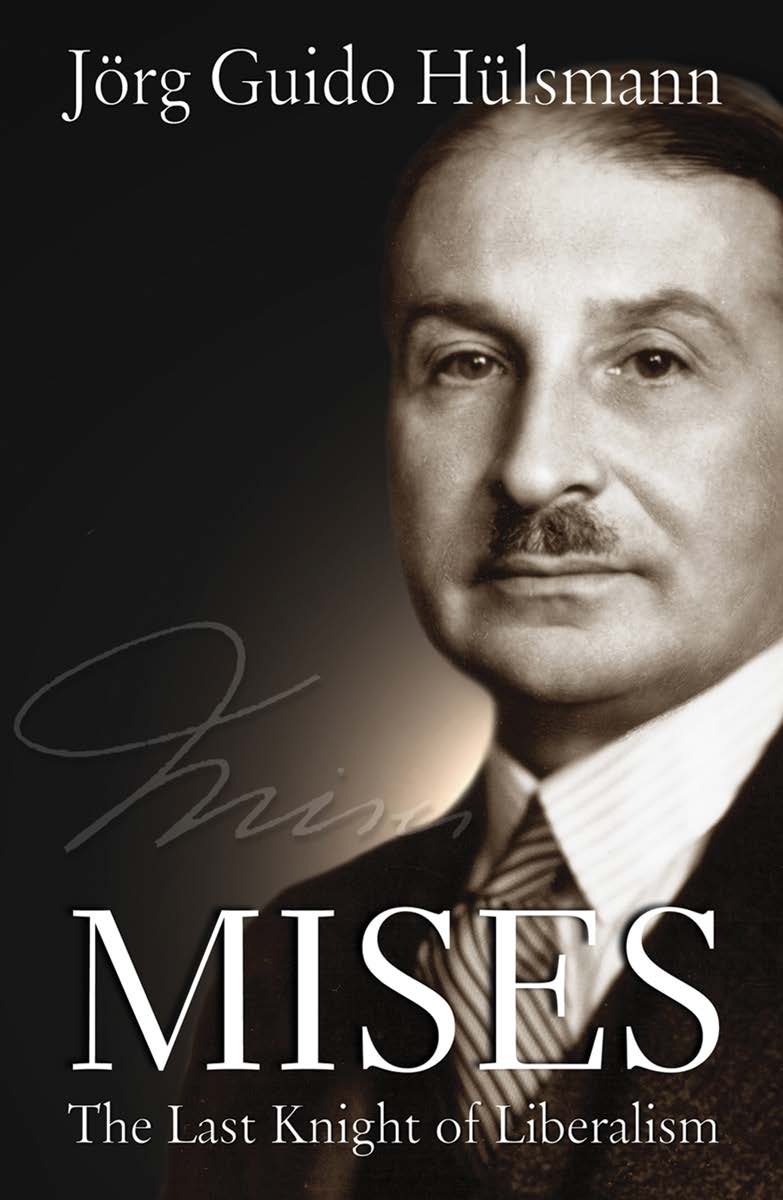
Jörg Guido Hülsmann's biography lets a reader watch Ludwig von Mises's economics take shape and change over a working life, alongside the jobs and grants that kept the work going. It follows Mises from his birth in Galicia and his Vienna education through the First World War, the Geneva years, the 1940 flight from Europe and the American decades. The book has twenty-three chapters in six parts, plus an epilogue, a bibliography and indexes of names and subjects. Long theoretical expositions make up much of its length, and in them the narrative pauses while Hülsmann works through an argument. Readers who came for the life story will find these sections slow. Readers who want to know where a doctrine came from will find them the most useful pages.
Hülsmann is open about where he stands. His admiration for Mises is explicit, although the two men never met. He built the book from Mises's personal papers in the Moscow and Grove City archives, from institutional records such as those of Geneva's Graduate Institute, and from Mises's published writings. His preface notes how little is known about Mises's emotional life, and he chooses to keep his engagement with other scholars brief. Read the book as a documented case made by an admirer.
The early chapters correct the picture of a thinker who arrived fully formed. Mises read Carl Menger's Principles in 1903, and Hülsmann describes the change that followed as gradual, shaped further in Eugen von Böhm-Bawerk's seminar. A 1904/05 study of Austrian factory legislation described harsh child labor and still looked to state intervention and continuous state control for the remedy. A 1907 article on currency regulation praised the central bank for suspending cash redemptions, because the suspension kept Vienna's interbank rates below those of Berlin and London. These German originals reach the reader through Hülsmann's quotations and citations. With them in view, the early papers read as stages in a research program, and Mises's later intransigence looks like a position he reasoned his way into.
Much of that reasoning happened after office hours. In 1909 Mises joined the Vienna Chamber of Commerce, a semi-official representative body, and he stayed for twenty-five years. His tax reports argued that the code protected agrarian interests and held back industry. He looked for compromises that would raise government revenue while sparing the Chamber's members the full burden, and a 1914 tax law granted most of the Chamber's demands. In those same years he finished his treatise on money, published in 1912. His private seminar later met every other week in his Chamber office, and the discussion carried on afterward in a restaurant and a café.
Chapter 10, "A Copernican Shift," repays a slow reading because Hülsmann rebuilds it from Nation, State, and Economy, a January 1920 talk and Mises's letters. Money prices for factors of production come only from exchange, and exchange needs at least two owners. If one collective owner holds every factor, no factor can be exchanged. Planners, however able or well-meaning, then lack the prices a business uses to compare different uses of capital in a complex, changing economy. In a letter to Emil Lederer, Mises answered Schumpeter's proposal to give citizens accounting money for consumer purchases: higher-order goods would stay outside exchange and would still have no prices. Mises had also written that business accounting depends on uncertain estimates, so his argument is about a missing tool for comparison and leaves plenty of room for capitalist error. Hülsmann names Nicolaas Pierson's 1902 critique as a predecessor. He also notes that no records of the 1919 seminar survive, which is why his classroom scenes are marked "probably" and "likely."
He goes on to argue that Mises's vocabulary lagged behind the idea. The 1912 money book described value as a feeling, and the 1924 edition replaced that with acts of valuation that cannot be measured. A 1922 sentence in Socialism about marginal utilities becoming equal also fits badly with the case against calculating in values. This reading is Hülsmann's interpretation. His further claim, that Hayek's Wieserian approach weakened the argument, is his side of a dispute that remains open.
Later chapters follow how the ideas reached new readers. From 1934 to 1940 Mises held a renewed visiting appointment at Geneva's Graduate Institute. It required three hours of teaching and left ample time for research, time Mises used to write Nationalökonomie. Hülsmann reports that the salary came largely from Rockefeller money passed through the Institute, alongside Swiss co-financing, and that William Rappard insisted the funds come with no strings. In New York, Mises's visiting seminar at NYU began in February 1945. Its salary came from private funds organized by the trustee Lawrence Fertig. The other donors are uncertain, though Hülsmann thinks the Volker Fund the most likely contributor. Mises had turned down offers from smaller schools such as the University of Rochester. The Foundation for Economic Education gave him a second channel, with pamphlets and weekend seminars for a general audience, while the NYU seminar trained a smaller circle in depth.
The archives also give the book its human detail. Wartime letters from his mother and records of parcels sent to the front show the home side of his service as an officer. In 1940 a proposed appointment at UCLA fell through. Hülsmann traces concerns over the initial salary and over passports and visas, a delayed written acceptance, a decline sent on Mises's behalf and a failed attempt to reopen the negotiation, with slow surface mail lengthening each exchange. A separate invitation from Berkeley helped him get an American visa. For the crossing of the French border, Hülsmann compares Mises's letter to Rappard of July 14, 1940 with Margit von Mises's later memoir and prefers the letter written at the time. It is a small example of how he weighs his sources.
The admiration has limits in the late chapters. Mises defended limited government against younger students who had moved toward political anarchism, Murray Rothbard and his Bastiat Circle among them. Hülsmann argues that neither of Mises's 1963 definitions of freedom answered them, and that his remark that anarchism would only work among angels missed Rothbard's reasoning. Readers can weigh this critique without taking it as settled. Hülsmann also shows that Mises kept working with the radicals and praised Rothbard's treatise. The memorial tributes near the end come from selected admirers.
The book suits readers who want the development and context of Austrian ideas and are willing to follow a frankly admiring narrator through long theoretical detours. Readers who want the mature system itself can turn to the Human Action review. The 2007 text edition can be read as the official Mises Institute PDF.