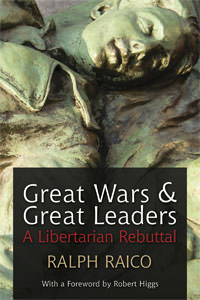
Ralph Raico's Great Wars and Great Leaders collects five historical essays and seven review essays, most of them expanded from earlier publications. They make one charge. In Raico's account, the wars of the twentieth century and the leaders honored for fighting them enlarged state authority at home, and admiring historians used categories that kept that growth out of view. A separate foreword by Robert Higgs comes first. Raico's own introduction, on pages vii to x, places the collection in the libertarian revisionist tradition of Murray Rothbard and Leonard Liggio and promises to expose the "consecrated lies and crimes" of beloved rulers. From the start, the reader knows this is an openly partisan brief built largely on secondary scholarship.
That openness is the reason to read it. Raico states his causal claims plainly enough to be checked, and his strongest pieces trace a line from a wartime decision to a domestic power and then to the historian who described both. Readers comparing anti-interventionist accounts of war and state growth get a compact, heavily footnoted version of the case. Readers looking for a neutral military history or a current survey of the scholarship should expect combative verdicts instead, along with review essays first published years earlier, some modified for this volume, that engage the books and debates of their own moment.
The opening essay on the First World War sets out the mechanism the rest of the book reuses. Drawing on Higgs's Crisis and Leviathan and David Kennedy's Over There, Raico describes American mobilization as a handover of tools to officials. Congress passed the National Defense Act before the United States entered the war, and in the statutory language Raico quotes through Higgs, it let the President place orders with private firms that took precedence over all other contracts and take possession of any plant whose owner refused a price set by the Secretary of War (PDF page 51). Ratification of the Income Tax Amendment in 1913 had prepared the way for steep tax increases once America entered the war, and when taxes still fell short, the government created new money through the recently established Federal Reserve system to finance its deficits. Kennedy, as Raico quotes him, saw entire industries organized into regular dealings with congressional committees and executive agencies. Congress also rejected the general price-fixing legislation Wilson submitted at Hoover's urging. Much of the wartime machinery came apart after the armistice, yet Raico's sources still report a lasting net gain in federal civilian employment (PDF page 53). The book's closing review, of Tooley's history of the war, returns to this ratchet: Raico summarizes Tooley's use of Higgs's framework, in which postwar cutbacks stop short of prewar levels and public opinion stays more receptive to state action. A reader can therefore ask of each emergency measure whether it ended, and which capacities and favored relationships survived it.
"Rethinking Churchill" puts the same question to a reputation. Raico quotes Mises crediting a Tory prime minister with British central planning, then backs the charge with the domestic record his sources describe. Attlee headed cabinet committees on domestic policy while Churchill ran the war. Raico records that Churchill had already accepted the Beveridge Report, and he quotes a radio speech in which Churchill counted himself and his colleagues as strong supporters of national compulsory insurance. Raico also cites Paul Addison's finding that by spring 1945 the coalition had prepared draft bills that included social insurance and a national health service, and that Churchill, as Leader of the Opposition, insisted the credit for the postwar welfare state belonged to the wartime coalition (PDF page 116). The essay separates the symbolic war leader from the committee machinery his successors inherited. Its harsher charges about wartime and postwar conduct remain disputed; they rest on Raico's sources, and this recommendation leaves them unsettled.
The Truman essay follows emergency authority from foreign war into domestic property. Raico treats two decisions as tests of a single claim to executive power: entering Korea without a congressional declaration, and seizing the steel mills in 1952. At a news conference, Truman was asked whether the same reasoning would let him seize newspapers. In Raico's quotation from the Public Papers, Truman answered that the President "has to act for whatever is for the best of the country" (PDF page 143). Raico's own account also shows where that claim met resistance. The Supreme Court rejected the seizure six to three in Youngstown Sheet & Tube Co. v. Sawyer. Earlier, in 1946, the Senate defeated Truman's request to draft striking workers after the House had passed it, with Taft joined by left-liberals such as Claude Pepper. Those episodes make the essay more useful than its invective. A reader learns to measure a celebrated president by the gap between the power he asserted and the power Congress and the courts let him keep.
The review essays apply that scrutiny to historians themselves. In reviewing Walter McDougall's account of American foreign policy, Raico argues that McDougall defines isolationism so narrowly, as a refusal of every foreign tie, that it never existed. That definition lets McDougall present Washington's unilateralism as continuous with containment's decades-long alliances. Raico replies that a unilateral policy can still be globally active. Counting nineteenth-century trade and missionary giving as evidence against nonintervention, he adds, erases what he calls the basic distinction between a civil society built on voluntary action and a state built on coercion (PDF page 196). The reader meets McDougall only through this review, and its lasting lesson is the habit of checking a historian's definitions before accepting the verdict built on them.
"Starving a People into Submission," a review of Vincent's study of the Allied blockade of Germany, shows Raico arguing with an author he admires. Following Vincent, Raico traces the hunger from bread rationing in 1915 through Wilson's closing of the loopholes the Allies had left for reprovisioning Germany. The armistice terms, as Raico reports them, provided for continuing the blockade until a final peace treaty was ratified, and his chronology of what followed is gradual: the first food shipments reached Hamburg at the end of March 1919, and only in July, after Germany formally signed the Treaty of Versailles, did trade resume (PDF pages 218 and 219). Where Vincent links childhood hunger to later Nazi brutality through psychoanalysis, Raico doubts that such an underpinning is needed. His alternative runs through attitudes he calls commonly intelligible though not justifiable, among them deep bitterness and resentment, with Theodore Abel's 1938 collection of life stories from Hitler's followers as a starting point for the analysis (PDF page 221). That remains an interpretation, and weighing it against competing explanations would take the kind of evidence Abel's material only begins to supply.
The remaining pieces cover Western intellectuals' sympathy for the Soviet experiment, Trotsky, John T. Flynn, and the prewar anti-interventionists. "Nazifying the Germans" argues against reducing German history to Nazism, but it makes sweeping claims about the motives of whole groups, and we do not adopt them. Nothing in Raico's case against Allied policy lessens Nazi crimes. Read the book to test one question: when a war ends, which of its powers end with it? For the ratchet thesis at full length, the next step is Higgs's Crisis and Leviathan, which Raico draws on repeatedly.
Edition and downloads
This recommendation covers the Ludwig von Mises Institute's 2010 edition (ISBN 978-1-61016-096-4) by Ralph Raico, with a foreword by Robert Higgs. The edition is copyright © 2010 by the Ludwig von Mises Institute and published under the Creative Commons Attribution 3.0 license. The original PDF is available from the Mises Institute. Identical, unmodified copies of that file (SHA-256 93b23ff749c659c38c6333f3e2191cddc8615d636eaad20c49b8b696292c0288) are mirrored at Towards Liberty, nostr.download and 24242.io. Under the license's attribution terms, this recommendation and its mirrors carry no implied endorsement from the publisher or the book's contributors.