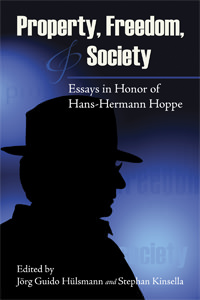
Property, Freedom, and Society is the 2009 Festschrift that Jörg Guido Hülsmann and Stephan Kinsella edited for Hans-Hermann Hoppe's sixtieth birthday. Its thirty-five contributions come from former students, colleagues and collaborators whom the editors' May 2009 introduction describes as united in admiration for Hoppe. Eleven personal tributes come first, followed by parts on intellectual crossroads, political philosophy, democracy and economics. The admiration sits alongside substantive disagreement among the contributors, and that disagreement is the best reason to read the book. In five of its chapters, a property-centered political economy has to decide a hard case: legitimate control, passage across boundaries, political authority, business judgment or persuasion.
Ownership and passage
Stephan Kinsella's "What Libertarianism Is" supplies a starting premise. Every political theory, he argues, assigns owners to scarce resources: nationalization claims an industry for the state, taxation implicitly claims the funds taken, eminent domain hands land to a developer, and a thief acts as though the watch is his to control. Libertarianism differs in its assignment rules, and labeling an act aggression already presupposes an answer about who the owner is. Kinsella separates ownership as a right to control from possession as actual control, and he treats the link to one's own body apart from the first appropriation of unowned external goods. Scarcity makes some allocation rule unavoidable. His case for the libertarian rules adds normative premises about avoiding conflict and about universalizable links between owner and resource.
Frank van Dun's "Freedom and Property: Where They Conflict" asks what those rules permit when everyone obeys them. On his hypothetical Quasi-Earth every point is privately owned by law-abiding people, yet a person surrounded by spiteful neighbors can be locked up on his own land, because nothing obliges them to grant him a right of way. Van Dun allows that opportunity costs may make such encirclement tend to disappear, and he treats a tendency as short of a guarantee. His free-movement proviso denies owners the right to deprive others of the possibility of moving between their own property and places where they are welcome. Entry to any particular place still depends on its owner. Quasi-owners manage the resulting rights-of-way under technical and safety rules and may earn a residual, and the routes need not belong to a state. Van Dun calls this restriction of the standard property definition controversial. Placed next to Kinsella's assignment rules, the proviso poses the sharpest question in these chapters: whether complete rules for appropriating external goods need a passage condition, and what would ground one.
Authority and judgment
David Gordon's "An Epistemic Justification of Democracy?" moves from land to political authority. His target, David Estlund, already concedes that expertise alone confers no authority, and he grounds democratic authority in a procedure's epistemic merits combined with mass participation, so Gordon presses on two specific inferences. The first is Estlund's suggestion that morally wrong nonconsent may lose its moral effect and count as consent. Gordon answers with an owner who refuses, on a whim and despite an offered fee, to let a student consult documents needed for a dissertation. Gordon grants that the refusal is wrong and denies that the student may therefore consult the documents against the owner's wishes; by parity, a person who wrongly withholds consent from a political decision has not thereby consented. His second target is the step from the advantages of deliberation to democratic decisions being right more often than chance. Gordon observes that one method's superiority over another says nothing about either method against chance, and that Estlund supplies no independent criterion of correct political decisions. These objections address one philosophical argument, and judging the record of actual democracies would require other evidence.
Peter G. Klein's "Risk, Uncertainty, and Economic Organization" carries judgment into the firm. He reports the frequentist class and case probability framework of Knight, Mises and Hoppe, sets Langlois's subjectivist alternative beside it and notes that the reading of Mises is contested. On the Knight-Mises account, original judgment under uncertainty cannot be contracted for like a fixed labor input, so ownership supplies residual control over deploying capital. Hiring experts and managers is itself a judgment, and employees exercise derived judgment through delegated decision rights. Klein treats capital heterogeneity in terms of the attributes and uses entrepreneurs perceive in assets, so firms and mergers become means of experimenting with asset combinations. Success depends on anticipating markets, on transaction costs, on control of the assets and on how much of the return the entrepreneur can appropriate. Profit and loss are residuals after factor payments, interest included, and uncertainty permits loss without promising profit. Readers who model business decisions without Knightian uncertainty should test that premise first.
Persuasion
Philipp Bagus's "Uncompromising Radicalism as Promising Strategy" asks how such ideas spread. After personal testimony about Hoppe as a mentor, Bagus builds on Hoppe's premise that government power rests on public opinion, so a dedicated minority that persuades a majority to withdraw cooperation changes what rulers can enforce. He grants that compromise can win short-term influence in institutions and journals, and argues that a coherent, uncompromising theory recruits and inspires that minority over the long run. The chapter is strategic advocacy and offers no controlled comparison of strategies.
The volume suits readers who want to test the premises of property-based social theory where its own sympathizers dispute the implications, choosing chapters by question from the contents. Its eleven opening tributes record admiration for Hoppe, so readers after close argument can start with the later parts and return to the tributes for context.
Download and license
The Ludwig von Mises Institute published this 426-page compiled volume, edited by Jörg Guido Hülsmann and Stephan Kinsella (ISBN 978-1-933550-52-7) and © 2009 Ludwig von Mises Institute, under the Creative Commons Attribution 3.0 license. The original publisher PDF and the copies on Towards Liberty, nostr.download and 24242.io are the same unmodified file, with its contributor, photograph and translation notices intact, including Arlene Oost-Zinner's and Ciarán Cassidy's chapter translation credits. Permission to distribute the whole file does not by itself relicense photographs or quoted works extracted from it, and listing a host implies no endorsement by the publisher.