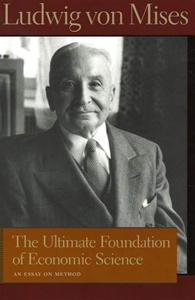
Ludwig von Mises wrote The Ultimate Foundation of Economic Science in 1962 as a commentary on what kind of knowledge economics provides. His target is logical positivism, the doctrine that every legitimate claim must answer to the experimental methods of the natural sciences. Mises replies that economic theory starts from a different fact: human beings act, pursuing ends with scarce means. The book rewards reading as a short statement of the method behind his larger work, provided its polemical asides get the scrutiny he demands of opponents.
Mises names that starting point praxeology: the formal theory of purposeful action, deduced from the idea of an actor using means to reach preferred ends. Action in his sense covers a gift to charity and choices resting on mistaken beliefs about which means will work. Economics studies fallible people pursuing nonmonetary ends as well as monetary ones, often with wrong means. Cost and indirect exchange follow by deduction. Experience and practice decide whether real conditions match the assumptions in a chain of reasoning. A valid theorem therefore requires a correct derivation and conditions that apply to the case. Critics, he says, should trace the deduction and locate any faulty step.
Prediction follows from the same division. Economics can say whether a policy will reach its aim and what it will bring about instead, but only qualitatively, since no constant numerical relations govern human affairs. Statistics belong to history: they describe a definite time and place, and they can inform plans while yielding no permanent laws. He separates direction from size and timing: a speculator who foresees the right change can still be ruined by misjudging its scale or date. Forecasts also enter the system they describe. In a hypothetical case Mises offers, traders told in May that a boom will last until December sell early and end it sooner.
These limits rest on a view of free will compatible with determinism. Mises accepts that each choice results from an individual shaped by everything before him, and he uses free will to name a boundary of present knowledge: the ideas guiding a particular decision cannot yet be traced to an ascertainable external cause. That boundary keeps economic prediction qualitative and makes understanding particular motives a fallible historical skill. Engineering forecasts, he adds, also depend on conditions and remain exposed to forces beyond human knowledge.
Only individuals act, yet the cooperation that forms nations or churches has real effects. Mises treats groups as actual cooperation that arises from individual thought and conduct and dissolves when those change; one person belongs to several at once. Because ideas originate in particular minds before spreading, initiative lies with individuals. He keeps this explanatory claim apart from the political question of whether individual interests outrank a group's. His remark that slaves yield to slaveholders explains how ideas sustain power; obedience under force differs from consent, and the passage describes domination, not a judgment against the oppressed.
Government, he argues, is indispensable and beneficial, since peace requires an apparatus ready to repel gangsters and foreign aggressors, and he rejects anarchism for assuming universal wisdom and virtue. The imperfection that makes the state necessary also makes it fallible. Coercion must be entrusted to people, and the agents hired to protect a community can become its aggressors, so the central political problem is keeping police power from turning tyrannical. With imperfect people, he adds, no system of government works satisfactorily. Majority rule offers a peaceful way to replace rulers, while majorities remain fallible. His hope that territorial self-determination could secure peace carries a condition stated in a note: general adoption of laissez-faire capitalism.
Physics tells an engineer which designs will work; economic calculation tells him which deserve building. That comparison needs money prices for factors of production, along with accumulated capital to put discoveries to use. Profit and loss subject capital owners to consumer demand, an incentive argument that stops short of calling every fortune deserved. Mises contrasts independent experimentation, where dissenters test ideas with their own means, with all-round planning by a single authority; his objection targets total control, not organized research. Within natural science he endorses experimental method and Popper's refutability standard. He grants that physical causes such as brain injury can destroy mental faculties, and his dualism is methodological, a report on present knowledge that leaves open whether mind and body may prove homogeneous.
The book's serious weakness is the distance between its arguments and its verdicts. Mises does argue about rival methods. He explains that national income adds accounting profit to wages and salaries counted as income under tax law. He notes that inflation swells the figure and asks why the nation should be the unit. Econometric correlations, in his reading, record one time and place, and he judges behavioral studies by the principle of relevance, with a note conceding that some of those scholars address medicine and hygiene. From these points he concludes that econometrics is useless for economic analysis and national income a political slogan, and he dismisses much behavioral research as trivial. His arguments show that statistical aggregates and correlations need interpretation; they fail to establish that the empirical research built on them is worthless.
The same overreach shapes his portraits of opponents and history. He attributes envy to capitalism's critics and a dictatorial wish to every socialist, and he charges logical positivists with knowingly attacking Western civilization. Capitalism alone, he says, produced organized modern science, and missing capital alone explains underdevelopment. He sets a liberty-seeking West against petrified Eastern civilizations and describes the majority as routinists who resist progress. None of this follows from the category of action. These historical and psychological generalizations arrive without the evidence history requires, and his own standard of logical scrutiny applies to them in full.
Readers should arrive prepared. The preface advises learning economic theory before its epistemology, and the prose assumes familiarity with marginal utility and the positivist debates. It is a commentary on method for readers who know economics; beginners should start with an introductory text. A reader who knows the theorems and asks what kind of truth they claim, or how a defender of markets can call government indispensable while distrusting its agents, will find a short, demanding answer here. The original 1962 Van Nostrand edition, with an index by Vernelia A. Crawford, is available as an official English text.