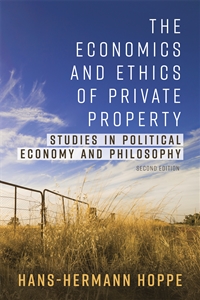
Hans-Hermann Hoppe's The Economics and Ethics of Private Property is a collection of essays built around one claim: private ownership of bodies and scarce resources best supports the production of wealth and is also the only arrangement that can be ethically justified. First published in 1993, the collection gained four chapters in the 2006 second edition, and the current Mises Institute paperback carries that text. Hoppe dedicated the book to Murray Rothbard, his teacher and later colleague. Its essays range from public finance and economic calculation to epistemology and the foundations of ethics. Many market defenders argue from results and many property theorists argue from rights; Hoppe insists the two arguments must meet, and these essays show where that meeting comes easily and where it strains.
The opening chapter, on public goods, is the easiest way in. Its examples of a rose garden, a deodorant and a lighthouse make a narrow point well: if people benefit from something they did not pay for, that fact alone does not settle who should produce it or who may be compelled to fund it. Whether a good can be restricted to paying users changes with technology and property rules, so a lighthouse looks different once stretches of sea can be owned. Hoppe goes further and rejects the public goods classification altogether, a claim that depends on his disputed subjectivist account of value and welfare and falls short of an established disproof. A reader can accept that the step from spillover to compulsion needs its own justification and still see that contesting this step does not answer every externality concern.
The same chapter sketches how protection might be supplied competitively. Security firms would sell contracts stating what clients are buying, agree in advance on independent arbitrators for disputes between their customers, and lose revenue whenever clients judged a fight unnecessary. Insurers liable for their clients' losses would have reason to refuse cover to aggressors. For this insurance model Hoppe quotes and builds on Morris and Linda Tannehill's The Market for Liberty. He concedes that an outlaw firm is possible, that his historical evidence is disputed, and that outcomes finally depend on public opinion. Those concessions leave conditional incentives and institutions that a reader can test.
Chapter 8, asking whether socialism faces a property problem or a knowledge problem, draws a useful line. Prices are exchange ratios produced by people trading things they own, and data about past prices only records those trades. A planner who pools the record does not thereby recreate the trades that would generate the next prices. Families and firms, Hoppe adds, can plan internally because they rest on an outside framework of property and prices. His verdict that Hayek's knowledge argument is confused is his own polemical reading, not settled history, and a reader may treat the property and knowledge accounts as complementary.
Chapter 12, on the justice of economic efficiency, is the core of the book's ambition. Hoppe separates two questions, how wealth is produced and which forms of ownership are just, and then proposes one answer to both. His chain of reasoning starts from the act of arguing, which requires each speaker to control his own body. From there he moves to a moral right of self-ownership, then to first use as the only defensible way to acquire other scarce resources, and finally to a universal property ethic. Each link is a proposed inference that critics dispute. Practical control during an exchange of arguments may fall short of a permanent, universal right. Showing that property cannot be acquired by declaration alone also does not establish that every other acquisition rule is false. The appendix answers critics without ending the dispute. One distinction holds up whatever one decides about the proof: protecting the physical integrity of property differs from protecting its market value, so ownership gives no claim against competitors or against changes in how others value things. His portraits of Rawls and Nozick are hostile and polemical, and readers should treat them as one-sided accounts.
The final reply in the appendix takes up the hardest case: a fully appropriated world and a newcomer who owns only his body. Hoppe denies that need grounds any enforceable claim, keeps first possession in force, and leaves room for charity, employment and trade. His tone toward the destitute here is dismissive, and he leans on an untested assurance that plenty of empty land would remain available. Both features are real limits of the position as he presents it, since a property ethic most needs to win agreement in how it treats people with nothing. Closing chapter 15 argues that political change follows ideas about the state's legitimacy more than appeals to efficiency.
Hoppe's collection is advanced and in places technical. It is also openly partisan, making no claim to be a neutral survey or an empirical estimate. Readers new to it might start with chapters 1 and 12, then the appendix. Its value lies in bridging institutional incentives and ethical conclusions; the mechanisms can be judged on their own terms, and the universal proof separately.