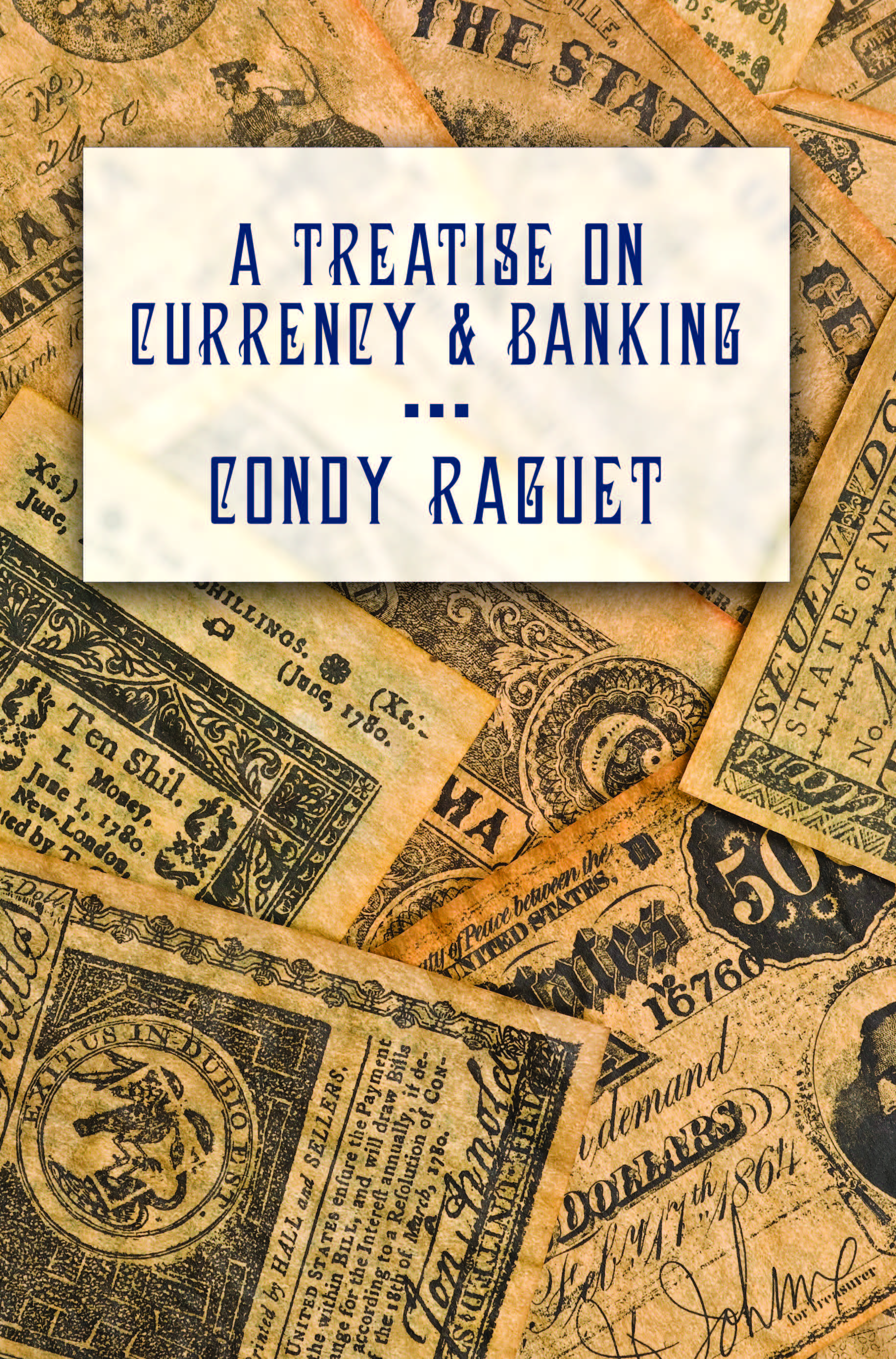
Condy Raguet built A Treatise on Currency and Banking around one enforceable promise: a bank issuing a note payable on demand owes coin to whoever presents it. First published in 1839, the book is discussed here in its revised second edition of 1840, reproduced in a later Kelley reprint and the Mises Institute's digital presentation. Its preface is dated April 1839 and an added note June 1840, so it answers the suspensions Raguet recounts from 1814, 1837 and 1839; readers should approach it as monetary history. Four books carry the argument from the metals and foreign exchange through credit and banking to suspension, statistics and reform.
Two moves make it worth reading. Raguet treats redemption as an obligation that statute and rival banks can enforce, and he keeps circulating claims distinct from the resources they command. Because he carries both into a detailed institutional proposal, a careful reader can locate where banker discretion fails and where Raguet's own assumptions outrun his evidence. He writes as a classical economist: Book I grounds value in cost of production and the metals' intrinsic qualities, yet treats the gold-silver ratio as a market outcome of supply and demand, outside any law of nature. Take him on those terms. Either metal could anchor the currency, though he favors silver for American conditions and wants statutes prohibiting small notes so coin stays in daily use.
The exchange chapters supply the first insight. Bills of exchange let an importer's debt abroad cancel against an exporter's claim, sparing coin a round trip across the ocean. Raguet then separates the balance of payments from the balance of trade, since customs books omit freight, insurance, profits and capital transfers. His hypothetical merchant ships flour entered at $8,000 and returns with coffee entered at $10,000; the larger import records a gain and leaves the accounts settled. The illustration shows why an import excess can mislead, and as a hypothetical it leaves modern deficits for separate evidence. He adds that quoted exchange rates rest on nominal conventions and legal metal ratios, which readers must decode before predicting coin flows.
His chapters on credit supply the second. In another hypothetical, a western settler with an axe, a cow and uncleared land obtains flour, seed and clothing from a merchant until harvest. Credit lends goods that already exist, so trust mobilizes land and labor, while a printed promise adds paper to a shelf holding the same goods. The same logic judges failed canals: the money paid out keeps circulating while the stone, food and labor are consumed. Two steps are weaker than the frame. Raguet asserts the workers would otherwise have found employment, a contested counterfactual, and he measures social benefit almost wholly by toll income. His examples involving plantations and enslaved people treat human beings as property uncritically.
The analytical center classifies banks by function: safekeeping, lending existing capital and deposits, and issuing notes or credits that circulate as money. Raguet allows that demand deposits may be lent when the depositor agrees, and he credits note issue with a real service: paper can replace coin, freeing specie for export as productive capital, provided redemption stays prompt. He rejects any fixed multiple of capital or reserves as a safe limit. Discipline comes from daily settlement at par between banks and freedom to export coin, with redemption backed by legislation. He even values the standard banknote, whose known issuer and familiar denominations cut payment costs during predictable banking hours.
A bank's own capital may sit in mortgages or public securities, while notes should be issued only against short paper arising from sales of merchandise. That real bills rule is Raguet's contested thesis that such paper tracks trade and therefore stays clear of inflation and overtrading; he concedes a neighbor's overissue can still injure a prudent bank. His boom narrative follows claims into real commitments: easy discounts raise prices, merchants import, manufacturers build, and when banks call loans, borrowers hold goods and machinery they can sell only at a loss. A footnote calls the exact doubling of prices after a doubled money stock an illustrative simplification. It remains a dated period argument, distinct from a precise modern capital-cycle model. He also grants that war and crop failure disrupt trade under metallic money, and he qualifies a sweeping Havana testimony by noting local failures.
The suspension chapters apply ordinary debt morality. A bank that stops paying coin is an ordinary debtor; before making noteholders finance forbearance to its borrowers, it needs their consent and owes them interest. In his hypothetical figures of fifteen and three million, the bank should have borrowed its shortfall, an answer that assumes a willing lender. He records exceptions, including interest once paid and a Pennsylvania reparation enacted but still unpaid. Inconvertible notes keep value because debtors need them to repay banks, and prices can even fall after coin leaves circulation. A hypothetical bank whose stock is paid with loans against that stock shows circular capital; he doubts many banks were built entirely that way. His charge of exchange manipulation through branches stays a possibility, and his national cost estimates are conjectural.
The statistical chapters turn discipline into accounting. Raguet argues that demand deposits circulate as money alongside notes, since large payments in American cities moved by check. He asks for quarterly statements at the same dates, separating immediate from deferred liabilities and resources, and he shows how to aggregate them without double counting. A note issued by one bank and lodged at another appears both as circulation and as a deposit, so his total of paper currency adds circulation to deposits and subtracts the notes of other banks reported on hand. Specie in bank vaults drops out of that total altogether, because it entered through deposits or note exchanges and is already represented by those claims. In his reckoning, coin held by the public outside the banks comes on top of that total, and he saw no reliable means of measuring it. He admits his own printed table fails to balance. His distinction between banks that lend existing money and banks that create notes is a contested framework belonging to his period.
For reform, he prefers unlimited personal liability for bank owners but judges it politically unlikely, so he endorses New York's general banking law: any qualifying association may bank after depositing approved public bonds or mortgages with the comptroller, who prints and registers the notes. Noteholders gain that security; depositors remain ordinary creditors, and banks lending deposits on short commercial paper can still be caught by panic. Appendix J reproduces the comptroller's report, which records falling bond prices and some notes exceeding current collateral, calls the system an experiment needing a longer test, and reports one bank wound up with its billholders paid in full, with two more expected to reach the same result. A treasury advance against security appears there as a proposal, and Raguet had only press abstracts of the newest laws.
Read it to see how an 1840 advocate of convertibility reasoned from a debtor's duty to banking design, with his classical assumptions exposed and his qualifications doing real work. Expect period prose and dense arithmetic. The Mises Institute hosts the digital edition: A Treatise on Currency and Banking.