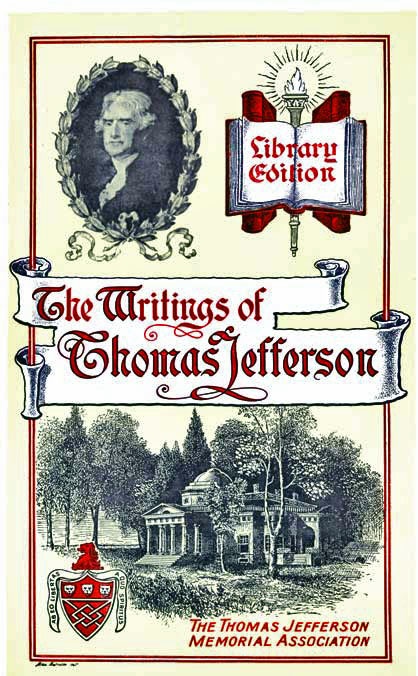
The Writings of Thomas Jefferson is a posthumous twenty-volume collection that places Jefferson's memoir, public papers and letters beside the late records of the university he founded, and its value comes from that arrangement. Taken in sequence, the documents let a reader follow general claims about law, religious liberty, invention and delegated authority into drafting compromises, a patent dispute and board votes, where a principle had to decide a concrete case. Several also record where his reforms stopped, which makes the set better suited to comparing principle with practice than to harvesting slogans. Andrew Adgate Lipscomb began the collection as editor-in-chief in 1903, and the Definitive Edition reviewed here, edited by Albert Ellery Bergh, carries a 1907 title page. Monticello's guide to the editions reports that its imprints are not known to differ in content, and it warns that the set inherited transcription errors and carries little annotation.
Volume one opens with the autobiography Jefferson wrote in 1821 for his family, a retrospective that should be weighed as his memory of contested events. Its account of revising Virginia's laws shows how language and institutional continuity bounded a reformer. Jefferson reports that the revisers declined to recast the statutes as a new code, since fresh wording could reopen questions the courts had settled and unsettle property held under the old text. They divided the existing laws among George Wythe, Edmund Pendleton and Jefferson, amended known texts and reported 126 bills. Negotiation shaped the result as well: he records that the legislature rejected an amendment inserting the name of Jesus into the religious freedom bill, and he reads that vote as extending protection to other faiths and to unbelievers. His own earlier penal proposals receive the same scrutiny. He recoils from retaliatory punishments he once approved and admits he cannot recall why, then describes prison plans reconsidered after reports of failure. Slavery surfaces at two separate points in this account, each marking a limit on the liberty argument. Early in the memoir he reports that an attempt to permit emancipation was rejected, and later, in the revision narrative, a vestige of retaliatory punishment survives in one case involving a slave.
Jefferson's letter of 13 August 1813 to Isaac McPherson, in volume thirteen, replies to McPherson's request for information, and the complete text is an engineering and administrative argument about Oliver Evans's patent. In it Jefferson objects to a patent burden reaching machines lawfully built after Evans's original patent expired. He traces the elevator to ancient bucket chains for raising water and separates a new machine from a new use or altered form of an old one. From that prior art he moves to the general claim, excerpted in The Founders' Constitution from the University of Chicago Press: an idea, once communicated, enters another mind without being taken from its first possessor, so exclusive property in ideas has no natural basis. Society may still grant limited exclusive profits when that incentive serves public utility, and Jefferson concedes the line is hard to draw. He allows that some of Evans's improvements could merit protection and discloses that he paid for a license for his own mill. The engineering history is Jefferson's own account. In the same letter he denies that even land carries a stable natural ownership, which makes him a poor fit for a modern absolute-property position.
Volume nineteen closes with Board of Visitors records from the University of Virginia. One enactment establishes the office of president, with control over faculty and proctor and a procedure for temporary suspension, conditional on William Wirt accepting the appointment. Jefferson entered a formal dissent, arguing that the board's enumerated powers did not cover such an office, that the existing faculty was adequate, that the expense weighed against it and that too few visitors were present. His familiar argument from enumerated powers here constrains a payroll and an organization chart. Resolutions on policing, expulsion and boarding, adopted by the Board as a body and separate from his dissent, set close disciplinary administration beside the liberty language of the earlier volumes. After his death in 1826 the sequence closes with the Board's own record of Madison's election.
Introductions written by admirers between 1903 and 1907 praise their subject and are best treated as evidence of his reputation when the set was compiled. Digital transcriptions add scanning errors to the inherited ones, including garbled dates and conflicting figures, and the sparse notes leave much historical context to the reader. The collection suits a reader who wants to watch a political writer reason through drafting, patents and governance, comparing his public principles with his administrative judgment, and who can work around a large, unevenly annotated set. Before relying on a particular quotation or figure, check it against a page facsimile or an annotated scholarly record, such as the Princeton Papers of Thomas Jefferson where that edition covers the document.