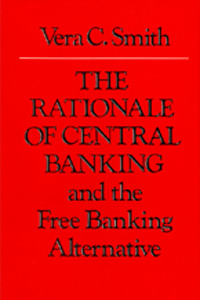
Vera C. Smith opened her 1936 book by calling belief in central banking universal and judging that its claimed superiority lacked systematic examination. Her study tests that belief. She reconstructs the nineteenth-century debate between advocates of a single privileged note issuer and advocates of competing banks with equal rights to issue, then reconsiders the arguments on their merits. The book earns a reading by keeping two questions apart: how central banks acquired their powers, and whether those powers outperform the alternative. Smith also concedes real force to the strongest case for central banking, the lender-of-last-resort argument.
The edition reviewed is the 1990 LibertyPress reprint of the P. S. King original. The publisher added the subtitle naming the free banking alternative, expanded the bibliography and prepared a new index. Leland B. Yeager contributed a new preface written after the free-banking revival of the 1980s, and its proposals belong to him. Smith's foreword, dated October 1935, and her main text follow the original apart from corrected spelling and renumbered footnotes.
Smith's first argument concerns origins. In her account, note monopolies grew from fiscal bargains: a government short of revenue granted one bank special issuing rights, rules then concentrated reserves there, and the favored bank sometimes escaped its redemption obligations. The responsibilities later assigned to central banks grew out of the position those privileges created. The reader learns to separate an institution's historical origin from the policy case made for it afterward and from the liabilities it owes noteholders. Origin leaves performance untested. Her introduction asks whether instability comes from a particular system or from technical difficulties common to any system, and saves that comparison for the closing chapter.
The decentralized United States system had many banks and little freedom: branch prohibitions and a requirement that national bank notes be secured by deposited government bonds constrained what banks could issue. Bond security tied note issue to the price of particular bonds, so circulation could not adjust promptly to demand for cash. Smith reports the banks' contention, which she judges reasonable, that this rigidity caused their suspensions: without extra notes, depositors' requests to convert deposits into hand-to-hand cash fell on legal-tender reserves. She separates that conversion from an expansion of total credit, granting the complaint of inelasticity some justification while warning that the word often cloaks a wish for inflation. The failure of that regulated design leaves the competitive alternative largely untested.
Doctrinal labels blur the comparison too. The quarrel between the currency and banking schools over strict limits on notes cuts across the quarrel between monopoly and competition in issue, so a school name says little about the rule proposed. Sound collateral does not by itself cap total credit, and a ceiling on notes alone leaves a central issuer free to expand deposits. Smith also marks where economics stops: whether law should spread losses evenly across noteholders is, she judges, a question analysis cannot settle scientifically.
Clearing between rival banks is Smith's defense against the standard objection to competitive issue. Defenders of a single issuer argued that competing banks would keep cutting discount rates until a late gold drain forced violent contraction, and that a cautious bank gained nothing by holding back while rivals expanded. In Smith's reply, an expanding bank's borrowers spend the new liabilities, recipients deposit them with rival banks, and those banks present them for redemption before the new loans fall due. The drain is temporary, since reserves return with repayments, so clearing restrains the bank to the extent its reserves can absorb the outflow during the interim. Checks pass through the clearings at once, while many notes stay in circulation, so the drain on deposit credit arrives sooner. The appendix's two-bank example is conditional arithmetic.
Clearing discipline has limits Smith states herself. If banks expand in step, their claims on one another roughly cancel and the drain shrinks; restraint then depends on whether expected profits outweigh the losses of failure without a backstop, a question of incentives her argument leaves open. The reader gains a sharper test for any competitive system: whether reserves cover the settlement interval, a question separate from whether the loans will be repaid.
The closing chapter makes the book's most consequential concession. Free bankers argued that regular rescue becomes data banks anticipate, so they lend beyond the margin their own resources justify. Smith grants the incentive but finds the argument weaker if unwise expanders exist and prudent rivals cannot escape them, since a panic may then sink even cautious banks, none fully liquid. Unless free banking would remove the trade cycle and general runs entirely, she concludes, the lender-of-last-resort argument remains a powerful defense of central banking. Clearing-house certificates relieved some American crises and failed in others, and a binding legal reserve ratio could force contraction or suspension despite reserves on hand, a shortage of usable cash that says nothing by itself about solvency. She also judges that the Federal Reserve partly remedied problems whose other remedies were politically or technically out of reach, while fundamental defects remained.
Smith argues that monetary stability requires a banking system that avoids causing disturbances and offsets changes in spending that start with the public. Following the banking school's theory of hoards, she grants that shifts in the public's demand for cash balances can generate cycles without fault in the banks, even under a purely metallic currency, and she allows that some fiduciary issue may be needed to keep money neutral. The free-banking alternative she examines assumes gold convertibility under ordinary company law and strict bankruptcy. She leaves the comparative verdict on stability open and, in 1936, judged the choice politically impractical. Yeager's 1990 preface discusses a different architecture, a separate unit of account with indirect redemption, and that proposal is his.
The book suits readers comparing monetary institutions who can follow bank liabilities, reserves and clearing. Expect dense national histories crowded with names before the analytical payoff of the final chapter, and check some historical figures in the narrative chapters against primary records. Smith helps answer a question that outlasts her period: which arguments for a privileged issuer rest on mechanism and which rest on inherited privilege. Yeager's preface points onward to Lawrence White and George Selgin. The reprint carries reserved rights, so read the 1990 edition in the Liberty Fund PDF at the Online Library of Liberty.