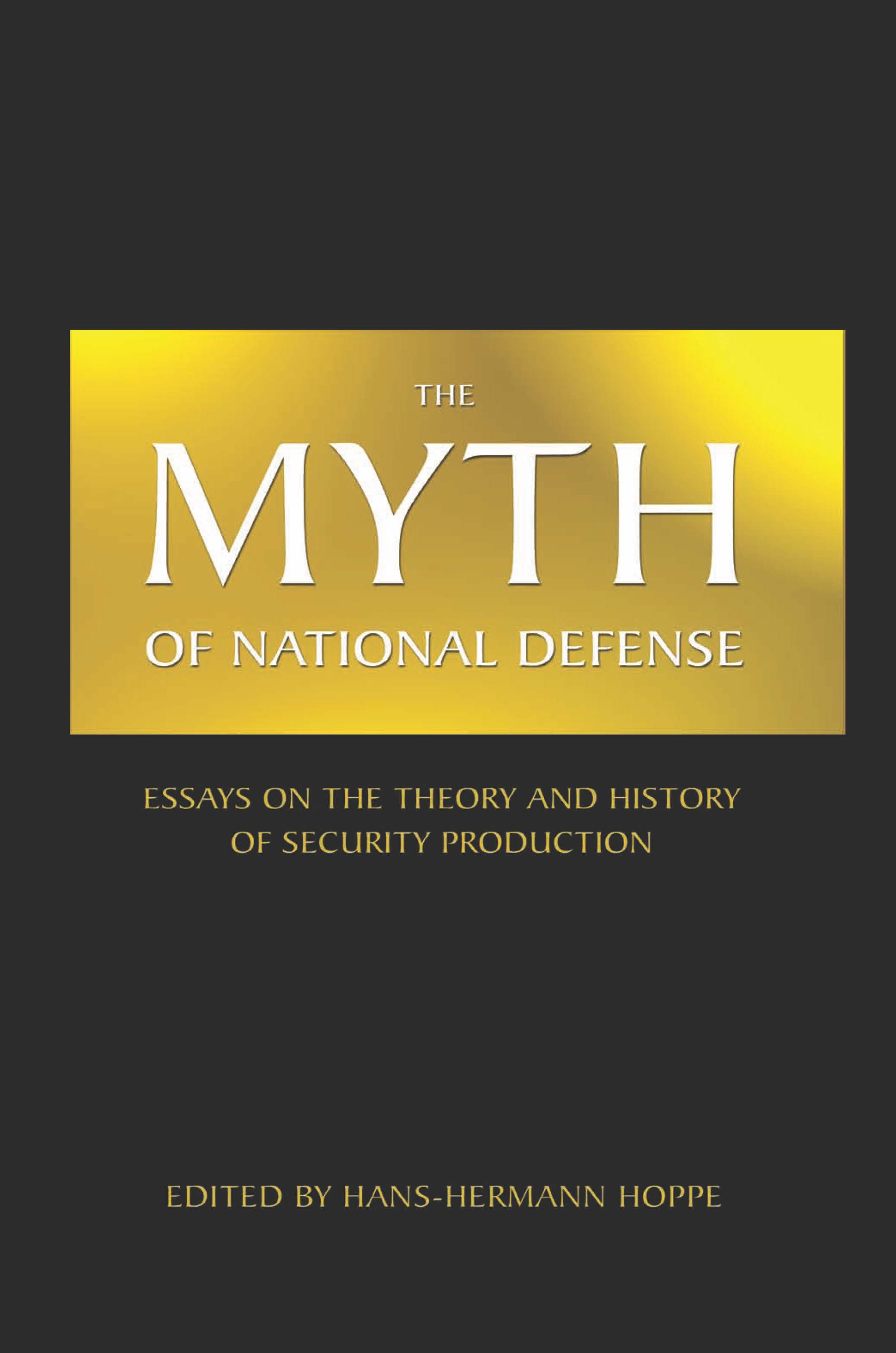
The Myth of National Defense asks whether protection against aggression requires a territorial monopoly financed by taxation, and its contributors answer no from several directions. Hans-Hermann Hoppe edited the 2003 Mises Institute volume and wrote its introduction and tenth chapter. It gathers eleven contributed chapters in four sections: state formation and war, regime forms and nuclear strategy, historical private military alternatives, and private security production with secession. Its value lies in bringing the ethical limits, financing, incentives, legal arrangements and transition problems of stateless defense into one book. The authors disagree on consequential points and offer no unified blueprint or guarantee that voluntary defense prevails, so the collection works best as a casebook whose chapters test one another.
Murray Rothbard sets the constraint the economics must satisfy. Jones may repel Smith with willing helpers, yet he may not steal to finance the pursuit, conscript a posse or kill bystanders while capturing the gang. Rothbard applies the test to private bodies and states alike, so private funding gives no cover to methods that injure nonaggressors. He carries the rule to weapons that cannot be aimed at aggressors alone, condemning nuclear threats and use and calling for disarmament. His criterion says which means are permissible and leaves open whether a force bound by it will win.
Walter Block attacks the step from spillover benefits to compulsory finance. A bodyguard protects one client better than a thousand, and an army defending two coasts does worse than one holding a single front, so protection has particular users and rising costs. Providers could bundle it with property services, the way a restaurant folds lighting into a meal's price, and contracts could confine service to subscribers. Splitting "national defense" into specific services is a real gain, though Block presses further than his evidence carries. A contract settles who may claim service, while deterrence works through physical effects: an invader turned away from a subscriber's port may spare the neighbor who paid nothing, or may strike him next. Armies that persist despite spillovers leave the worry about underprovision standing, and his claim that unpaid spillovers prove no benefit is a contestable methodological premise.
Privateering, in Larry Sechrest's history, binds finance, labor incentives and legal enforcement into one mechanism. Investors held shares in a ship, and crews signed articles paying them in prize shares, so their income rose and fell with the cruise. The first man to sight a ship later taken earned extra shares, and a mutineer or deserter lost all of his. Surety bonds guarded against a privateer turning pirate. Owners needed a government's letter of marque before raiding enemy commerce, and a captured ship and cargo could be sold lawfully once a prize court condemned them, because prizes technically belonged to the state and captors' claims derived from it. Stateless defense remains an inference for readers to weigh, and Rothbard's rule returns here too, since profit from a seizure is silent on whether the enemy merchant was an aggressor.
Hoppe's chapter models defense as insurance. On his account, insurance excludes losses the insured deliberately brings about, such as an attack he provokes, so an insurer covers unprovoked attacks provided it contractually forbids its own clients to provoke or aggress. Paying for losses gives the insurer an interest in preventing them. Insurers serving different law codes agree in advance on jointly chosen independent arbitrators for their disputes, and an arbitrator seen as biased loses future appointments. Contracts specify prices and duties and change by unanimous consent, against a state's revisable promise, and Hoppe backs them with capital reserves and international reinsurance. The book's most detailed account of aligned incentives remains a proposed model: whether reserves could absorb war losses hitting many clients at once, or competition deter collusion and predation, awaits evidence.
Jörg Guido Hülsmann takes up transition. Following Mises, he distinguishes breaking a hegemonic bond of command, which he calls secession, from breach of contract: a business division that leaves with its firm's property commits theft. In a voluntary order, soldiers, donors and customers can redirect labor and capital toward a steel mill or a shoe plant, within their existing obligations, so defense must keep winning support against other uses of those resources. His claims of military advantage assume other things equal and strong popular support, and they promise no victory for a small seceding group.
Bertrand Lemennicier builds a rational-player game in which nuclear war costs far more than it gains, and argues from it that proliferation is a blessing, the opposite of Rothbard's conclusion. The two chapters apply different tests, Lemennicier asking when calculating players choose war and Rothbard asking whether a weapon can be used without killing nonaggressors, and a reader can apply both. A simplified game guarantees nothing against accident, error, escalation or harm to third parties. His chronology also misdates the first French and Chinese tests, which the University of Helsinki's nuclear test monitoring history places in 1960 and 1964. Elsewhere, broad historical claims are arguments to evaluate, and statements about the present describe 2003 or earlier.
Readers already working on political economy and private law will get the most from the book. Its sharpest question is what a voluntary defense order would have to get right, from a bystander's rights to an arbitrator's selection, before anyone asks whether it would win a war. Expect deductive ethics, economic theory, a formal model and historical work of uneven quality. Anyone wanting neutral military history or current nuclear policy guidance should look elsewhere. The Mises Institute offers the original 2003 edition as a free PDF, with all rights reserved.