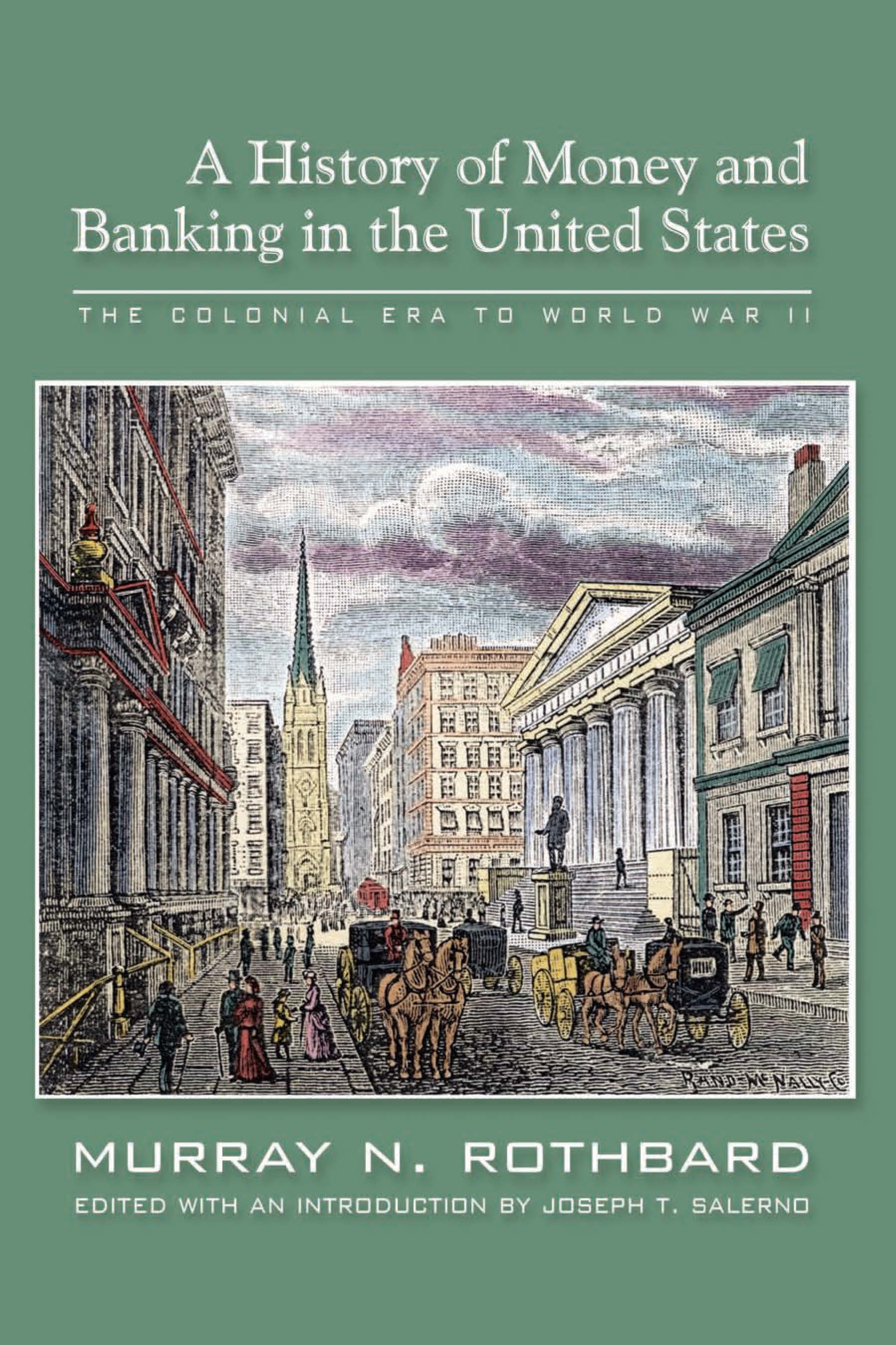
Murray N. Rothbard's A History of Money and Banking in the United States is a posthumous collection, published by the Ludwig von Mises Institute in 2002 and edited with an introduction by Joseph T. Salerno. Its five parts run from colonial paper money through the origins and early operation of the Federal Reserve to the interwar gold-exchange standard and the New Deal's international monetary policy, ending with the dollar order planned during the Second World War and an epilogue reaching spring 1971. Rothbard asks two questions of each monetary rule: what a holder could redeem money for, and which organized interests pressed for the change.
The collection earns its place when a reader keeps those questions apart. Its comparisons of redemption rights give a portable test for any arrangement sold under the name of gold, though some historical details need correction. Its genealogies of bankers and board seats work better as hypotheses about sponsorship, and Rothbard's own footnotes sometimes weaken them. A reader who accepts the institutional analysis while auditing the coalition claims gets more than one who takes the whole package as proof, and the interwar and New Deal chapters reward that approach most.
Salerno's introduction is his own argument. He presents the collection as joining Austrian monetary theory with attention to the financial interests behind policy, and he sets it against work by Douglass North, James Buchanan, George Stigler, and Milton Friedman and Anna Schwartz. Those comparisons are his assessments. His most useful passage limits the method: interest analysis guides research, and where evidence fails to show a financial stake, noneconomic or altruistic motives remain open. The later chapters should be judged by that limit.
Part one began as Rothbard's contribution to the Gold Commission report issued under the names of Ron Paul and Lewis Lehrman. When a government makes paper or an overvalued coin legal tender at a fixed rate, debtors pay in the cheaper money and the undervalued coin leaves circulation, so the resulting shortage of good money becomes an argument for more paper. In Rothbard's account debtors with political influence push these issues, yet wealthy merchants sometimes back expansion too. The reader learns to ask who held debts and who received a new issue first.
Part two follows the Indianapolis Monetary Commission, a businessmen's reform effort that began before the Panic of 1907. Hugh Hanna of its executive committee hired the journalist Charles A. Conant to promote its recommendations, and Conant worked with the secretary, Jules Guthridge, to get newspapers around the country printing abstracts of questionnaire replies, so a sponsored body could appear to speak for business everywhere before its report was public. A monetary rule acquires legitimacy through funding and publicity, and both leave records. Board seats and marriages place men near a decision without proving they directed it, and some reformers addressed real defects in the banking system of the period.
The Federal Reserve chapters of the 1920s reward the same discipline. Rothbard counts the original seven-member board by affiliation, finds Morgan, Kuhn Loeb and Rockefeller connections beside an independent banker and an economist with vague family ties, and concludes that Morgan control was incomplete. His case for Morgan influence runs through Benjamin Strong at the New York bank and through friendly Republican administrations. Discount terms and reserve operations decide which institutions receive support, so the instruments carry the analysis. A later chapter speaks loosely of a Morgan majority while its own footnote lists a mixed board, and the counted version deserves more weight. Fed attempts to expand reserves leave open whether larger attempts would have changed events.
Part four contains the book's central institutional argument. Rothbard's hypothetical Ruritania keeps its reserves in sterling bills and London deposits, so a holder who presents rurs for redemption receives pounds. In his account, sterling that flows abroad when Britain expands credit becomes reserves for further expansion elsewhere, postponing the gold drain that would have forced British contraction under a classical standard. He says British residents could redeem no bullion, yet the Gold Standard Act 1925 obliged the Bank of England to sell bars of about 400 fine ounces to any qualifying buyer; bar size and a clearing-bank pledge he describes limited domestic access in practice. The model rests on assumptions about price adjustment and specie flow, and his universals need care, since he lists smaller countries outside the sterling arrangement. The test survives those repairs, because a gold label says little until the reader knows who may redeem the money and what asset arrives.
Part five applies that test to the New Deal and complicates the coalition story. J. P. Morgan welcomed Roosevelt's 1933 gold embargo as a remedy for deflated prices and wages, and after Roosevelt's message sank the London Economic Conference, Morgan partner Russell Leffingwell congratulated him for refusing to peg the dollar. Rothbard calls the situation curious, and a footnote back in part four concedes that later research by Thomas Ferguson superseded some details of his earlier account of financial interests. Business labels carry no fixed monetary principle. In January 1934 the dollar was fixed at thirty-five dollars an ounce, and with domestic coin and bullion redemption gone, gold remained a means of settling balances with foreign authorities.
Part five's closing sections ask whether, and how far, German economic nationalism contributed to the American drive toward war, then assert with more confidence that rebuilding an international monetary order was an American war aim. A question about trade rivalry is no proof that trade or bankers caused the war, and Axis aggression stays in any account. Barter agreements described as mutually beneficial record the consent of governments, which leaves the consent of their citizens unshown. Rothbard reads Bretton Woods as a revived gold-exchange system with the dollar as key currency and gold confined to central-bank payments, while recording Guaranty Trust and the American Bankers Association criticizing the White Plan. His epilogue speaks from the late 1960s and early 1971, so its forecast of a European hard-money bloc is a period prognosis.
The collection suits a reader who wants to take apart any claim that a currency stood on gold and to trace a reform to the people who funded and publicized it, and parts four and five carry most of that value. It expects comfort with dense footnoted narrative and basic central-banking vocabulary. Before citing it, check statutory claims against primary texts, rework its figures, treat Rothbard's money aggregates as his own constructions, and test motive attributions against the Ferguson research his footnote names. The Mises Institute PDF carries reserved rights.