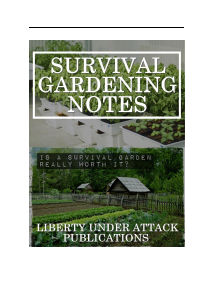
Survival Gardening Notes collects material from Jim Stumm's 1980s newsletter, which he wrote and edited, with letters from correspondents credited as Diogenes, James E.W., Falcon, James H. and Jim B. Liberty Under Attack Publications issued it as a December 2020 edition and hosts the PDF, where anyone can read the notes. Shane Radliff designed the interior and Miriam Zachariah the cover. The notes run from 1978 plans to a 1989 retrospective and cover two places, a main garden at his parents' suburban property and a mostly paved yard at home. Stumm keeps moving from what a plot produced toward what the harvest supplied and what it cost in his own hours.
Yield density comes first, with each crop weighed against the ground assigned to it. Stumm asks readers to send comparisons, because the figures he has seen are all his own, leaving him unsure whether they are good or run-of-the-mill. Cucumbers and sweet potatoes crept beyond their allotted ground, a hole he flags in his own arithmetic that overstates their results. Replying to Falcon, he notes that kohlrabi loses a heavy peel while a big tomato crop is mostly water. He proposes a table of edible shares and conversion factors for calories and protein per square foot, then reports that he has yet to complete either. By his own account, whether a patch could feed someone stays unresolved.
That gap between weight and food shapes his reply to James E.W., who is weighing retirement and asks about subsistence crops, storage and menus. Stumm answers with grains and beans and puts a price on his own labor. Bulk staples from a food co-op were cheap enough that, in his hypothetical soybean example, growing them would pay him less per hour than other work, so he would earn money and buy the sacks. If prices climbed or supplies vanished, he would have to grow them, so he proposes acquiring the skills and tools and shelving them until needed. The prices belong to one co-op and decade, and the ten hours of labor per sack is his own supposition.
Flooding held back the main garden. An open trench widened and failed during rain, and an earlier pump ran on a washing-machine motor and was not automatic. After reworking the drainage, Stumm credits it with most of his higher yields since 1980 and with letting him plant weeks earlier. He also works leaves into the soil each fall and concedes that one record year owed part of its numbers to planting high-yielding crops exclusively. The attribution is one grower's judgment, formed while those changes ran concurrently, and stops short of an experimental test.
The longest connected section reprints his 1978 plans for the home yard beside 1989 comments. His aunt owns the house, living upstairs and using some of the space for flowers, while Stumm lives downstairs. The asphalt he planned to break up stayed in place, and by 1989 he judged grow-boxes on the pavement the better solution, with shade, tree roots, family uses and upkeep reshaping the rest. The old cold frame box still grows garlic, though he removed its glass years ago and now starts seedlings on a windowsill. Carpenters rebuilt the bottom of the porch, and Stumm then enclosed the sides with recycled storm windows. He uses the space to warm the house and does not normally grow plants there, and he doubts it cuts the heating bills much, especially as neighbors' trees grow into the low winter sun.
The closing installments carry the harvest into the kitchen. A surplus becomes food when it fits the household's meals and can be processed with the time and equipment on hand and then stored, so the labor accounting continues past picking. The grape-leather pieces end the substantive text by guessing that other fruit, especially berries, would suit the same process, which he had yet to try, and by asking for letters on other fruit or different methods. It is the same appeal for outside data that runs through his yield reports.
All of this is self-report from particular plots and selected letters, without replication or controlled comparison. The passages on lead in soil and on nutrition record Stumm's own historical claims, and his food handling and preservation steps record period household practice. They show what one grower believed and did between 1978 and 1989 and give no basis for present health or food-safety decisions.