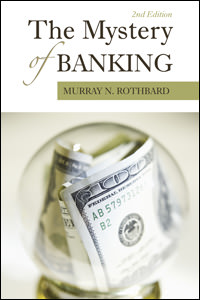
The Mystery of Banking is Murray N. Rothbard's argument that modern banking can be understood, and judged, with a balance sheet and some arithmetic. Richardson & Snyder published it in 1983; the Mises Institute's 2008 second edition carries Douglas E. French's preface and Joseph T. Salerno's foreword, plus Rothbard's later appendix on Scottish banking. His case runs from the demand for money through deposit banking and central-bank reserves to a plan for abolishing the Federal Reserve, and the conclusion's monetary figures come from 1981 and 1982. The T-accounts let anyone check each mechanical step before weighing his radical verdict on fractional reserves, and even a reader who rejects it learns to separate creating money from moving it.
A loan company comes first. Rothbard funds one with $10,000 of his own savings, and its lending shifts existing money to borrowers while the total stays the same. His deposit bank, holding $50,000 of deposited gold, lends Smith $80,000 of newly issued receipts: an IOU enters the asset column against a matching demand liability, and money in the example rises to $130,000. Repayment runs the entries backward. Default leaves the liability standing after the asset is lost, which gives the bank a solvency problem. Rothbard also allows that real banks mix both businesses, lending some saved funds alongside created deposits, so intermediation accounts for part of the ledger.
His fraud charge rests on a normative premise: a demand deposit ought to be a bailment, with the money remaining the depositor's property like grain in a warehouse. He concedes that English law went the other way. Drawing on J. Milnes Holden's treatise, he reports that the House of Lords in Foley v. Hill (1848) made deposited money the banker's property and the depositor a creditor; the judgments reach the reader through that secondary account. A bank unable to redeem every deposit on one day faces a liquidity mismatch, which by itself shows neither negative equity nor a crime under present law.
Earlier chapters separate the demand to hold money from the demand to borrow it. If people want smaller cash balances at existing prices, they spend the surplus and bid prices up until the same stock of money does its work at a higher price level, so prices can move while the quantity of money stays fixed. Swapping a deposit for notes changes the composition of the public's money while leaving the total intact, though bank reserves fall by the amount withdrawn. Any later contraction of credit depends on how close banks ran to their target ratio and on lending conditions.
In Rothbard's free-banking model, entry is open and no central bank stands behind the system. Banks may hold fractional reserves, and the model's single legal rule, as for any business, is prompt payment: redeem notes and deposits on demand or close as insolvent. Rothbard grants that contagious runs bring deflation and failures, and he treats a run as a late, costly check. The earlier restraint is each bank's limited clientele. A borrower spends new notes with someone who banks elsewhere, and the rival bank presents them for redemption, so a bank that expands faster than its competitors loses reserves while its own customers still trust it. His figures are hypothetical and assume the losing bank cannot fund the shortfall; they show which way the pressure runs without proving that every clearing deficit ends in failure. The model leaves banks free to try a cartel against that pressure, and he predicts such cartels would prove unstable. Fractional free banking is his second-best arrangement, ranked behind enforced full reserves, and he treats the currency standard and the choice between free and central banking as separate questions.
In the central-banking chapters, a Fed purchase of a $100 desk from Rothbard raises his Citibank deposit by $100, and once Citibank presents the Fed's check, its reserves rise by $100 too. Buying government bonds from a bank instead swaps one bank asset for another and leaves public deposits unchanged at first. He derives a money multiplier equal to the inverse of the reserve requirement, valid while ratios stay fixed and banks remain fully loaned up, and he notes the excess reserves banks piled up in the 1930s amid fear of failures and scarce trustworthy borrowers. A 2014 Bank of England Quarterly Bulletin article, Money creation in the modern economy, offers a later contrast. Its published summary agrees that lending creates deposits, as Rothbard's matched entries show, and adds that the quantity of reserves does not mechanically limit lending, placing the main constraint with monetary policy. That contrast confines the multiplier to the regime Rothbard modelled and leaves his warehouse argument untouched.
Rothbard's closing plan runs on his account of end-1981 balances: M-1 stood at $444.8 billion, and defining the dollar as 1/1696 of an ounce would value the gold behind the Fed's dollar-denominated certificates at that whole sum. Gold would redeem Federal Reserve notes and pass to commercial banks before the Fed liquidated itself, leaving each bank with full reserves and equity written up by the same amount. Rothbard treats the Fed as able to hand over the metal, while noting that its holding is technically a claim on Treasury gold. The Federal Reserve gold FAQ says ownership passed to the Treasury in 1934 and that the Fed's certificates carry no title to the gold and no right of redemption in metal, so the plan presupposes a change in law reallocating Treasury gold, a step readers must supply. He calls the equity gift to banks the strongest objection. Pricing gold near $500 to cover the notes alone would force the money supply down to existing reserves, and he accepts the gift to avoid that deflation and the bankruptcies that would follow. His $1,696 figure is arithmetic on those balances and says nothing about later gold prices.
A correction separates the editions. Rothbard's original text praised Scottish free banking, following Lawrence White's account; the later appendix withdraws that praise and calls his earlier acceptance uncritical. He argues that the Scottish banks pyramided on the Bank of England and performed no better than English ones, and he faults White for offering no comparative data on money or prices. Part of the disagreement depends on the test applied, since a low count of failures and restraint in credit expansion measure different things. Settling the history requires White's work and the Scottish record alongside this revised case.
Read the book to trace how a loan or a central-bank purchase moves through balance sheets. Arithmetic and basic supply-and-demand diagrams are the prerequisites. Expect a combative tone, including a comparison of fractional reserves to a Ponzi scheme; because the conclusion's monetary figures date to 1981 and 1982, present-day operations call for current central-bank sources. The Mises Institute offers the second edition as a free PDF: The Mystery of Banking, second edition PDF.