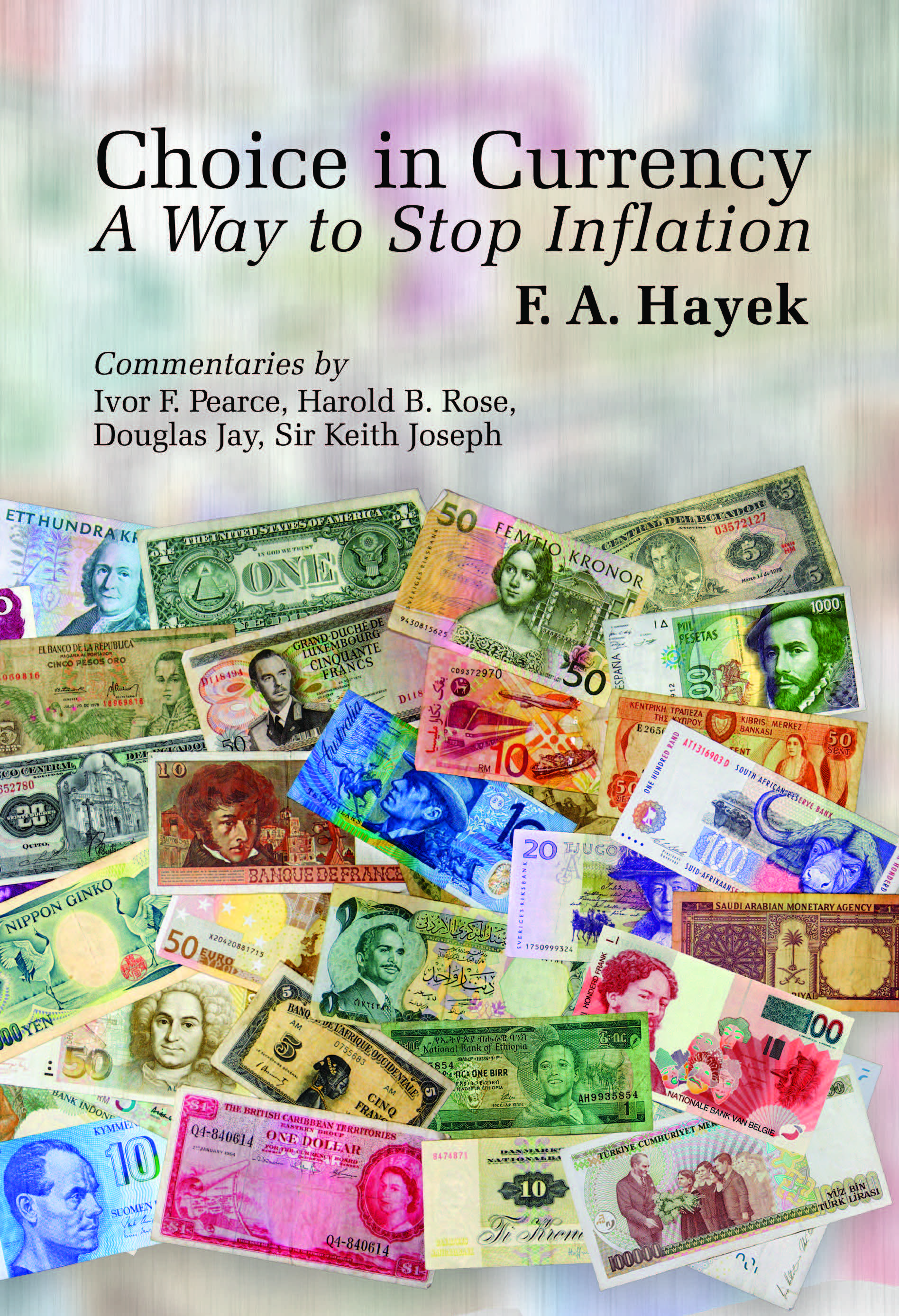
Choice in Currency argues that governments would restrain the issue of money, and inflation would slow, if people were legally free to hold, account and contract in other currencies. The text is Hayek's edited Lausanne address of 25 September 1975, issued by the Institute of Economic Affairs as Occasional Paper 48 in 1976 and republished by the Mises Institute in 2009. Seldon writes the preface, four commentators reply separately, Sudha Shenoy compiles historical and theoretical excerpts, and a 1975 Financial Times report is reprinted. The pamphlet repays reading because it ties the proposal to a narrow legal change and prints serious objections beside it.
Hayek grants that monetary expansion can raise employment fast and that a desperate government could be justified in buying brief relief that way. His charge is that such employment is unstable and perpetuates fluctuations. He even concedes that an intelligent, wholly independent monetary authority could outperform an international gold standard. His objection is political: any authority exposed to organized groups that gain from extra spending will end up serving them, whatever central banking could achieve in principle.
Hayek attacks the government's monopoly claim, including its powers to limit the monies usable in contracts and to fix exchange rates between them, and leaves governments free to issue. His concrete request is a treaty among European Economic Community or Atlantic governments not to restrict the use of one another's currencies within their territories, including trade at any agreed price and bookkeeping in them, with banks free to branch across borders. An issuer that keeps supply below the demand to hold its money sees that demand grow, while one that debases can no longer hide behind compulsion and must restrict issue or lose holders.
Legal tender survives in a narrow sense: a government that issues money must still say what discharges debts contracted in it and how taxes and liabilities for damage are paid. Private parties may choose another unit for their own sales and contracts, and nobody becomes obliged to sell against any particular money, so a merchant may decline a currency he distrusts. Courts and enforceable treaties remain.
Hayek's answer to Gresham's law is the book's most portable insight: bad money drives out good when law fixes the rate at which both must be accepted. Under freely agreed rates the trusted money tends to win, as in great inflations when people turned to other monies, even cigarettes and brandy, despite severe penalties. He expects national currency to stay in everyday retail use unless badly mismanaged. Pressure would come from the willingness to hold money and from business and capital transactions moving to a more reliable standard for calculation and accounts. Employers could also write wage agreements in a currency they trust. Calculators would ease conversion, though spreads and the cost of leaving a currency everyone nearby uses would remain.
The long-run section stays open where a pamphleteer could have promised. Hayek argues that competition would not breed deflation, since borrowers avoid a currency expected to appreciate as lenders avoid one expected to depreciate, a symmetry economists can contest. He leaves open whether a government currency or ounces of gold would prevail, and he judges a return of gold likelier through free choice than through any organized restoration. On our reading, competition rewards the relatively better issuer, which falls short of proving absolute price stability.
Rose presses the strongest objection: once exchange control goes and rates float, interest rates and forward exchange rates already reflect trust in each currency, so ending legal tender adds little. He adds that governments can inflate together and doubts they would abolish exchange controls more readily than accept direct monetary limits. Jay imagines a bus conductor refusing a rouble with nobody able to rule on the fare, and likens the scheme to abolishing courts. His picture assumes a retail free-for-all, yet the text keeps legal rules for debts in state money and expects national money to stay in shops, so his worry about dispute and conversion costs survives in weaker form. Joseph sees partial protection worth exploring, and Pearce's claim that hoarding unemployment is transient stays his own.
Shenoy's compilation supplies secondary history that supports the argument without testing it. The German excerpts admit that some private emergency monies depreciated or were abused, and Bresciani-Turroni calls the estimates of foreign money in circulation unreliable. In his account the rentenmark was accepted though it was inconvertible paper, because the public took the new name for a new money and believed in its mortgage guarantee. That confidence, he argues, depended on strictly limited issue, and it grew stronger when the Rentenbank's management refused a government attempt to exceed the limit in December 1923. He adds from personal observation that in the cities the paper mark was not rejected, while appreciated foreign currencies were taken more willingly. Credible limits on issue thus sustained confidence without convertibility in his telling, and the excerpts cannot isolate a single cause.
The pamphlet preceded Denationalisation of Money (1976, expanded 1978), which admits private issuers and sketches an elastic unit, the ducat, aimed at stable purchasing power against a price basket and backed by a redemption floor distinct from that target. Choice in Currency asks for less: legal freedom to use existing monies, with national issue intact and its critics printed alongside. Read it to see how a narrow legal change, secured by treaty and cross-border branching, would make issuers compete for holders, and which objections it must survive. Some familiarity with 1970s British exchange control and the Keynesian employment debate helps. Readers persuaded here can take the issuer design from the later book. The text is available as the Original PDF, Mises Institute 2009 edition.