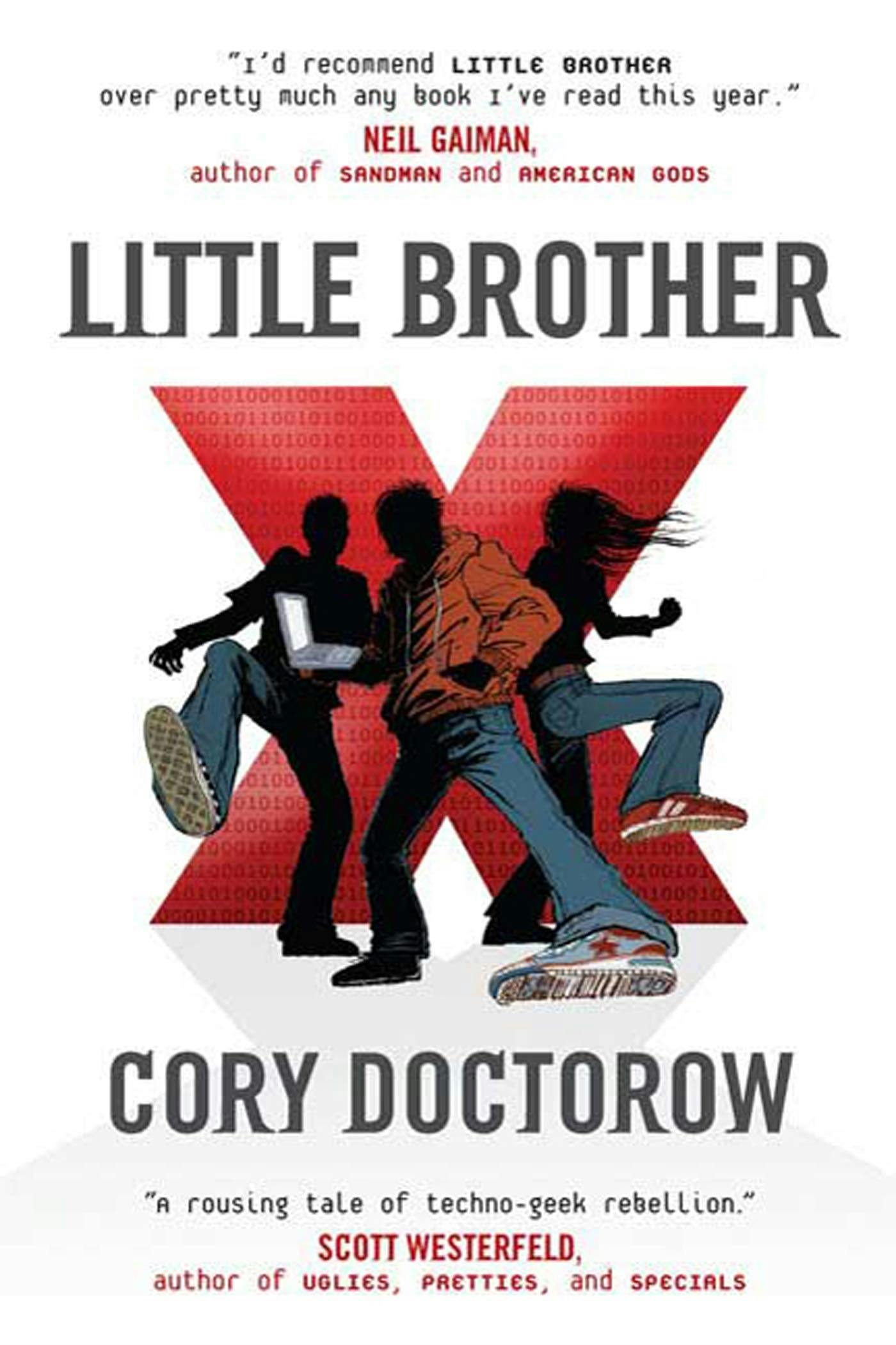
Cory Doctorow's Little Brother is a 2008 novel for teenage readers. It follows Marcus, a San Francisco high-school student, after a terrorist attack on his city. Homeland Security agents detain Marcus and his friends, interrogate them and release him with a threat of prison if he talks. He comes home to a city of checkpoints and data mining. His answer is the Xnet, an encrypted network that passes traffic from one game console to the next until it reaches the internet. The novel is worth reading because it treats surveillance and resistance as decisions with technical and social consequences. Each move Marcus makes changes what the authorities can observe, and each new ally changes whom he has to trust.
The first problem appears when Marcus realizes that encryption hides what Xnet users say but leaves visible how much ciphertext they send. An agency tapping the whole internet can look for households whose traffic departs from the average without reading a single packet. Jolu proposes changing the average itself. He works at Pigspleen, an independent internet provider serving more than half the broadband connections in the city, and he suggests encrypting the large music downloads that its indienet service distributes for independent labels. If ordinary customers routinely carry that much ciphertext, Xnet users look like everyone else. Marcus helps him with the work. That answers a different question from keeping messages secret. The scene teaches a reader to ask what an observer can still learn from outside an encryption boundary, and it shows that blending in can depend on the habits of a whole population. The novel offers this as a plan inside its 2008 story, and readers should take the lesson about baselines without treating the scheme as a present-day defense.
Doctorow then turns statistics against the watchers. Marcus explains why a screening system aimed at a rare target flags far more innocent people than guilty ones, using an invented disease and a hypothetical terror detector. His numbers are a teenager's illustration, and his loose use of "accuracy" is no substitute for a statistics text, but the mechanism drives the plot. Marcus and his allies interfere with the RFID tags that feed the city's travel records, so the system produces more suspects than investigators can clear. They exploit the burden that broad classification already places on its operators, and they never need to break into a database. Readers come away able to separate two questions: how a classifier performs across a population, and how much weight one accusation deserves.
As the Xnet grows, informers can join it too, and the book moves from hiding to authentication. Marcus and Jolu plan a key-signing session disguised as a teenage party, because the web of trust Marcus has in mind requires its members to meet in person at least once to get started. That meeting is itself a gathering the authorities could notice. The scene turns an abstract protocol into a coordination problem with a guest list and a cover story. Marcus calls the method nearly foolproof; the story is more careful than its narrator. A verified key tells you who sent a message, and the characters still have to judge whether that person deserves trust.
The detention chapters mark a boundary encryption cannot reach. Interrogators work through fear and through the friends held alongside Marcus, and the threats follow him home as silence. The book depicts coercive detention and torture. Tor Teen lists it for ages 13 to 18, and readers should expect those scenes. Later, Marcus tells his family what happened, and the conflict expands into journalism and law. A secure channel can carry testimony, but it cannot make strangers believe it or make an institution answer for it. Doctorow leaves accountability incomplete at the close, and the details are better met in the book.
Each layer of protection in the novel moves the contest to the next weakness: from message content to traffic patterns, from patterns to classification, from data to people, and from people to the public institutions that can confirm or ignore what they say. The technology belongs to 2008 and works as a narrative device. Readers should not treat it as current operational advice or as a security guarantee. Questions about present-day protocols need present-day sources.
Doctorow offers the novel as a free download at https://craphound.com/littlebrother/download/ under a Creative Commons Attribution-NonCommercial-ShareAlike 3.0 license, which allows sharing on those terms. His ebook carries the 2008 text along with an introduction, afterwords and later notes on availability. The Tor Teen print edition runs to 384 pages.
Read Little Brother for a story that ties traffic analysis and key verification to the slower public work of disclosure and legal accountability. Expect Marcus to explain things in the middle of scenes, sometimes at the length of a lecture. Readers who want fiction without exposition will notice those passages. Readers who want the reasoning will find it tied to consequences they can follow.