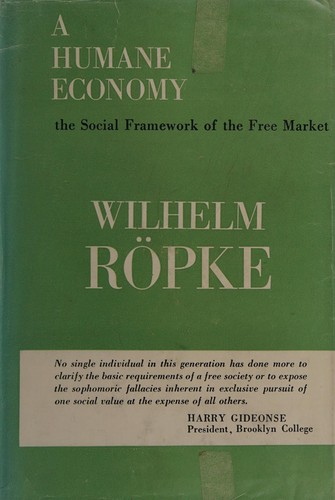
A Humane Economy argues a claim many market defenders state and few develop: the price system coordinates economic life well, and its survival depends on conditions it cannot fully produce. Wilhelm Röpke published it in German in 1958 as Jenseits von Angebot und Nachfrage, and Elizabeth Henderson's English translation appeared in 1960 with the subtitle The Social Framework of the Free Market. Röpke writes as an economist who trusts prices and competition and as a Christian conservative who locates the deciding conditions in property, family, community, law and money. Read it to watch both commitments argued together, each correcting the other.
Röpke's economic argument starts from a distinction within competition. He grants that rivalry among Soviet managers or among Yugoslavia's competing public enterprises can raise productivity. He then separates two functions: competition spurs effort, and it orders the economic process, steering resources toward what buyers value. A collectivist system can borrow the spur. Steering requires independent, privately owned firms facing scarcity prices, whose owners bear the financial consequences of their investment decisions. Any reform can then be tested by asking whether it adds incentives to a system that still lacks a regulator.
His moral argument has the same shape. Within a sound legal framework, market sanctions cultivate a minimum of honesty: whoever lies and breaks contracts loses partners, and Röpke notes that even the Soviet state built a reputation abroad for prompt payment. He credits this education, then places the market's deeper moral support outside it, in standards of fairness, restraint and public spirit formed in families, churches and communities, which competition strains and draws down. That dependence leaves open how far a given competitive act draws on those reserves, and his own account of market-taught honesty shows competition also supplying a minimum of reliable conduct. He also rebukes moralists who judge ordinary self-interest by standards no society has met.
Property carries much of the structure. Röpke defines proletarianization by dependence and rootlessness, a life in which a person owns little, belongs nowhere and relies on an employer or the state; low income is only one part. Mass society means atomized individuals whose intermediate institutions have broken down, and an individualism that dissolves families and associations feeds that dependence. His remedy, decentrism, joins personal autonomy to small associations, wide ownership, federalism and family tradition, and asks its adherents to remain universalists. Competition, on this view, works best among people who have somewhere to stand when a market turns against them.
The final chapter draws policy from this. As independent proprietors become employees of large concerns, the market economy loses part of its human advantage, though job changes, free trade unions and the rule of law keep escape routes open. Röpke supports employee responsibility and a voice inside the firm, at times reaching into management, while attacking union monopolies enforced by compulsion. Against concentration he would slow or reverse the loss of independence only where economic rationality suffers no real damage, and he rejects new compulsory legislation as a cure. He calls instead for research into how tax and company law favor big firms, suggesting sales-tax reform and an end to double taxation of distributed profits.
The welfare chapter applies the property argument to saving. Compulsory public providence competes with saving, insurance and family or group aid; as it grows it erodes the ability and willingness to provide, feeding demand for more. Röpke still keeps a compulsory minimum of public pensions, health and accident insurance, widows' benefits and unemployment relief, subsidiary aid that keeps the weak from destitution where private resources fall short. His test is whether the floor leaves people willing to build above it, and he cites Switzerland and the United States, where savings and private life insurance rose after compulsory old-age insurance arrived. Crowding out therefore depends on a system's extent, organization and spirit.
In his monetary analysis, Röpke treats inflation and deflation as twin diseases; he opposed deflation in the 1930s and later the postwar full-employment doctrine he blamed on Keynes. He traces inflation to fiscal spending, imported pressure, investment beyond voluntary saving and wages outrunning productivity. He separates inflation proper from relative price changes: wages that rise in sectors with rising productivity spread through the labor market to comparatively low-productivity services, making those services dearer without necessarily causing general inflation. A wage-price spiral, he argues, needs continual injections of new money; without them, employers paying higher wages must dismiss workers and buyers cannot purchase the same goods at higher prices. A central bank can technically stop the spiral, and the obstacles are political, chiefly transitional unemployment, hence his case for independent central banks. His forecast of ever-accelerating inflation is a strong prediction of its time.
The closing section, Reckoning Without Man, turns this concern on method. Röpke accepts mathematical illustration, historical statistics and the probabilistic forecasting that planning requires; his target is the habit of treating aggregates as mechanical quantities whose past elasticities license confident prophecy. His entrepreneur works under uncertainty, disciplined by profit and loss, and sometimes tempted toward cartels and protection.
The cultural critique is openly Christian, conservative and Eurocentric; its judgments on cities, modern art and other civilizations rest on anecdote, literary reference and preference, and include Cold War rhetoric and dated racial and demographic claims. Read those as the author's commitments. A second tension runs from dispersed ownership and chosen community toward settled hierarchy. Röpke defends inherited wealth as the ground of a public-spirited natural aristocracy, attacks heavy death duties, praises families that hand occupations from father to son, fears that equality of opportunity turns society into a permanent race, and finds it reasonable for townships to delay giving newcomers the rights of original inhabitants. He keeps government by consent, rights against majorities and compulsory education, yet the book leaves readers to reconcile delayed local rights for newcomers with those liberal commitments. The newcomer to a town resembles the entrant to a market, and the competition he praises disciplines incumbents by admitting outsiders. A reader can accept his case for rooted associations and still ask what evidence would show they need protection from open entry.
Read A Humane Economy if you already understand how prices coordinate and want an argument about the legal, moral and social conditions that keep that coordination humane and politically durable. Expect a sweeping midcentury polemic, rich in literary reference, that ranges from German postwar recovery through mass society, the market's limits, welfare and inflation to decentralization. It serves poorly as a price-theory text or a current policy manual and well as a sparring partner for anyone who treats markets as self-sufficient. The Mises Institute publishes the official text, reproducing the 1961 second printing.