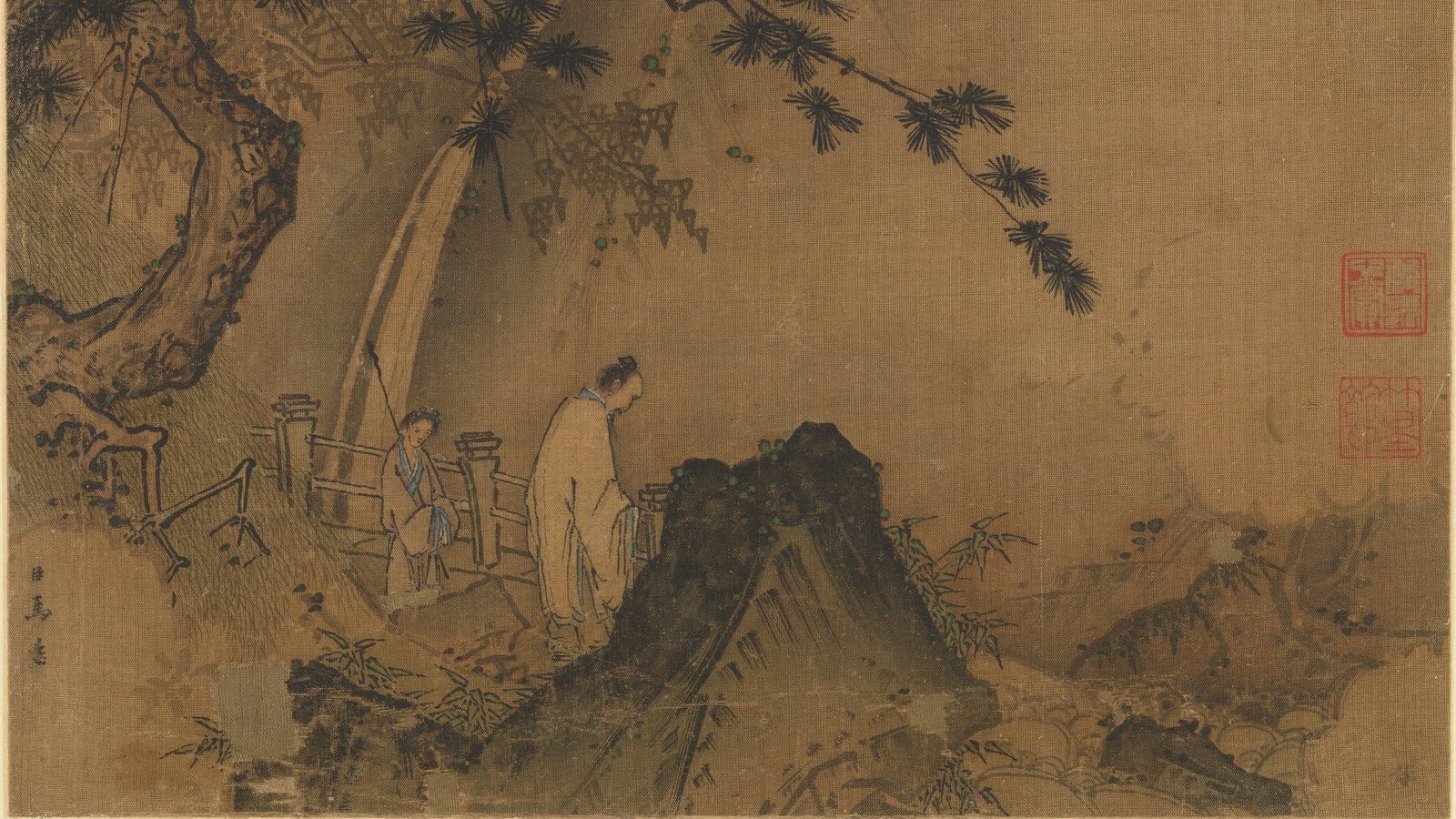
The Great Learning is a short treatise of the Confucian school that rests the peace of an empire on the inner condition of those who govern it. Its opening chapter names three aims: to illustrate illustrious virtue, to renovate the people and to rest in the highest excellence. It then runs a chain in both directions. Ordering the empire requires ordered states, regulated families, cultivated persons, rectified hearts, sincere thoughts, extended knowledge and the investigation of things. Cultivating the person is the root "from the emperor down to the mass of the people." Ten brief commentary chapters take up the links, ending with a long chapter on how rulers gain or lose their people and their wealth. The text reviewed is James Legge's translation in the 1869 second edition of The Chinese Classics, volume 1, available from the Online Library of Liberty. The date belongs to the translation. Legge assigns the treatise to about the fourth century before our era. Its strength is one connected observation: what a person permits himself unobserved, and how he judges people he favours, become the habits he brings to authority. Its promise that such cultivation yields a tranquil empire is weaker, and Legge says why.
The first habit is concealment. Commentary chapter VI defines sincere thought as allowing no self-deception and illustrates the failure. The mean man, dwelling retired, proceeds to any evil, then disguises himself when a superior man appears. The disguise is useless, since what is within shows without. Hence the repeated instruction to be watchful when alone. Chapter VIII moves the test from conduct to judgment. Affection, contempt, awe, pity and arrogance each make a person partial, so few who love know the faults of the beloved, and few who hate know the merits of the hated. The adage gives the household case: a man does not know the wickedness of his son, nor the richness of his growing corn. These are moral illustrations. A reader can check them against his own solitary conduct and his verdicts on familiar people.
Chapters IX and X extend family example to rule and supply the treatise's most exact instrument, the measuring square. What a man dislikes in his superiors he should not display toward inferiors, and what he dislikes in inferiors he should not display in serving superiors. The same holds before and behind, right and left. Legge reads it as the golden rule in negative form. The mechanism is positional. One act is judged from every seat in the hierarchy, so a man who gains authority is held to the standard he applied while subordinate. The rule assumes monarchy, filial order and teaching by example. It constrains rank without dissolving it, which lets a reader tell a reciprocal standard apart from deference to whoever stands higher.
The rule then reaches personnel and revenue. Virtue is the root and wealth the result. A ruler who reverses them will wrangle with his people and teach them rapine, and accumulating wealth, the text says, scatters the people. A quoted duke of Ts'in condemns the minister who resents ability and blocks its advancement. The text asks for many producers and few consumers, activity in making and economy in spending, and Legge's note identifies the consumers as salaried officers. A ruler who makes revenue his chief business, it says, is under the influence of some small, mean man. The claims are unquantified and form no theory of property or taxation. They still offer criteria for judging an administration: the condition of the people and the competence of officers, ahead of the treasury's size.
Legge's introduction states the limit. He reads the seven steps as a rhetorical climax whose earlier links never establish the passage from states to empire. In his account, the empire chapter repeats the state chapter's claims, and beneath both lies an assumption that example is "all but omnipotent." His translation follows the arrangement of Zhu Xi (Legge's Choo He) while disputing it. He rejects the split into Confucius's text and Tsăng's commentary, prefers "love" to the reading "renovate," and calls Zhu's supplied passage on investigating things too extravagant.
Read the seven paragraphs on PDF page 161 first, then commentary chapters VI, VIII and X. Then turn to Legge's introduction (pp. 26-31) and notes (pp. 259-266), sorting each sentence into received treatise, Zhu's insertion or Legge's judgment.