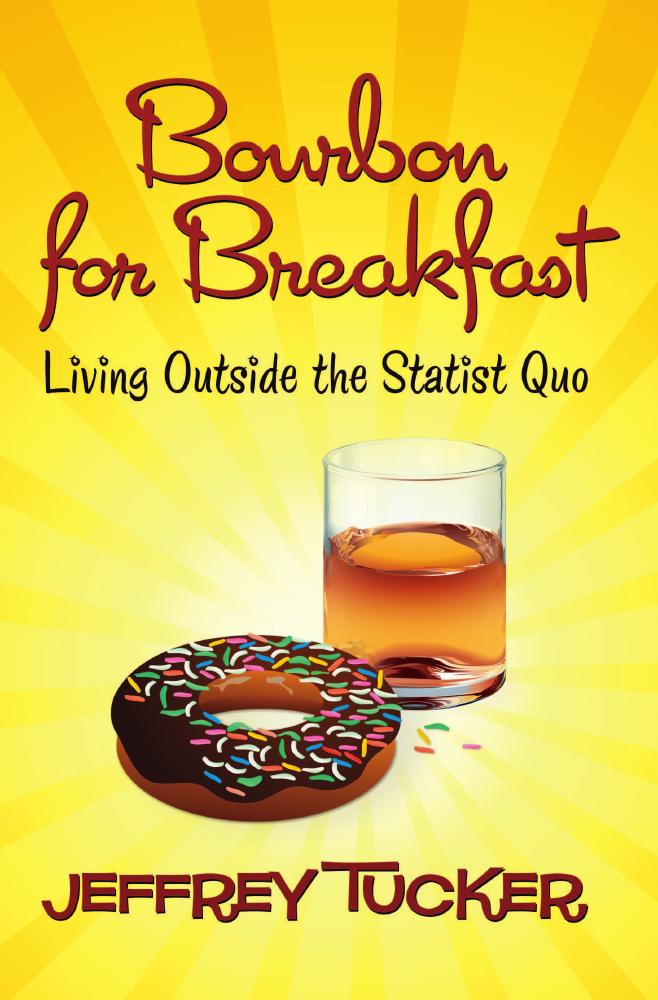
Jeffrey Tucker's Bourbon for Breakfast, published by the Mises Institute in 2010, gathers 71 dated essays under headings that run from water and life through commerce, technology, crime, manners, food, books and movies. The title recalls a breakfast at which a Southern scholar offered bourbon in the coffee, and the introduction builds on that small shock: people live in two realities, the one government imposes and the one they make for themselves. Tucker argues that official edicts, together with conventions absorbed without examination, shrink the range of lives people think available, and that economic reasoning and private culture can widen it.
Not every piece argues. An essay celebrating the electric fan stops where a writer would normally justify the topic with a history lecture or a defense of free enterprise, declines both, and notes that the economic point is obvious because fans are available everywhere. Its praise of comfort is comic testimony that traces no annoyance to a statute.
Where Tucker does argue, economics carries the load. A 2008 commerce essay sets two people baking pies and bagels, one faster at both. Because an hour of pies costs each baker a different number of forgone bagels, the slower one can devote the whole day to bagels while the faster one shifts toward pies, raising total output enough that a trade can benefit both. The figures are invented to illustrate opportunity cost; they explain why an outmatched partner still has something to sell and measure nothing about any actual market.
The same view of cooperation drives a 2009 essay on copyright, which describes an academic book on business cycles kept in print in a technical sense at a price suited to state-funded libraries, while the publisher holding its rights would produce a paperback for the Mises Institute at a high price. Tucker blames convention and contracts backed by state power and urges authors toward open licenses. The essay is dated advocacy anchored in one dispute, and contract terms differ among publishers, yet this book carries a Creative Commons Attribution 3.0 license on its copyright page, and the Mises Institute hosts the complete PDF at complete Bourbon for Breakfast PDF under that notice.
A 2006 essay on computers carries the argument into security, describing an endless contest of attacks and patches, with running disputes over disclosure, in which he judges competing private developers better placed than bureaucracies answering to political incentives. That verdict draws on anecdote and his reading of motives, and the private approaches he describes remain fallible and in competition with one another.
The jail essay turns coercion into narrative. Told in the third person though the introduction marks it as autobiographical, it follows Inmate 501 from a stop-sign ticket through a missed payment and court date to arrest and discretionary humiliation under crackdown politics. Tucker generalizes that every law, however mild, is finally backed by a threat of force. The episode supplies texture; the generalization rests on his political premise.
Private creation is the counterweight. A 2002 essay on kneading bread by hand presents baking amid war and recession as making something new and giving it away, framed in Catholic sacramental language, while admitting his fondness for time-saving devices. It argues from preference and meaning yet belongs to the freedom argument because it shows what people do with the room coercion leaves them.
The anthology closes with a 2009 essay tracing Tucker's shifting judgments of Nixon. He respected the opening to China and arms talks with Moscow while condemning the EPA and the move to a pure paper dollar, and he welcomed the resignation for exposing the vulnerability of the presidency. It then reviews Oliver Stone's 1995 film Nixon, whose plot links its subject's rise to a covert plot; Tucker calls that account a theory he finds plausible, and a dramatization cannot verify it. His stated point concerns power: he credits Stone with refusing a civic religion that treats the American system as immune to the corruption he finds in every regime.