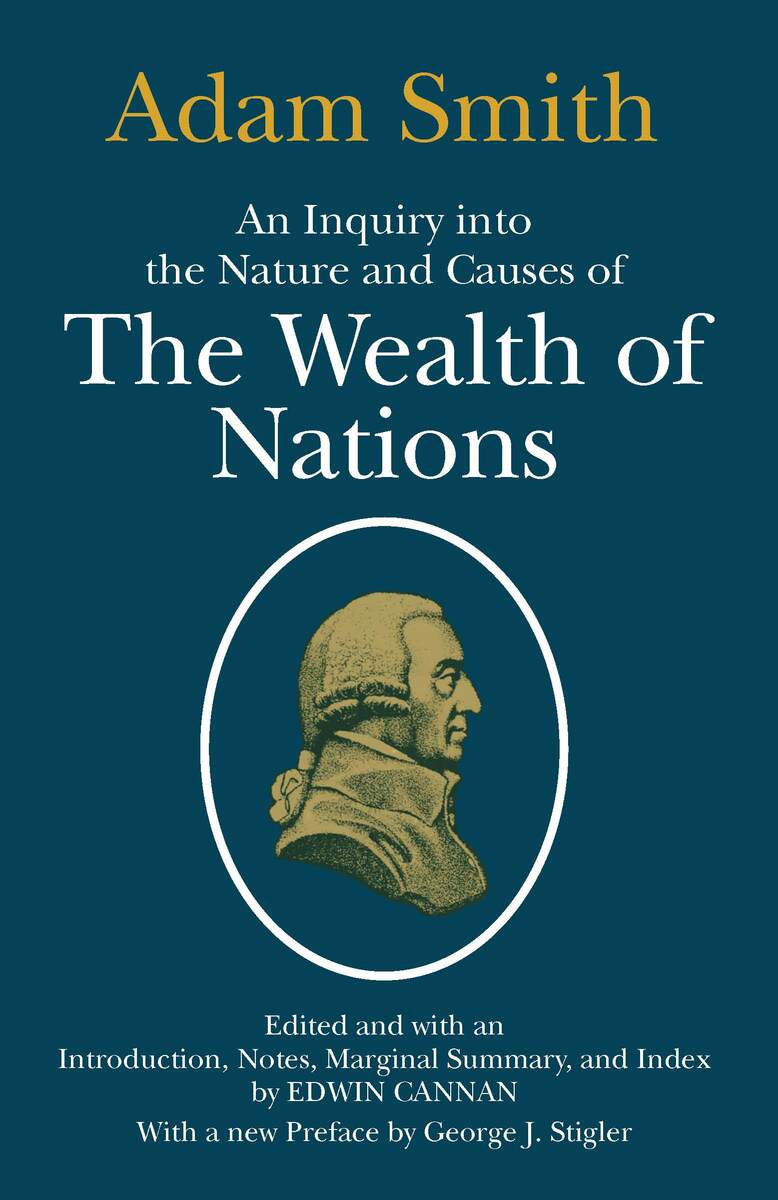
Adam Smith published his inquiry in 1776, and its five books build one argument: how labour grows productive and how its produce is shared; how capital accumulates and finds employment; how wealth advanced in different nations; how commercial and agricultural systems of policy compare; and how a sovereign should meet public expenses through taxes and borrowing. Edwin Cannan's 1904 edition, which follows the fifth lifetime edition, appears in Liberty Fund's 2011 two-volume online files, and his introduction, notes, marginal summaries, and index are editorial additions distinct from Smith's text.
Smith credits divided labour with dexterity and with time saved when a worker stays at one task. He adds that attention fixed on one object tends to suggest machines that ease the work. His pin workshop, where ten workers shared about eighteen operations, is a reported observation from his century, and its figures illustrate a historical argument. Farming resists such separation because its tasks return with the seasons. Chapter three adds the governing constraint: divided labour depends on the power to exchange. A Highland nailer working at a thousand nails a day would find his remote district unable to buy one day's output in a year. Market extent therefore means paying demand within reach of bearable carriage costs. Coasts and navigable rivers improved first for that reason, since sheer numbers count only where goods can travel. Read for transaction costs, these chapters explain how transport and institutions bound specialization.
Exchange between town and country carries that logic into Book Three. Country produce feeds the town and supplies its materials while the town pays in manufactures. Smith insists that both sides gain, and farmers near the town also save the cost of carriage. At equal or nearly equal profits, he argues, owners favour land because stock under their own view feels safer; the same reasoning ranks manufactures above foreign trade, so capital in a natural order would move from agriculture through manufactures to foreign commerce. Smith presents this stylized sequence as observed in some degree wherever a society held territory, and he states plainly that modern Europe had in many respects inverted it. There the foreign commerce of cities introduced finer manufactures, which later spurred the main improvements in farming. He also allows that a society short of capital gains when foreign merchants carry its surplus abroad, freeing domestic stock for more useful work.
Import restraints draw out Smith's habit of comparing alternatives. Duties and prohibitions give producers a home-market monopoly and steer labour and stock toward the favoured trade, yet total industry stays bounded by capital. He allows that a protected manufacture may arise sooner, then asks what the same capital and consumer spending would otherwise have achieved. His passage on private investment and public revenue sits inside that argument and assumes nearly equal profits among uses, with owners who prize the security of nearby stock. It also credits local knowledge that a distant lawmaker lacks, and even within those limits Smith claims only that self-interest frequently serves society. Defence justified the Navigation Acts despite their commercial cost, and an import duty matching a tax already laid on the domestic good keeps competition level. Retaliation earns approval where it is likely to win repeal of a foreign barrier. Humanity, he adds, counsels restoring free trade by slow steps where protection has gathered many workers and much fixed capital. Readers expecting absolute laissez-faire will meet a reasoned presumption, argued case by case.
Public works draw the same scrutiny of incentives. Smith gives the sovereign a duty to maintain works useful to a great society whose profits would fall short of repaying any individual builder. He prefers that users pay tolls, which tie charges to the wear they cause and keep projects where commerce wants them, and he favours local revenue for local works. Canals and roads then diverge. A neglected canal becomes impassable, and private owners of its tolls lose their whole profit; Smith reports that the Languedoc tolls went to Riquet, the engineer who planned the work, and that they formed a large estate for his heirs, giving the family a strong financial reason to maintain the canal. A neglected high road stays passable, so a private toll holder could let repairs lapse and still collect nearly the same tolls. For that reason Smith assigns road tolls to trustees, and he concedes that complaints of abuse by British trustees were in many cases just. His reports on France and on toll proportion remain period reasoning about incentives.
Schooling turns the gains of the first chapter into a public problem. Endowed salaries and captive pupils weaken the pressure to teach well, while student fees keep reputation in play. A life spent repeating one or two operations, Smith warns, can dull a worker's understanding and his capacity to judge public affairs, so the dexterity praised at the start carries a mental cost. His remedy starts with parish schools whose masters are paid partly by the public and partly by fees modest enough for a common labourer. Small prizes would reward children who excel, and beyond encouragement Smith would make an examination in basic literacy and numeracy a condition of entering a trade. That examination is compulsion, and a fair account keeps it in view.
His closing pages recast the colonial question as public finance. Britain, he argued, should either draw revenue from its American provinces through some union in which they share common costs, or stop paying for their defence and civil establishments and fit its designs to its means. He calls the empire a costly project awaiting returns while treating the crown's acquisitions as legitimate, so the ending reads as a budget argument, short of any general doctrine of colonial independence.
Readers curious about where debates over specialization and protection took shape, and patient with long historical digressions, will find a qualified and inquiring author; seekers of a compact textbook should look elsewhere. A good route runs from the opening chapters to the import chapter, then on to public works and education. The cover shows the University of Chicago Press printing of Cannan's text, and Liberty Fund's Online Library of Liberty hosts the official complete two-volume edition.