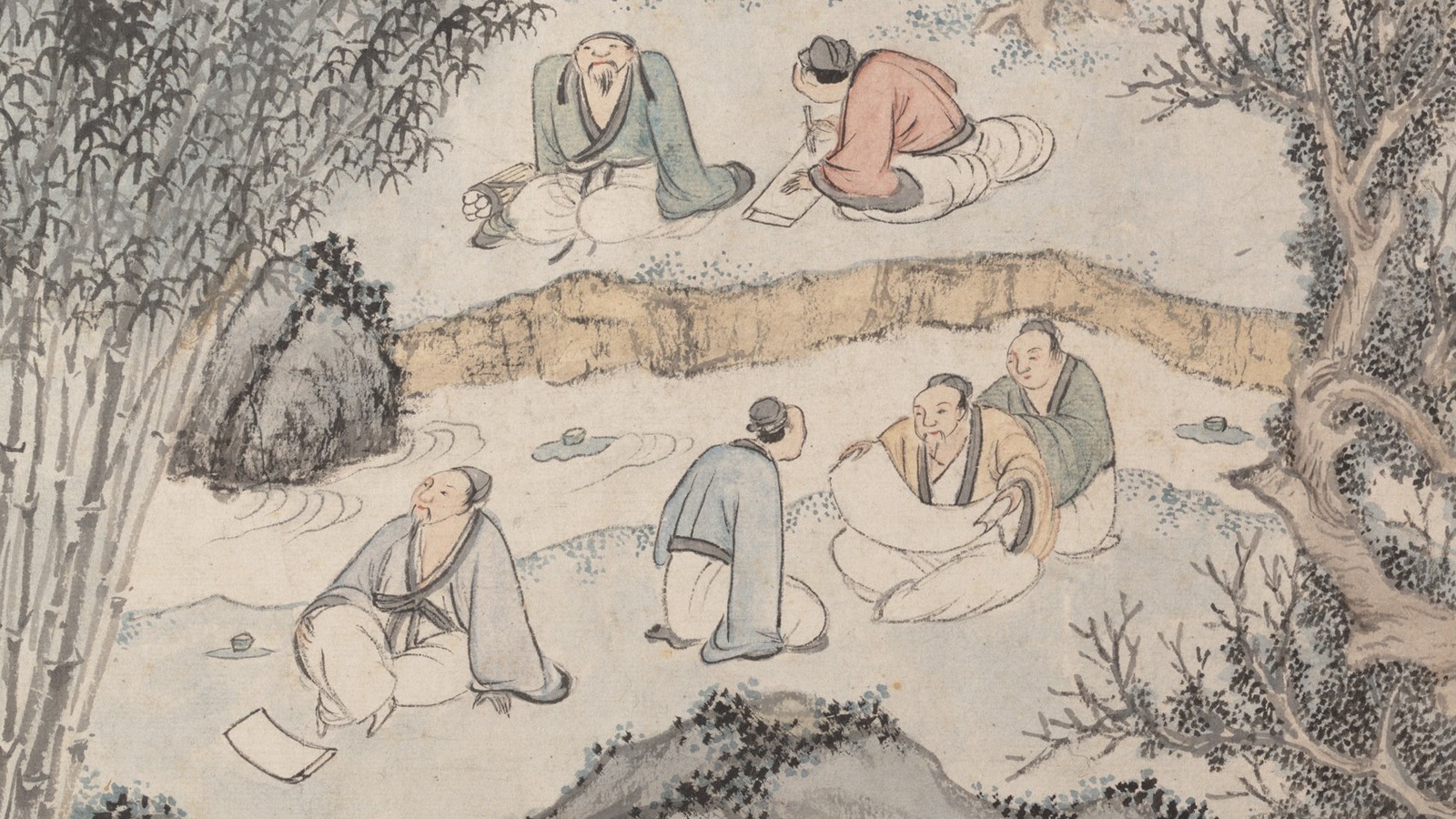
The Doctrine of the Mean (Zhongyong), a Confucian treatise of thirty-three chapters, connects the way one person governs feeling and conduct to family and court and, in its boldest chapters, to heaven and earth. It opens with a sequence: Heaven confers the nature, following the nature is the path of duty, and regulating the path is instruction. Each later extension of that sequence can be traced, so a reader can see where the argument rests on ordinary practice and where it rests on claims about Heaven and sincerity. That traceability is the reason to read it. James Legge's 1869 translation uses Choo He's chapter divisions and notes, one of which quotes his master, the philosopher Ch'ing, and adds Legge's own introduction and criticism. Legge accepts the traditional attribution to Tsze-sze, grandson of Confucius, on early testimony, and concedes that the treatise offers no internal evidence for it.
Legge argues that the English title covers only part of the project. The phrase rendered as the Mean belongs mainly to sayings of Confucius in chapters 2 to 11, which he finds out of place beside a first chapter on equilibrium and harmony. Equilibrium is the mind before pleasure, anger, sorrow or joy have stirred. Harmony follows when the stirred feelings act in their due degree, so each feeling has a proper size for its occasion. Steadfastness completes the measure. Hwuy holds fast to any good he grasps. Answering Tsze-loo, Confucius praises a person who keeps friendly harmony without weakness and, when bad principles rule his country, holds his course to death. Since the text holds that nothing is more visible than what is secret, the measure starts with watchfulness over oneself when alone.
Chapter XIII applies the measure to ordinary duties. The speaker says he has not attained four standards: serving his father, prince and elder brother as he would require a son, minister and younger brother to serve him, and setting the example toward a friend that he would require of the friend. Three of these relations are hierarchical, and the test keeps the hierarchy in place: a man measures his own service in the junior position by what he demands from juniors. The friend case asks for initiative between companions. In chapter XIV the archer who misses seeks the cause in himself, which directs attention inward and does not call every misfortune self-caused.
Chapter XX explains how a person who is not a born sage acquires sincerity: extensive study of the good, accurate inquiry, careful reflection, clear discrimination and earnest practice, spending a hundred efforts where another needs one. The chapter promises that the dull will surely become intelligent and the weak strong. Legge explains sincerity as a character complete in goodness, with no defect of intelligence and no intrusion of selfish thought, and reports that Choo He added the positive element of truth and reality. His objection targets three doctrines: that some sages are born morally perfect, that others can reach the same perfection, and that understanding the good will certainly produce it. Intelligence and goodness, he argues, are not related as cause and effect.
In the ancestral rites of chapter XIX, kin take places by descent, participants by rank and services by talent. At the general pledging the juniors present the cup to their seniors, so even the lowest participants have a part, and the closing feast seats people by age. The rites are religious acts in which the living serve the dead as they served them alive. Chapter XX makes government depend on proper men, drawn by the ruler's own character, and recommends honouring able advisers, keeping imposts light and calling on the people's labour only at proper times. In chapter XXVIII the text bars a throne-holder without virtue, and a virtuous man without the throne, from making ceremonies. Chapter XXIX names tests for a ruler's institutions: attestation by the people, comparison with the three ancient kings, agreement with heaven and earth, freedom from doubt before spiritual beings, and readiness to await a sage a hundred ages later. A reader may ask how far such standards could bind a ruler who claims to meet them.
From chapter XXII the claims widen. Complete sincerity develops one's own nature, then that of others, then the natures of creatures, until its possessor forms a third with Heaven and Earth and foreknows events through omens in milfoil and tortoise. The final chapter returns to concealed virtue and says that sincere reverence brings the whole world to tranquillity. These are the work's own metaphysical claims. Legge's verdict joins conceptual objections, chiefly obscurity and weak connections between chapters, to Christian premises about human sin.
Read it to trace which personal standards the text treats as qualifications for rule and where its cosmic premises enter the argument. Expect older romanizations and commentary set between chapters; Legge himself found some passages shadowy. His introduction, pages 38 to 45 of the PDF, maps the argument before judging it.