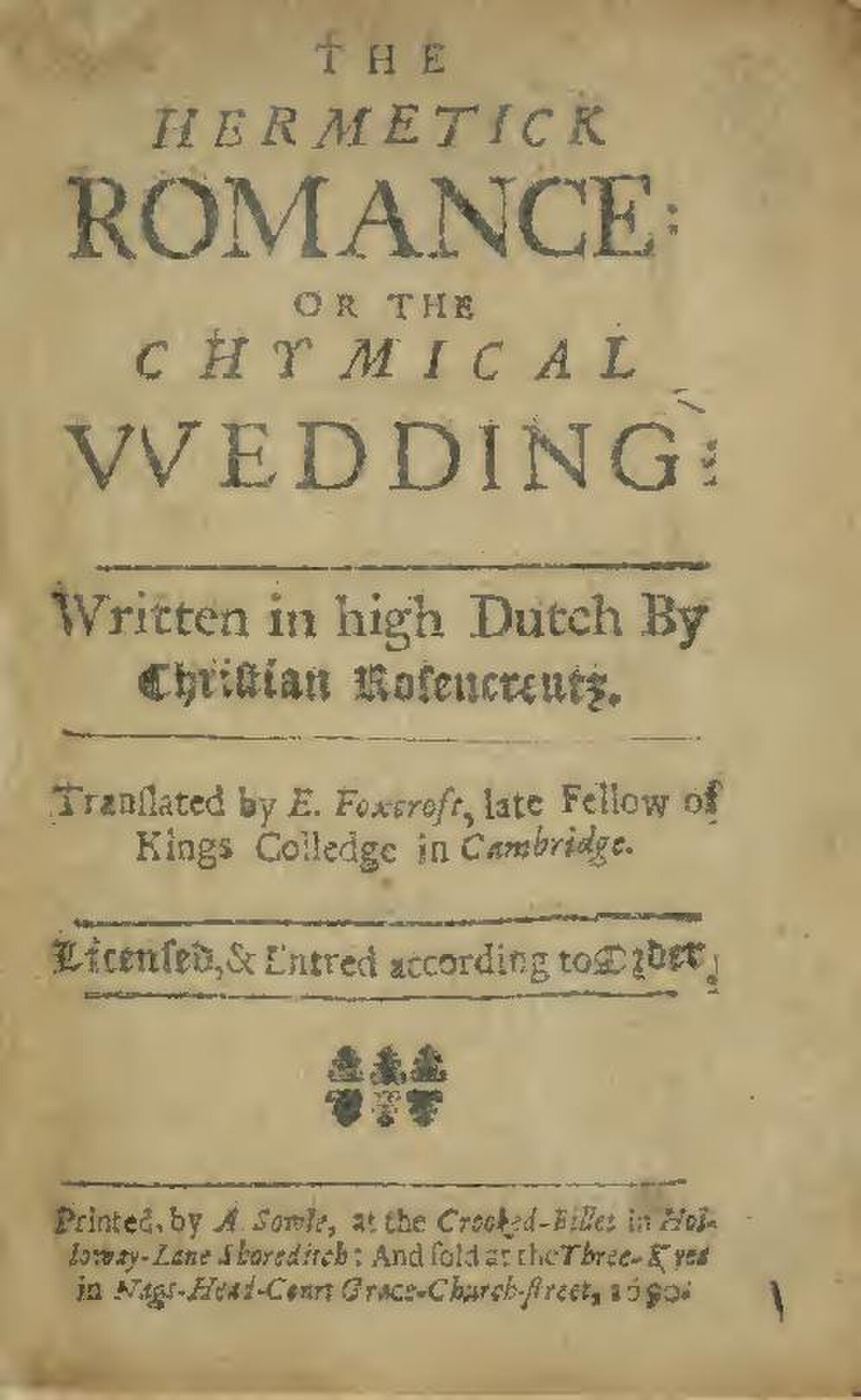
Johann Valentin Andreae wrote The Chymical Wedding, first published in German in 1616, and its title page names Christian Rosencreutz, the pseudonymous narrator. E. Foxcroft's English translation was printed in London by A. Sowle in 1690, and the Text Creation Partnership keeps a CC0 keyboarded transcription of that edition as A25376. The Fama and Confessio announce a fraternity and its program. This book is a seven-day allegorical romance, set in a fictional 1459, in which an old man accepts a wedding invitation and each stage changes what admission requires and what knowledge obliges a guest to do.
On Easter eve, during a storm, a winged woman in a star-covered gown lays a letter on the narrator's table and leaves without a word. The invitation warns off the unprepared, and the old man doubts he qualifies. The second day's forest road splits into routes that cannot be retraced, and the gatekeepers check his letter and hand him tokens for the stages ahead. Access depends on choices made with partial information and on gifts from the people who keep the route.
On the third day the assembled guests face golden scales and seven weights. Before the weighing, a virgin recites verses mocking anyone who claims a skill or an invitation he lacks. One emperor steps in with a thick book under his gown and is flung out at the third weight. Most of the great fail, though unevenly: a short emperor with a curled beard outlasts every weight and receives laurel, and some persons of quality survive the later rounds. The guests who admitted ignorance and accepted bonds the night before escape the punishment kept for the presumptuous, yet each still stands on the scale, and humility guarantees none of them a pass. Rosencreutz passes and uses his standing to help another guest. Inside the story, the scale separates a claim from a capacity.
The following castle days make the survivors an audience for a comedy and a ceremony that leaves the royal persons dead. A ship carries a chosen group to a tower, where they stop watching and start laboring under its old lord as the work climbs from floor to floor. The shift from spectator to worker changes what a guest can know, since understanding now comes through assigned tasks and each worker sees the stage of the process in front of him.
Late on the sixth day two figures formed in the tower lie on a table, ringed with torches so nobody notices how life enters them. Rosencreutz has twice seen flames descend and watches the vaulted roof. A small hole opens, a stream of fire runs down a trumpet into each mouth, and the hole closes. His companions credit the burning wreath around the trumpet, and he leaves them in that belief. Another set of artists works in gold and assumes the whole operation exists for it, though the virgin later calls gold a lesser part of the art. Read as an account of knowledge, the episode ranks observers by where they look: revelation reaches the one who watches the right spot, while torches and gold mistaken for the aim keep the rest occupied.
The seventh day turns service into rank and rank into obligation. The guests learn they are Knights of the Golden Stone and swear articles binding them to credit their order to God and nature and to aid the worthy with their talents. They laugh at the last article, which forbids any wish to outlive God's will. Each knight may make one wish. Rosencreutz chooses gratitude toward the porter at the first gate who once gave him a token, and the choice collides with a forbidden glimpse he took in a vault on the fifth day, an offense he shares with the porter. Recognition obliges him to confess, and his curiosity sets a price on the reward that none of his companions pays.
Before the seventh day ends, Atlas announces that price under the king's ancient usage: whoever shares the porter's offense must stand in his place, so the porter goes free and Rosencreutz replaces him at the first gate, with no release expected before the marriage feast of the king's future son. He puts on the porter's ring and takes the king's farewell embrace to mean he will sit at the gate in the morning. The narration reaches no morning. That night the Lord of the Tower and Atlas lead him to a lodging with three beds, and a note reports about two quarto leaves missing before the printed text breaks off. The 1690 edition gives no account of what becomes of him after that night.