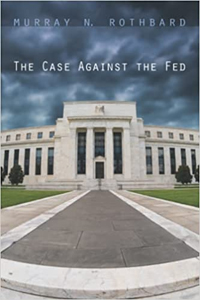
Murray N. Rothbard's The Case Against the Fed, published by the Mises Institute in 1994, argues that a central bank serves two clients: a government that wants its deficits financed, and commercial banks that want to expand credit together beyond the limits redemption and competition would set. The book is short and openly combative. Its value lies in compact monetary mechanics, which Rothbard carries into a political history of the Fed's founding and a plan for its abolition.
The argument starts by separating money from wealth. Rothbard treats money as a commodity that emerged from barter, and he holds that extra units add no houses or food. Because prices adjust to the quantity in circulation, the revealing question becomes who receives new money first. A hypothetical counterfeiter makes the point concrete: early spenders buy at old prices, and later receivers meet higher ones. His further view, that any money stock serves equally well once prices adjust, is a contested premise of his framework.
Lending receives the book's most consequential distinction. Rothbard approves of banks lending their owners' capital or funds borrowed for a fixed term through certificates of deposit; that is legitimate intermediation in his framework, and defaults are ordinary entrepreneurial losses. His target is the demand deposit, modeled as a warehouse receipt for cash. In that bailment the depositor keeps title, so lending the cash while promising instant redemption issues more receipts than goods. Citing secondary authorities, Rothbard reports that nineteenth-century British courts classified ordinary deposits as debts of the bank, with American courts following, and he argues those rulings were wrong. His embezzlement vocabulary is a normative argument about legal principle, separate from any accusation against ordinary banks today.
Under competition, a bank that expands faster than its rivals sees its checks travel through clearing to other banks, which present them for redemption, while depositors wanting cash drain reserves directly. Rothbard argues that these frictions restrain isolated expansion and that a cartel expanding in step grows harder to hold as banks multiply. A central bank relaxes both constraints by supplying reserves and standing behind the system. One useful lens separates two kinds of information: whether a bank can produce cash on demand, and who bears the loss when its assets sour. A backstop mutes the first signal and shifts the second, and there his incentive analysis earns attention.
Balance-sheet illustrations give the book its clearest pages. When the central bank buys an asset from a nonbank seller, the seller's deposit at a commercial bank rises, and that bank's reserve account at the central bank rises by the same amount; new reserves appear without anyone saving first. Rothbard then assumes banks pyramid ten dollars of deposits on each reserve dollar within weeks, a multiple he links to the legal reserve minimum of his day. According to the Federal Reserve's reserve requirements page, ratios were reduced to zero percent effective March 26, 2020, so a multiplier read off a legal requirement belongs to an earlier regime. Its two-ledger logic still repays study.
Political history fills the book's center. Rothbard argues that large financial interests wanted an elastic currency and shelter from competition. In his account, Morgan and Rockefeller groups, rivals elsewhere, cooperated on banking reform, and economists and organized conferences lent the project public legitimacy. He records resistance too: small country bankers helped kill an early reform bill. His method is stated openly, with self-interest offered as a hypothesis to investigate. Family and business ties he documents show networks of access; motives and causal control demand more evidence, and his secondary sources deserve weighing. Rothbard also dismisses a favorite theme of other Fed critics. Private bank ownership of Fed stock is, for him, an unimportant legal fact, since the Treasury takes Fed profits, and he records that the President appoints the Washington board with Senate consent. Bankers benefit through operations: coordinated reserve creation and a lender standing behind credit expansion. That framing points to incentives that can persist under formal public control.
On deposit insurance, Rothbard first traces a real problem: guarantees invite riskier banking, and failures cluster in panics, so a fund sized for ordinary years can face correlated claims. He then draws on Frank Knight's distinction between measurable risk and uncertainty to hold that business outcomes are inherently uninsurable, a categorical step that follows from his methodology and remains contested. A thin fund ratio also falls short of proving a guarantee hollow, since the promise can rest on borrowing authority and fiscal backing.
The closing proposal holds the surprise. Working from Federal Reserve balances dated April 6, 1994, Rothbard would redefine the dollar as a smaller weight of gold, set so that the gold stock he attributes to the Fed covers its liabilities in full. The Fed would then be liquidated, its notes swapped for Treasury-minted gold coins and bank reserve balances for bullion held in bank vaults against deposits redeemable in coin. Federal deposit insurance ends with it. Fractional-reserve banking stays legal at that stage; discipline comes from contract enforcement, because a bank that balks at redeeming any deposit in gold must close at once and liquidate for its depositors. He calls this second-best, reserving full 100 percent banking as a later ideal.
That attribution needs correcting. A Federal Reserve FAQ on gold explains instead that ownership passed to the Treasury in 1934; the Fed holds dollar-denominated gold certificates conveying neither title to the metal nor a right to redeem them for it. Rothbard's redefinition therefore depends on allocating Treasury gold and changing the legal arrangements around it, a heavier step than his talk of simplicity suggests. Operational risks, and the redistribution a revaluation would cause, also stay unresolved. In our reading, his suggestion that cancelling the Fed's Treasury securities would relieve taxpayers also needs care. Across consolidated public accounts, the Treasury would stop paying interest to the Fed but would forgo the remittances that interest helped fund. Any net fiscal effect depends on how the remaining liabilities are handled, and the cancellation by itself creates no real resources.
Read it for a compact challenge to monetary privilege and portable mechanisms for examining any lender of last resort. Its broad claim that the Fed drives inflation and deepens downturns is asserted more than demonstrated; testing it calls for historical data and comparison with gold and free-banking systems, which carried risks of their own. A neutral guide to central-bank operations or full business-cycle theory lies elsewhere. The 1994 edition carries reserved rights, and the Mises Institute distributes it as an official PDF: The Case Against the Fed, Mises Institute PDF