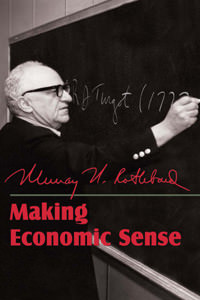
Making Economic Sense collects 117 pieces by Murray N. Rothbard, including the long postscript that closes its ten thematic divisions. The bulk are short monthly commentaries for the Mises Institute's Free Market between 1982 and 1995, though a few, such as the protectionism monograph, run long. The expanded 2006 second edition adds items to the 1995 collection, including Rothbard's 1973 obituary of Ludwig von Mises, along with a preface by Llewellyn Rockwell and an introduction by Robert Murphy. Most essays take one policy fight or headline and work it through a compact toolkit: relative prices, the supply of and demand for money, the incentives of whoever controls a resource, and a property premise about whose income is at stake. The collection is historical and openly polemical, and its value lies in watching that toolkit work on concrete cases.
One habit the book drills is this: when a shortage appears, look for a price held below the level that would clear the market. Rothbard's essay on the 1984 airport congestion applies it to peak-hour delays. Government-owned airports, he argues, charged slot fees far beneath what peak capacity commanded, so delays piled up at the busiest hours, and the aviation regulator answered with flight quotas. His remedy is steeply higher peak fees, which ration the same runways while leaving room for newcomers to bid. Quotas instead froze allocations in ways that, on his account, helped an established carrier against a fast-growing rival based at Newark. The flight counts belong to his narrative of that episode; the mechanism, scarce capacity allocated by price or by permit, reaches well beyond airports.
A long essay on protectionism carries the logic into trade. A tariff, Rothbard argues, acts like an artificial transport cost on imports. Its benefits flow to protected producers, while consumers and other domestic producers bear the opportunity cost through higher prices and diverted labor and capital. Beyond his case, a full policy assessment would still weigh the real adjustment costs facing displaced workers.
An April 1984 essay on ten economic myths shows the collection at its most instructive. Rothbard separates two ways of financing a deficit. Bonds sold to the public move existing deposits to the Treasury; bonds bought by banks with newly created deposits add new money to the spending stream and push prices up. On interest rates, credit expansion pushes rates down by adding supply to the loan market, while expected inflation pushes them up through the inflation premium lenders demand, and which channel dominates depends on public expectations whose strength and timing resist precise forecasting. The payoff is a reader alert to news stories that assign one direction to an effect with two causes. His ten-to-one reserve arithmetic describes the 1980s framework he was writing within, so present banking rules deserve a separate check. Later essays go further and call fractional-reserve banking inherently fraudulent, a contested Rothbard thesis best weighed as argument.
Budget headlines invite a different question: cut relative to what? A smaller nominal outlay, a lower inflation-adjusted outlay and slower growth than projected are distinct benchmarks, and naming the benchmark lets a reader evaluate the claim. The essay on deducting state and local taxes adds a normative edge. Calling a deduction a subsidy, Rothbard argues, makes sense only if the government justly owns all income and property, or if a fixed revenue requirement is taken for granted so that any taxpayer who keeps more shifts the bill to someone else. Drop both assumptions and the deduction looks like income its earner retains, a different thing from a check funded by other people's taxes. The argument rests on his property premise and pinpoints the disagreement. His Laffer-curve passage makes a related move: maximizing Treasury revenue and expanding liberty are separate goals.
The privatization essays qualify what many readers expect. Rothbard divides government activity into services people want, such as roads, libraries, schools, and police and fire protection, and directly coercive operations such as regulatory commissions and tax enforcement. The first group, he argues, should be run competently, like a business, until ownership changes, and he calls deliberate degradation of those services immoral and likely to fail. The second group should be abolished, and a more efficient contractor collecting taxes would be a step backward. His writing on postcommunist transition shifts over time, from a 1989 openness to buying off the old elites with shares divided alongside workers, to a 1990 case for worker homesteading, to 1994 criticism of former managers capturing monopolies under a private label. Read in order, those essays show a change of title mattering through the competition that follows it.
The political essays weigh deeds against labels: commercial success differs from opposition to state privilege, since firms often lobby for quotas and tariffs, and a party that campaigns on small government answers for its record on taxes, spending and controls. The long postscript, a 1994 strategy memo first printed here, is the most reactionary part of the book. It portrays immigrants as unassimilable, applauds California's Proposition 187, and treats civil rights and disability protections as rewards for groups the elites designate as victims. These are Rothbard's positions, built on group stereotypes that sit uneasily with the individualism he defends elsewhere. He does grant that opponents may sincerely believe what they say and that outsiders struggle to judge motives, and he values democracy as a peaceful substitute for violence. It remains a partisan document of its moment.
One technical essay needs correcting. Rothbard claims that all statistical inference from samples rests on assuming the normal curve, yet the NIST handbook on distribution-free procedures describes tests that require fewer assumptions about the population's shape, though still some, and the bootstrap he welcomes carries assumptions of its own. His caution about overconfident poll margins survives the correction.
The book suits a reader who already knows supply, demand and opportunity cost and wants short, pointed answers to what a policy does to prices, credit and incentives, more than a systematic textbook. Its figures and personalities belong to the 1980s and 1990s, so the mechanisms travel better than the facts, and current conditions need separate evidence. The Mises Institute publishes the official second-edition text.