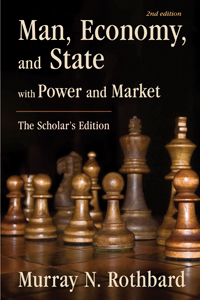
Murray N. Rothbard first published Man, Economy, and State in 1962. In it he tries to build economic theory as one continuous argument. The argument starts with one person using scarce means for chosen ends. Chapter by chapter, it then works through direct exchange, money, prices, the structure of production, interest, factor incomes, entrepreneurship and monopoly, and it ends with coercive intervention. That sequence is the reason to read the book. Many readers already know the conclusions associated with Rothbard. This treatise shows which premises each conclusion uses and where a later chapter relies on a result from an earlier one.
Rothbard's Preface to the Revised Edition is signed May 1993. It describes the book as an integrated treatise on principles that an intelligent lay reader can follow step by step, and it says the book also advances and disputes points of doctrine. The preface also states the foundation. It is the axiom of action plus two further postulates: resources vary, and leisure is a consumer good. Keep that short list in view while reading. The reasoning rests on these premises, on stated conditions and on admitted imaginary constructions. Applying any result to a historical episode still requires evidence about the institutions involved.
The first chapter sets up habits that the rest of the book depends on. Action means using scarce means for a purpose. A person values a concrete unit of a good according to the next use that unit would serve. Rothbard's examples show why the unit has to be specified. One example uses a stock of cows and horses. The other uses eggs that become useful for a cake when enough of them are available together. Whether a decision concerns one egg or a set of eggs changes what is given up. Rothbard derives this from the logic of ranking ends and does not present it as a measured psychological curve. The habit a reader gains is to name the alternative a choice displaces before talking about cost or value.
Indirect exchange extends the same reasoning. An egg seller wants shoes, but the shoemaker has no use for eggs. So the egg seller acquires butter, which the shoemaker does want. The butter enters his hands because it is marketable. Once one commodity becomes the most marketable, it links trades between people whose consumption wants never matched, and a system of money prices becomes possible. Rothbard then takes up a circularity problem. People demand money for its purchasing power, and that purchasing power depends on the demand for money. His answer traces today's demand back to yesterday's prices. He follows that series back to the point when the commodity was valued for its direct, nonmonetary uses, before it served as a medium. The premises do the work here: a commodity medium emerges from barter, and people form their demand for money by reference to its earlier purchasing power. Anyone applying the argument to a later monetary question should check those premises against that case.
The middle chapters hold the book's largest construction. Production takes time and passes through stages. Capitalists pay present purchasing power to the owners of labor and land before the final product sells. In return they earn pure interest, which time preference governs across the whole market for present against future goods. The loan market is one part of that larger market. Factor services earn rents, and durable factors sell at the capitalized value of their expected rents. To isolate these relations, Rothbard uses the evenly rotating economy, an imaginary construction that he labels as one. He starts with purely specific factors. Their shares in that setting are left to bargaining, and factors with competing uses enter the analysis later. The reader gets a set of questions to ask about any income: how much is rent, how much is capitalization, how much is pure interest and how much is profit.
Chapter 8 drops the stationary assumption. When conditions change, some returns appear that interest and wages cannot account for. Entrepreneurs buy factors based on uncertain forecasts of future selling prices. Profit or loss is the gap between the actual return and the going rate of interest, and a correct forecast can still yield a profit when the entrepreneur bought factors priced below their value in relation to the future product. Rothbard compares returns against a common 5 percent interest rate. A project can show a positive gross return that is still below that benchmark. In that case it earned less than the 5 percent benchmark, and the shortfall below that rate is an entrepreneurial loss. This test shows what judgment an investment involved. The accounting tells the reader what a return rewards. It leaves open whether a particular profitable transaction has wider social merit.
Two contested arguments use this framework. In chapter 10, Rothbard argues that an unhampered market offers no identifiable competitive price against which an actual price could be called monopolistic. A cut in output may correct earlier overproduction, and nothing in the data marks it as a move to a monopoly price. In chapter 12, the capital analysis returns in a theory of the business cycle. In Rothbard's example, a fall in time preferences leads people to save more and shifts the ratio of investment to consumption, which lowers the interest rate. Bank credit expansion lowers borrowing rates while those time preferences stay the same. New money lent to businesses bids capital goods and original factors out of the existing stock into higher stages of production. The owners of those factors spend their higher incomes according to unchanged time preferences, and resources move back toward consumption. That shift reveals overinvestment in the higher stages and underinvestment in the lower ones, because the newly created money supplied no saved real resources to complete the longer projects. In a footnote, Rothbard adds a condition: insofar as the newly created money is lent to consumers, the particular cycle effects analyzed in that section do not occur. The monopoly definition and the cycle explanation are both disputed positions. The book offers them as deductions to be assessed together with their assumptions. They are not observed regularities covering every credit expansion, and they are not forecasts for any particular year.
The conclusion of the main treatise comes at the end of chapter 12. It contrasts voluntary exchange with coercion. It also separates the economist's analysis of consequences from any ethical or political choice the economist may make afterward. Appendices on government borrowing and on collective goods and external benefits follow. Because of that separation, a reader can weigh the analytical claims on their premises whether or not they share Rothbard's politics.
The official text is the Ludwig von Mises Institute's second Scholar's Edition of 2009. That volume prints Man, Economy, and State together with Power and Market: Government and the Economy. The two are separate works, and the page numbering runs continuously through both. The treatise discussed here takes up printed pages 1 to 1041. Power and Market begins at page 1047 and has its own chapters and conclusion. The volume opens with a modern introduction by Joseph T. Salerno, followed by Rothbard's 1993 preface. Robert P. Murphy's study guide is a separate work and is not in this file.
Read Man, Economy, and State if you want to see how one line of deductive reasoning connects a choice about a single unit of a good to money prices, interest, profit and the effects of bank credit. Expect to track definitions, value rankings, imaginary constructions and long sequences of production. The book rewards a reader who stops at each step to check which premise it uses. Readers who mainly want familiar antistate conclusions should know that most of the book is the reasoning that leads to them. The Mises Institute publishes the complete 2009 edition as Man, Economy, and State with Power and Market.