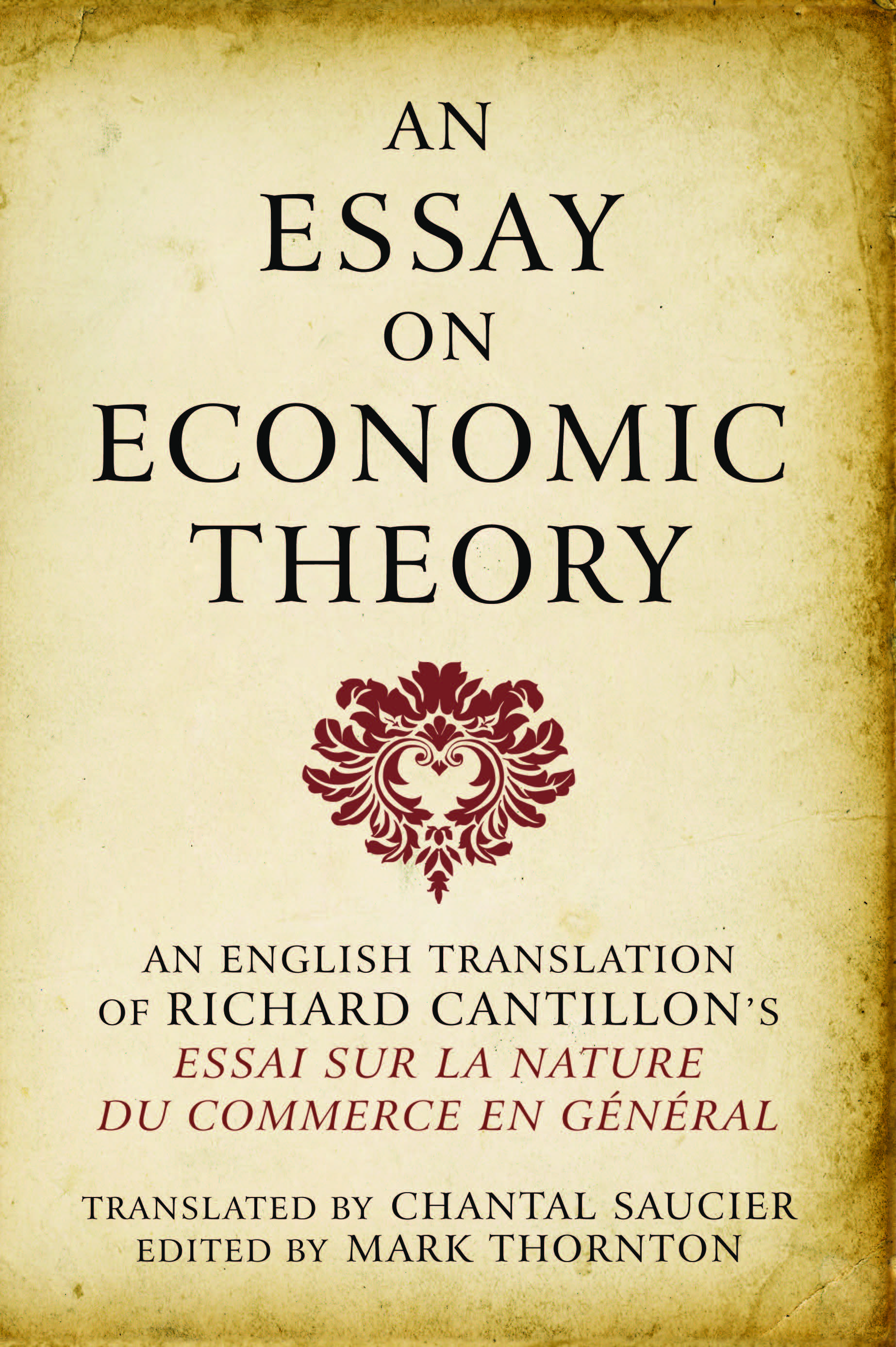
Richard Cantillon's Essai appeared in French in 1755, after its author's death, and the modern introduction proposes he completed it around 1730. His account of commercial society starts from land: wealth, for Cantillon, is the food, conveniences and pleasures of life that labor draws from land, and landowners' tastes decide much of what gets grown. From there he works outward to entrepreneurs and then to money and credit. The book's lasting value lies in its mechanisms, especially who receives a payment first and who holds a claim when settlement comes due. Its policy advice belongs to an age of bullion and navies, and a careful reader keeps the two apart.
The 2010 Mises Institute edition, An Essay on Economic Theory, is Chantal Saucier's English translation, edited by Mark Thornton, with a foreword by Robert F. Hébert. Saucier and Thornton also wrote the introduction and added footnotes, chapter abstracts, section titles and diagrams, and they restore entrepreneur where Henry Higgs's 1931 version had undertaker. Read that apparatus as a second voice. Opportunity cost, time preference, Cantillon Effects and business cycle are the editors' modern labels, not Cantillon's vocabulary.
Cantillon defines the entrepreneur by a commitment. A farmer promises his landlord a fixed rent and then plants by judgment, exposed to weather and demand. Retailers survive because households pay a little extra to buy small amounts when needed. When a street has too many hat makers, the least patronized go bankrupt; when it has too few, profits draw newcomers in. Water carriers and chimney sweeps are entrepreneurs of their own labor and need no capital, while hired workers draw fixed wages as long as work lasts. Beggars and robbers also fall into his class of uncertain incomes, a description of risk with no moral approval attached. Landowners stay independent only while they keep their land. On this account, bearing the leftover result of a fixed commitment differs from being rich or holding a title.
Price gets a two-sided treatment. Intrinsic value measures the quantity and quality of land and labor that enter a product. Market price depends on buyers' desires and on the scarcity or abundance of the goods, so it can sit above or below that cost. A gentleman who digs ditches and raises terraces in his garden might sell it for half his expense, or for double if several buyers compete. Wheat sown beyond the year's needs sells below its cost. The editors call intrinsic value opportunity cost, but Cantillon's own account measures cost in land and labor. What a producer spent and what the market will pay remain separate figures, and a loss stays a loss however much labor the goods contain.
Money supplies the book's best-known argument. Cantillon accepts Locke's point that abundant money raises prices and asks how. Silver from a domestic mine first raises the spending of mine owners and their workers, whose demand for meat and finer clothing employs artisans and leads farmers to plant more land. Landowners bound by leases and servants on fixed wages face higher prices before their income catches up, and in time costly home manufactures lose ground to imports. In a second case, foreign visitors double England's money, yet prices need not double, since the new holders favor particular goods. Meat might triple while wheat rises by less than a quarter, because England admits foreign wheat and bars foreign cattle. Both cases are hypotheticals, and Cantillon admits he cannot say exactly how far new money redirects spending. His question fits any monetary expansion: where does the new money enter, and whose income adjusts slowly?
Interest, he argues, is settled by the relative number of lenders and borrowers, and a lender who goes without collateral must be paid for the risk of losing everything. The quantity of money moves prices without any necessary connection to the rate. New money that reaches lenders may lower rates, while money that reaches spenders can raise them, because their spending draws more entrepreneurs into business and those entrepreneurs must borrow to supply it. Cantillon treats deferred payment as a loan by another name: a new farmer who buys wheat or cattle on credit gladly pays more than the cash price, and the difference is his interest. A journeyman hatter without capital who takes wool and beaver on credit stays in business only while his creditors trust him, and a small trader's own living costs can eat up what he borrows. Living costs also explain why, for Cantillon, a Paris water carrier's 5,000 percent is no investment yield. It compares a year's gross earnings of 50 ounces of silver with the one-ounce price of two buckets, and only knowing what the carrier spends on his upkeep would reveal his clear profit.
Foreign trade opens with an account of settlement. Paris pays for Brussels lace while Brussels pays for Champagne, and bankers offset the payments with bills of exchange, so only the balance needs to travel as silver. Cantillon then counts land and judges the lace trade a loss for France, since thousands of acres of vineyard and pasture pay for a quarter acre of flax. He names bringing money into the country as the goal, urges England and France to stop their people from wearing Indian fabrics, praises the English Navigation Acts for protecting domestic shipping, and closes the chapter demanding a favorable balance of trade. The editors' abstract calls the Navigation Acts his only clear exception to free trade. His text is more protectionist than that summary, and Higgs's older translation carries the same cloth prohibition. The settlement analysis stays useful; the thinking about national power remains mercantilist.
In the last chapter, Cantillon describes how the Bank of London held off runs, then sets out a hypothetical. A minister who wants lower interest persuades the bank's directors to issue unbacked notes and buy public stock with them. The price climbs as imitators follow, and the bank may later sell at a profit and cancel the extra notes. Because those notes stay among stock traders, household spending carries on as usual, though a panic that sent holders to demand silver would expose the operation. Cantillon expects such schemes to enrich insiders more often than the state. The editors suggest Robert Walpole was probably the minister in question and read the passage as business cycle theory. The book ends on this conditional warning.
Readers studying how new money spreads unevenly, or how business risk is structured, will find the Essai rewarding. Saucier's English reads easily, though sums in ounces of silver and acres of land take patience, and each abstract deserves checking against its chapter. The Mises Institute offers the edition as a free download: An Essay on Economic Theory, Mises Institute PDF