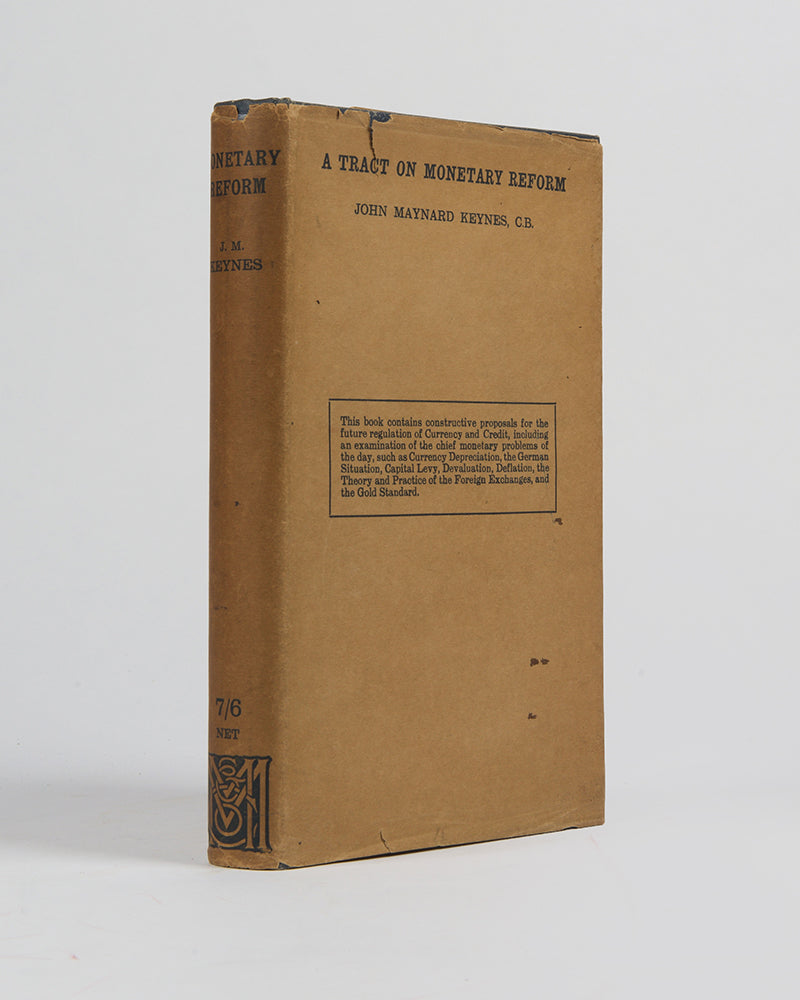
A Tract on Monetary Reform, published by Macmillan in London in 1923 and issued in the United States as Monetary Reform, argues that postwar price disorder forces Britain to choose a monetary standard and that the right choice is a managed one. Predating The General Theory, it addresses a narrower problem: how currencies broken by war finance should be stabilized, and toward which target. The book earns its place because Keynes assembles the case for management from mechanisms a critic can test: unequal contract losses, inflation as a tax on cash holders, adaptive cash demand and speculative risk bearing. Each step also rests on assumptions about state powers, forecasting knowledge, index choice and international cooperation.
A change in the price level harms society to the extent that it falls unequally, because receipts and outgoings never move in one proportion and money contracts fix the gap. Keynes's investing, business and earning classes overlap in the same person. Inflation moves wealth from holders of fixed money claims to debtors and traders; deflation reverses the transfer and pushes producers to cut output. Wages need not lag prices: poorly placed labour could lose, while organized sections in Britain and the United States raised real pay. Outside German-scale collapse, he ranks deflation the greater harm, since idle workers cost more than disappointed rentiers. Capitalism that leaves saving to investors and production to employers, he argues, needs a measure of value with stable purchasing power, which a pound fixed in name alone cannot supply.
Unequal incidence becomes policy when the government is the debtor and the printer. A government that issues notes to cover spending levies the holders of existing money in proportion to their holdings, cheaply and with little room for evasion. Once the public learns who pays, people keep durable goods as reserves, hold cash for shorter periods and turn to foreign money, so prices can rise faster than the note issue. The real base of the tax shrinks as habits adapt, and the government must print ever larger quantities to command the same resources. A bigger issue can still raise more real revenue for a time. Keynes separates a falling value of money from its rate of fall, and a continuing tax from the one-time relief that depreciation gives an indebted state.
War debt turns the same mechanism against bondholders. Keynes rules out explicit repudiation except alongside revolution, because its victims see it at once. Depreciation reaches the same end without defaulting on any nominal claim, and devaluation then fixes the currency near its depreciated value. The capital levy is the deliberate alternative, a one-time tax on wealth that he calls the fairest way to shift burden from present effort to past accumulation whenever the country judges effort overtaxed. For Britain in 1923 he calls the case doubtful: a levy may be needed if sterling prices fall materially, as in restoring the old parity, and may be unnecessary if prices settle well above prewar levels. The argument assumes a sovereign right to revise vested interests, and legal power over claims differs from the consent of their holders.
Keynes formalizes adaptive cash demand as n = p(k + rk'), where n is cash in circulation, including bank reserves, p the cost-of-living index, k and k' the consumption units held in cash and bank balances respectively, and r the banks' reserve ratio. Prices move in proportion to cash when the coefficients stay fixed, and his gibe about the long run attacks reliance on that comparison during transitions, when a large issue alters habits and reserve practice. He would give central banks control of n and r and steer them against shifts in k and k'. The variable coefficients motivate that proposal without showing that an authority can observe them in time.
Purchasing power parity carries the cash-and-price reasoning across borders. Built from broad price indices, it can diverge from the exchange, and the gap signals a change in the relative prices of traded and nontraded goods. Keynes keeps the doctrine as a conditional anchor: when divergence stems mainly from different degrees of inflation and the basic economic relations between two countries stay stable, parity and exchange tend to converge, and comparative purchasing power replaces the old gold parity as the point about which rates fluctuate. Persisting structural change voids the expectation, and parity yields no automatic true rate.
Seasonal swings escape parity reasoning: trade can balance over a year while payments arrive unevenly, so someone must carry the timing gap. A merchant owing dollars in three months can buy them forward, at a margin that tends to track interest differences between the two centres, modified by credit standing and by hazards such as moratoria and exchange controls. Keynes defends creditworthy speculators as natural bearers of this risk and ties much month-to-month volatility, distinct from persistent depreciation, to scarce speculative capital. Cover on the currency still leaves losses on unsold stock if the commodity's world price shifts.
When prices abroad are unstable, a country must choose between a stable exchange and stable internal prices, weighing its foreign trade. Keynes presumes in favour of internal prices, because more contracts assume them, while admitting that an index-regulated standard was untried. For currencies after prolonged, severe depreciation he prefers devaluation, fixing the currency near the value to which wages and commerce have adjusted. Within about 5 or 10 percent of old parity, restoring gold may justify the deflation if the country still wants an unqualified gold standard. American gold absorption had already placed gold's value under central-bank policy.
His procedure has the Bank of England announce weekly gold buying and selling prices beside bank rate, adjusting them when sterling prices require it, so the dollar exchange moves within a band between changes. Gold stays an important reserve for sudden needs. Keynes wants cooperation with the Federal Reserve Board to grow from mutual advantage, with neither side bound. The plan assumes that an index represents the stability contracts need and that authorities read the credit cycle in time, and Keynes concedes that other banks could thwart or delay the policy.
Readers of monetary history who know bank rate and prewar gold mechanics, and can follow one equation and dense exchange tables, will find the case against restoring the old parity built step by step, along with the powers and knowledge it presupposes. The 2021 transcription of the 1923 Macmillan text, updated in 2024, is available as a Project Gutenberg edition.