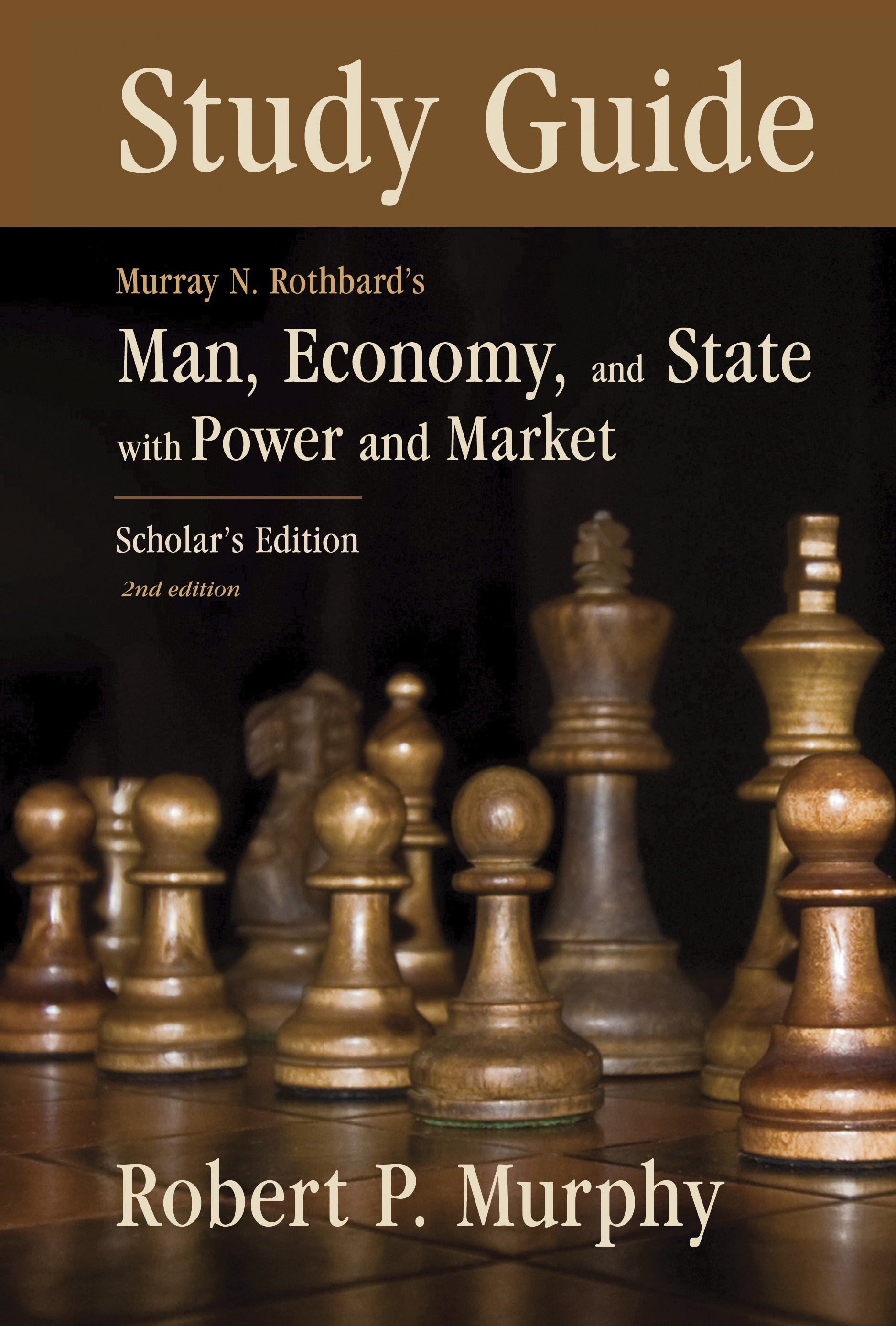
Robert P. Murphy's Study Guide to Man, Economy, and State is a companion to the Scholar's Edition of Murray Rothbard's treatise, which binds Man, Economy, and State together with Power and Market. The Mises Institute published it in 2006 with Murphy's January 2006 introduction. It covers all twelve chapters of the first book and all seven of the second, and it ends with an index. A typical chapter treatment begins with a one-page summary and an outline that follows Rothbard's section numbering. It then sorts the chapter's contributions into Austrian doctrine and Rothbard's own innovations, adds technical notes for advanced readers and closes with ten study questions. Murphy uses the word typical on purpose. The short first chapter of Power and Market gets a summary without an outline, and its second chapter and the conclusion get outlines without summaries while keeping their notes and questions.
Murphy writes as a sympathetic Austrian, and the guide's value comes from the work it lets a reader do with Rothbard's text open beside it. The technical notes find the assumption that carries a derivation and restate mainstream objections in terms their holders would accept. Some questions play advocatus diaboli and point to apparent contradictions or problems in Rothbard's analysis, and Murphy expects a reader who considers them to understand Rothbard's case better whether or not those alleged flaws can be resolved.
The production chapter shows the method well. Rothbard builds his account in stages. He first assumes completely specific factors whose owners jointly own the product, then adds capitalists who advance money to workers and landowners, and leaves nonspecific factors for a later chapter. In the first stage he treats the pricing of specific factors as an outcome of bargaining, where marginal imputation gives no answer. Murphy's technical note asks which premise supports that result. A factor that is useful for one product can still differ in marginal contribution. If Smith and Jones own equal plots fit for growing one kind of berry, and Smith's plot is twice as fertile, Smith will earn more. Marginal reasoning stops helping when each factor is also indispensable, as eggs are to a cake, since removing one leaves no cake at all. Murphy reads Rothbard as having this stricter case in mind. He grants that Rothbard could handle the berries by treating each plot's output as a separate good. The note teaches a habit the whole guide rewards: before carrying a staged result over to firms with a different technology, identify which assumption applies at that stage.
Murphy endorses Rothbard's critique of monopoly theory and then rebuilds the opposing case with care. Rothbard argues that consumers benefit from voluntary exchanges with an alleged monopolist and would boycott the firm if those exchanges hurt them. He adds that the monopolist's motives are the same as any other producer's. Murphy explains that a mainstream economist compares monopoly with perfect competition. In that model the same profit motive leads firms to produce where price equals marginal cost, while a monopolist facing a falling demand curve stops where price exceeds it. Rothbard's own text grants that consumers always prefer lower prices, and Murphy adds that Rothbard takes up the benchmark arguments elsewhere. The note therefore clarifies the dispute without settling it. A second note separates the market demand for wheat from the flat demand curve each wheat farmer perceives. One study question asks whether Rothbard's argument that no one can isolate a competitive price applies with equal force to the pure rate of interest in Austrian theory, and it leaves the answer open.
The money chapter's questions turn a familiar diagram into an exercise in timing. Rothbard divides the demand for money into two parts that sit on either side of income. The exchange demand is the pre-income side: a seller of labor, land, capital goods or consumers' goods supplies them and demands money in return to earn a money income. The reservation demand is the post-income side, where someone who has acquired income decides how much of it to keep in his cash balance and how much to spend. Rothbard adds the two into a total demand for money to hold and sets that schedule against the existing stock. Murphy then asks about a man who sells a car for ten ounces of gold and keeps those ounces in his cash balance, and whether his actions count as a demand for twenty ounces. On our reading, the question asks the reader to separate the act of acquiring money from the decision to retain it, and to ask what the total schedule measures at a given moment against a given stock, so that the same ten ounces do not enter the count twice by default. The next question asks why the money supply appears as a vertical line when a higher purchasing power should encourage mining. A line drawn for a given moment states the stock that exists at that moment, and mining can respond in later periods without contradicting it.
The conclusion of Power and Market names the discipline behind these exercises. Economics yields conditional laws: if A holds, B follows, and B describes the world when A is satisfied. Murphy's technical note separates Rothbard's belief that an objective ethics is possible from his agreement with Mises that economics by itself supplies no value judgments. The study questions press on that boundary. One asks whether an economist who explains the effects of socialism remains Wertfrei, given Rothbard's view that an economist who advises an interventionist government endorses its goals. Others ask whether Rothbard's table of market and hegemonic principles oversimplifies societies that mix the two, and whether a purely free economy is necessarily stable. A reader who works through them gets practice in separating a causal deduction from the ethical premise or empirical condition that a policy conclusion also requires.
The guide suits readers working through the combined treatise alone or in a reading group, and graduate students who want Rothbard set against mainstream price theory. Read each summary and outline before Rothbard's chapter, then take the notes and questions back to the cited pages. Its page references follow the Scholar's Edition, so check locators if you use another printing. The money chapter treatment repeats several of Rothbard's strong positions on banking and price indices, and those positions deserve the same scrutiny the questions apply elsewhere. The Mises Institute hosts the Study Guide to Man, Economy, and State PDF, and our recommendation of Man, Economy, and State with Power and Market covers the treatise itself.